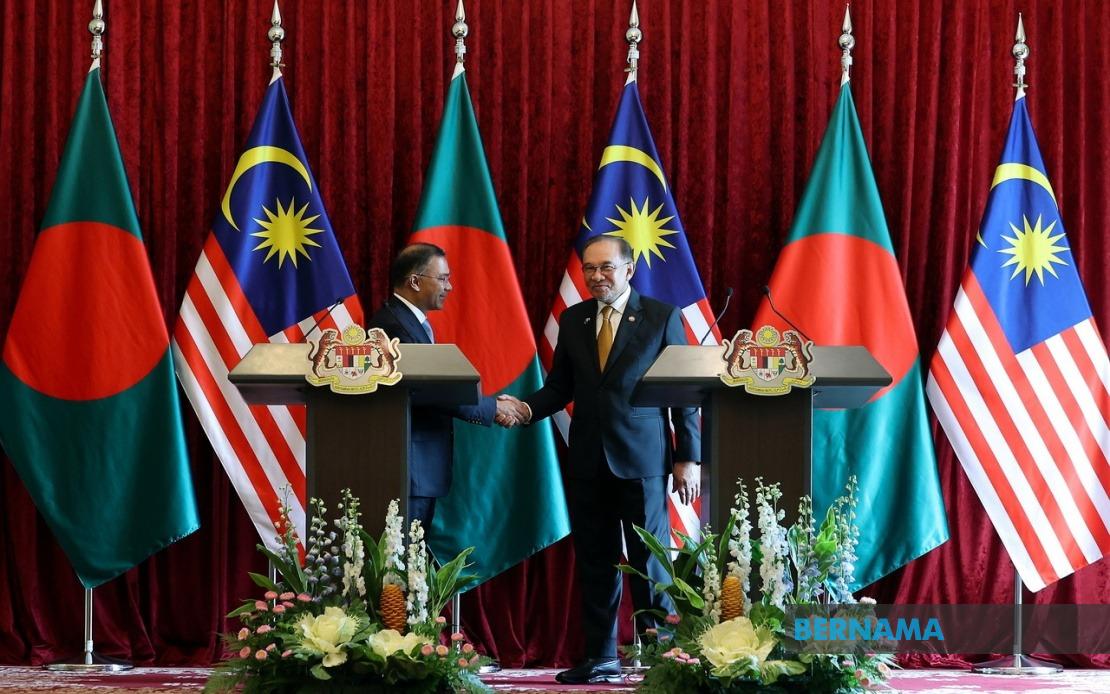
Malaysia and Bangladesh have pledged to activate a defence cooperation framework aimed at advancing military collaboration across multiple domains, ranging from technical expertise to joint defence initiatives. During Bangladesh Prime Minister Tarique Rahman's official visit to Putrajaya on June 22, Prime Minister Datuk Seri Anwar Ibrahim and his counterpart reaffirmed their commitment to transforming the Memorandum of Understanding on Defence Cooperation into a working operational instrument. This move signals a significant escalation in bilateral military ties between the two Muslim-majority nations, establishing a foundation for sustained engagement across defence-related matters.
The relationship between Malaysia and Bangladesh has long been anchored in military cooperation, characterised by regular exchanges at senior command levels, routine personnel training initiatives, and goodwill visits by naval vessels. However, the formal operationalisation of the MoU introduces a more systematic and structured approach to defence engagement. Rather than relying solely on ad hoc arrangements, both governments will now have a clearer strategic roadmap governing their military interaction. The joint statement released by Malaysia's Foreign Ministry indicates that the nations intend to convene the bilateral Joint Committee on Defence Cooperation, which will serve as the primary mechanism for coordinating defence activities and ensuring alignment between their respective strategic priorities.
A crucial dimension of the enhanced cooperation involves building institutional capacity through education and professional development. Both Malaysia and Bangladesh have agreed to expand mutual seat allocations at their respective National Defence Colleges and Command and Staff Colleges, allowing senior military officers from each nation to undergo advanced training in the other's institutions. This exchange mechanism is particularly significant for Southeast Asia, where knowledge transfer regarding regional security challenges, operational doctrines, and emerging defence technologies can enhance the professional standards of both militaries. Such officer exchange programmes historically foster deeper personal relationships between military establishments, creating informal networks that can facilitate smoother coordination during joint operations or security crises.
Counter-terrorism and violent extremism prevention constitute another pillar of the renewed partnership. Malaysia and Bangladesh have committed to strengthening their capacity to combat these transnational threats through intelligence sharing, systematic information exchange, and collaborative capacity-building programmes. Given that both nations face security challenges from extremist groups, particularly those with transnational connections, this commitment reflects a pragmatic recognition of shared vulnerabilities. The agreement to share best practices and training programmes allows each country to benefit from the other's experience in countering terrorism, whether through border security, intelligence gathering, or counter-narrative initiatives aimed at preventing radicalisation.
The two nations have also pledged enhanced cooperation in United Nations peacekeeping operations, one of the most tangible forms of military collaboration available to developing nations. Malaysia has deployed troops to multiple UN peacekeeping missions globally, as has Bangladesh, which maintains one of the largest troop contributions to UN peacekeeping operations worldwide. The commitment to conduct joint tactical exercises and pre-deployment training collaboration will ensure that Malaysian and Bangladeshi soldiers can operate more effectively together in shared peacekeeping environments. This coordination becomes particularly relevant if both nations are deployed to the same mission, as improved interoperability can enhance the effectiveness of peacekeeping efforts and potentially save lives.
Beyond strictly military matters, the two prime ministers recognised the substantial educational linkages binding their societies. Approximately 11,000 Bangladeshi students currently study in Malaysian institutions, representing a significant human capital exchange that extends well beyond bilateral government cooperation. These students contribute meaningfully to Malaysia's higher education sector while acquiring skills and knowledge that they carry back to Bangladesh, creating lasting socio-economic connections. The joint statement emphasises the importance of expanding university-to-university partnerships and joint research programmes, with particular attention to technical and vocational education (TVET). By aligning academic programmes with labour market requirements in both countries, the two nations can ensure that educational collaboration produces tangible economic benefits.
The expansion of mutually recognised qualifications and joint degree programmes represents a strategic investment in regional human capital development. Graduate mobility between Malaysia and Bangladesh enables skilled professionals to work across borders, potentially filling labour shortages in priority sectors while generating professional networks that strengthen bilateral ties at the grassroots level. This educational cooperation transcends typical state-to-state interaction, creating enduring relationships between academic institutions that can outlast changes in political leadership or diplomatic orientations. The emphasis on skills development aligned with labour market needs reflects both nations' recognition that education must serve practical economic objectives while simultaneously deepening cultural and intellectual understanding.
Tourism constitutes an emerging area of cooperation, with both leaders expressing optimism about expanded visitor flows. Malaysia's 'Visit Malaysia 2026' campaign and the concurrent 'Malaysia Year of Medical Tourism 2026' initiative present opportunities for Bangladesh to participate in regional tourism dynamism. Malaysia extended explicit welcome to Bangladeshi travellers, signalling commercial interest in tapping Bangladesh's growing middle class as a source of tourists. Reciprocal cultural exchanges accompanying increased tourism can reinforce people-to-people connections that complement government-level cooperation. Medical tourism, in particular, represents a mutually beneficial arrangement whereby Malaysian healthcare facilities can serve Bangladeshi patients seeking advanced treatments, while Bangladesh benefits from the economic multiplier effects of its citizens' spending in Malaysia.
The timing of this defence cooperation expansion warrants consideration within the broader South and Southeast Asian geopolitical context. Rising regional tensions, maritime disputes, and growing great power competition in the Indian Ocean and beyond have prompted smaller nations to strengthen bilateral military partnerships as a means of enhancing security without formal military alliances. Malaysia's position in Southeast Asia and Bangladesh's role in South Asia make their cooperation symbolically and practically significant. Enhanced military coordination between the two nations could contribute to regional stability by improving information sharing and operational capability across a critical geographic zone spanning the Strait of Malacca and the Bay of Bengal.
The operationalisation of the MoU also reflects both nations' commitment to multilateralism and rules-based international order. Neither Malaysia nor Bangladesh seeks to challenge the international security architecture; rather, they seek to strengthen their positions within existing frameworks by building capacity and deepening regional partnerships. This approach contrasts sharply with zero-sum strategic competition, instead emphasising that mutual benefit accrues from sustained cooperation. The emphasis on UN peacekeeping operations underscores both nations' investment in global governance mechanisms, suggesting they view their bilateral defence cooperation as complementary to, rather than competitive with, broader international security arrangements.
Moving forward, the success of this enhanced partnership will depend on consistent implementation and resource allocation. Both governments must ensure that the Joint Committee on Defence Cooperation receives adequate political support and bureaucratic backing to translate commitments into concrete action. Training programmes must be adequately funded, officers must be released for exchange postings, and intelligence-sharing protocols must function reliably. The educational and tourism components, while appearing less directly military in nature, will prove equally important for building the comprehensive relationship envisioned in the joint statement. For Malaysian observers and policymakers, this deepening partnership with Bangladesh signals a deliberate strategy of building cooperative relationships across the Indian Ocean, potentially positioning Malaysia as a bridge between South Asia and Southeast Asia during an era of geopolitical flux.

