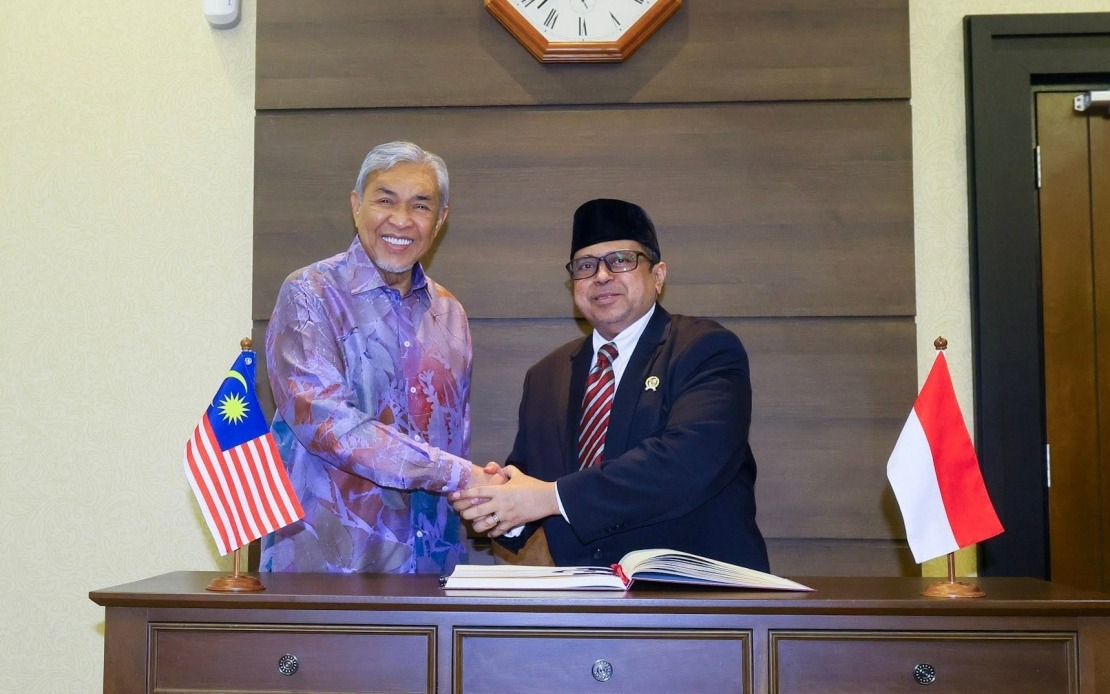
Malaysia and Indonesia are moving to cement a comprehensive partnership in the halal sector, with Deputy Prime Minister Datuk Seri Dr Ahmad Zahid Hamidi signalling the two nations' commitment to deepening ties across halal development, commerce, and institutional frameworks. The announcement emerged from discussions held at Parliament between Ahmad Zahid and a high-level Indonesian delegation comprising Ambassador to Malaysia Raden Datuk Mohammad Iman Hascarya Kusumo and Dr Ahmad Haikal Hassan, head of Indonesia's Halal Product Assurance Organising Body, better known locally as BPJPH.
The timing of this diplomatic engagement underscores the strategic importance both Kuala Lumpur and Jakarta place on halal industry development as a cornerstone of economic cooperation. Ahmad Zahid, who chairs Malaysia's Halal Industry Development Council, framed the initiative as an opportunity to leverage the region's combined influence in global halal markets. Rather than operating in parallel, the two Southeast Asian powerhouses intend to synchronise their approach to standards, certification, and market expansion—a move that could position ASEAN as a unified force in an increasingly competitive international halal economy.
Central to the partnership framework is the proposed establishment of the Malaysia-Indonesia Halal Council (MIHC), a bilateral body designed to coordinate policy and commercial initiatives between the countries. Beyond this bilateral structure, the discussions also covered the conceptual groundwork for an ASEAN-wide Halal Council and an international World Halal Development Council. These layered institutional arrangements reflect a sophisticated understanding of how regional cooperation can amplify influence at global forums and standard-setting bodies where halal compliance and certification have growing commercial significance.
The strategic logic underpinning these councils revolves around harmonisation—aligning halal standards across member states to reduce friction for businesses operating across borders, simplifying supply chains, and creating a cohesive regional brand for halal products and services. For Malaysian manufacturers and traders, such alignment could dramatically reduce compliance costs when exporting to Indonesia and other ASEAN markets. Conversely, Indonesian producers seeking access to Malaysia's established halal infrastructure and certification frameworks stand to benefit from clearer regulatory pathways. This mutual advantage forms the pragmatic foundation for the partnership.
Trade expansion figures prominently in the cooperation agenda. Malaysia has long positioned itself as a global halal hub, with established certification bodies, research institutions, and commercial networks. Indonesia, as the world's largest Muslim-majority nation with a burgeoning domestic halal industry, offers enormous market potential. By establishing platforms for dialogue and standard-setting, both countries can facilitate the movement of halal products, services, and investment capital across their economies. This is particularly relevant in sectors such as food and beverages, pharmaceuticals, cosmetics, and financial services, where halal compliance commands premium pricing and growing consumer demand.
Beyond commerce, the partnership encompasses rural development and human capital initiatives. These dimensions reflect recognition that halal industry growth must extend benefits beyond urban commercial hubs. Rural communities in both nations depend heavily on agriculture and small-scale food production; strengthening halal value chains in these areas could provide sustainable income diversification and market access. Workforce development in halal certification, auditing, and supply chain management similarly represents an investment in creating skilled employment and reducing brain drain to wealthier nations.
The proposed World Halal Development Council carries particular significance for Malaysian and Indonesian interests. Such a global body would amplify Southeast Asia's voice in international standard-setting, where halal definitions and certification methodologies have historically been influenced heavily by Middle Eastern institutions and standards bodies. A stronger Malaysian-Indonesian presence in global halal governance could shift norms and practices in directions that reflect the region's diverse Muslim populations and commercial realities, potentially opening new market opportunities and influencing how non-Muslim countries implement halal provisions.
The initiative also addresses an underlying competitive dynamic within ASEAN. As halal industry growth accelerates globally, individual ASEAN member states risk fragmenting efforts through competing certification systems and standards. The proposed councils serve as coordination mechanisms to prevent wasteful duplication and present a unified ASEAN front to international bodies and trading partners. This is particularly important as global corporations increasingly seek streamlined halal compliance across multiple markets simultaneously.
Geopolitically, deepening Malaysia-Indonesia cooperation in halal carries symbolic weight beyond economic metrics. The two nations represent the largest Muslim-majority populations in ASEAN and among the world's largest. Joint leadership in halal industry development signals regional stability and shared commitment to inclusive economic growth. It also positions Southeast Asia as an authoritative voice in conversations about Islamic commerce and standards, countering perceptions of the region as merely a consumer or follower of standards set elsewhere.
For Malaysian businesses and policymakers, the framework offers tangible advantages. Indonesian market access could alleviate domestic market saturation pressures for certain halal product categories. Joint certification standards reduce duplicate testing costs. Coordinated trade promotion opens doors in third markets where unified ASEAN positioning carries greater weight than individual nation representation. The human capital dimension also benefits Malaysian education and training providers, who can tap Indonesian demand for halal expertise programmes.
Implementation challenges nonetheless loom. Harmonising halal standards between two nations with distinct regulatory traditions requires genuine technical work, not merely symbolic council creation. Bureaucratic coordination across government agencies, industry bodies, and private sector players must function effectively. Competition between Malaysian and Indonesian commercial interests could at times conflict with cooperative frameworks. These practical hurdles mean the ambitions outlined will depend heavily on sustained political will and institutional capacity.
The partnership also operates within a broader context of Malaysia and Indonesia's regional roles. Both nations compete for influence within ASEAN, yet halal industry cooperation represents an arena where their interests genuinely align. Success here could establish a model for deeper integration in other sectors where mutual advantage exists. Conversely, setbacks would undermine confidence in bilateral cooperation mechanisms and suggest limits to ASEAN integration capacity.
Moving forward, concrete deliverables will matter more than council announcements. The actual establishment of the MIHC, its operational charter, and early joint initiatives will signal whether this represents sustained institutional commitment or aspirational rhetoric. Given Malaysia and Indonesia's combined economic heft and the genuine global demand for halal products and services, serious follow-through offers substantial rewards.

