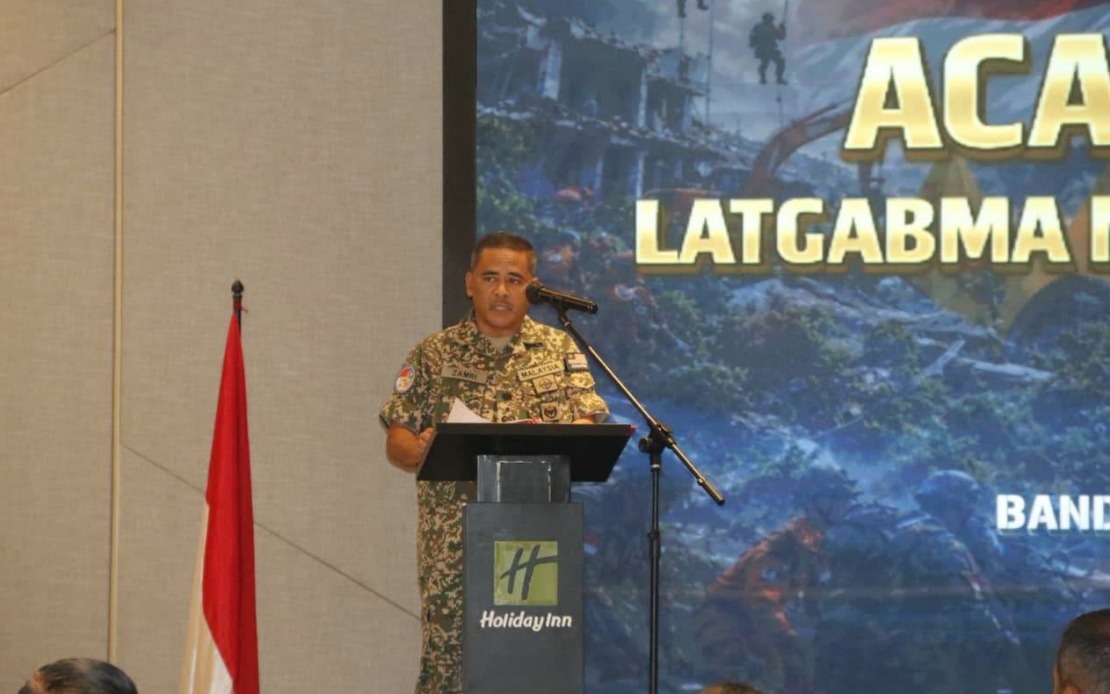
The Malaysian Armed Forces (MAF) and Indonesian National Armed Forces (TNI) have significantly deepened their defence partnership through a major 13-day joint exercise currently underway in Lampung, Sumatra. Designated as LATGABMA MALINDO DARSASA 12AB/2026, the collaborative operation brings together 719 military and civilian personnel from both nations, representing one of the most substantial bilateral defence initiatives in recent years. Conducted from the Al-Sultan Abdullah Camp headquarters in Kuala Lumpur, this exercise underscores the enduring commitment between Southeast Asia's two largest Muslim-majority nations to maintain robust security cooperation.
Brigadier General Datuk Zamri Othman, who serves as both Commander of the 1st Infantry Brigade and Chief of the MAF Exercise Planning Group, emphasised that this operation transcends routine military drills. Rather, it constitutes a tangible demonstration of the brotherly relationship and mutual strategic confidence that binds Malaysia and Indonesia together. The exercise provides an invaluable testing ground for joint operational methodologies spanning land, sea and air domains, while simultaneously fostering deeper comprehension of each nation's operational protocols and building interpersonal confidence among the military personnel involved in the multinational effort.
The contemporary security landscape throughout Southeast Asia has evolved considerably, presenting challenges that conventional military doctrine alone cannot address. Non-traditional threats including maritime piracy, organised smuggling networks, transnational terrorism, sophisticated cyber attacks and the ever-present danger of natural disasters have compelled both Malaysia and Indonesia to recognise that effective defence requires coordinated regional responses. This realisation has motivated both nations to substantially advance their defence cooperation mechanisms, moving beyond bilateral arrangements to develop genuinely integrated operational capabilities that can address these multifaceted challenges.
The LATGABMA MALINDO DARSASA series represents an institutionalised commitment spanning four decades. Since its inception in 1984, these exercises have operated through the General Border Committee and the Malaysia-Indonesia Joint Training Committee, conducted triennially on a rotating basis between the two nations. The most recent iteration prior to the current exercise took place in Pekan, Pahang during 2023, where the focus centred on counter-terrorism operations. This historical continuity demonstrates that both governments view defence cooperation not as a project dependent on political fluctuations but as a cornerstone strategic commitment requiring sustained investment and progression.
The deliberate selection of Bandar Lampung as the exercise's primary location reflects sophisticated planning rooted in geographical and geological realities. Lampung Province sits at the convergence of three active tectonic plate boundaries, positioning it within one of the world's most seismically active regions. This geographical characteristic transforms the province into an exceptionally suitable training environment for disaster response scenarios. The exercise architects incorporated real-world disaster experiences—particularly the devastating earthquakes and tsunamis that have periodically struck southern Sumatra—ensuring that training environments replicate authentic conditions that personnel might encounter during genuine humanitarian emergencies.
The exercise curriculum has been structured around two complementary learning phases that build upon each other progressively. The initial Staff Exercise phase employs classroom-based academic instruction to establish conceptual frameworks around ten critical operational scenarios. These scenarios encompass the initial response phase following disaster onset, management of mass casualty incidents, infrastructure damage assessment and repair, emergency medical protocols, coordination of international assistance mechanisms, cyber warfare contingencies, information security threats, large-scale civilian evacuation procedures, stabilisation efforts in affected areas, and the transitional phase toward normalcy. This academic foundation equips participants with theoretical knowledge that grounds the subsequent practical training.
The Field Training Exercise component transforms theoretical knowledge into practical capability through Force Integration Training involving MAF personnel, TNI counterparts, and civilian disaster management agencies. Participating Indonesian organisations include the National Search and Rescue Agency (BASARNAS), the Disaster Preparedness Cadets (TAGANA), the Indonesian Red Cross (PMI), and the Regional Disaster Management Agency (BPBD). During this phase, personnel engage in hands-on training encompassing technical rescue skills such as rope work, rappelling techniques, rapid emergency response protocols, and the establishment of field medical facilities. These practical competencies prove essential when international assistance mechanisms must activate during actual disasters.
Beyond humanitarian and rescue operations, the exercise incorporates an Engineering Civil Action Programme and Medical Civic Action Programme that generate tangible community benefits. The engineering component involves repairing two uninhabitable houses in Kampung Sukamaju and constructing a concrete road in Kampung Keteguhan, directly improving living conditions for local residents. The medical programme, conducted at a Community Health Centre, provides general health screenings, distributes free spectacles to those requiring vision correction, and organises blood donation initiatives. These community-focused activities cultivate goodwill and demonstrate that military cooperation generates civilian dividends.
Cyberspace has emerged as a contested domain where both traditional and non-state actors pursue strategic objectives, prompting both nations to develop integrated cyber defence capabilities. The exercise's cyber component addresses technical attack vectors that contemporary security forces must understand and counter effectively. Training encompasses reconnaissance methodology, system enumeration techniques, credential-based attacks, man-in-the-middle interception tactics, IP spoofing strategies, and feed manipulation. By working through these scenarios jointly, MAF and TNI personnel develop shared understanding of cyber threats and coordinated response protocols.
The personnel composition of the exercise reveals the comprehensive nature of the security challenge being addressed. The TNI contributes 463 personnel, whilst the MAF provides 150 military staff members. Supporting these core military elements are two representatives from Malaysia's National Disaster Management Agency (NADMA), 25 members of the Indonesian National Police (POLRI), and 79 participants representing various Indonesian civilian agencies. This composition demonstrates that modern security threats require seamless integration between military forces, civilian law enforcement, and specialised disaster management authorities—a reality that the exercise's structure explicitly acknowledges and practises.
For Malaysia and Southeast Asia more broadly, the strengthening of defence cooperation with Indonesia carries profound implications. As both nations confront transnational security challenges in an increasingly multipolar geopolitical environment, the institutional mechanisms for coordination and the interpersonal relationships forged through joint exercises provide essential infrastructure for rapid response when crises materialise. The LATGABMA MALINDO DARSASA series exemplifies how neighbouring nations can transform geographical proximity and historical experience into mutually beneficial security partnerships that enhance regional stability without requiring costly military buildups or potentially destabilising security competition.
Looking forward, the success of this collaborative framework suggests that Malaysia and Indonesia should continue expanding joint capabilities in domains where shared interests predominate. Climate change will likely intensify natural disasters throughout the region, making enhanced humanitarian response capacity increasingly valuable. Transnational organised crime affecting both nations requires coordinated law enforcement and maritime security cooperation. Cyber threats transcend national borders, necessitating joint defensive and offensive capabilities. By institutionalising defence cooperation through regular exercises, bilateral training programmes, and integrated planning mechanisms, both nations create conditions for more effective security responses whilst demonstrating to the broader region that multilateral approaches to security challenges produce superior outcomes compared to unilateral posturing or competition.