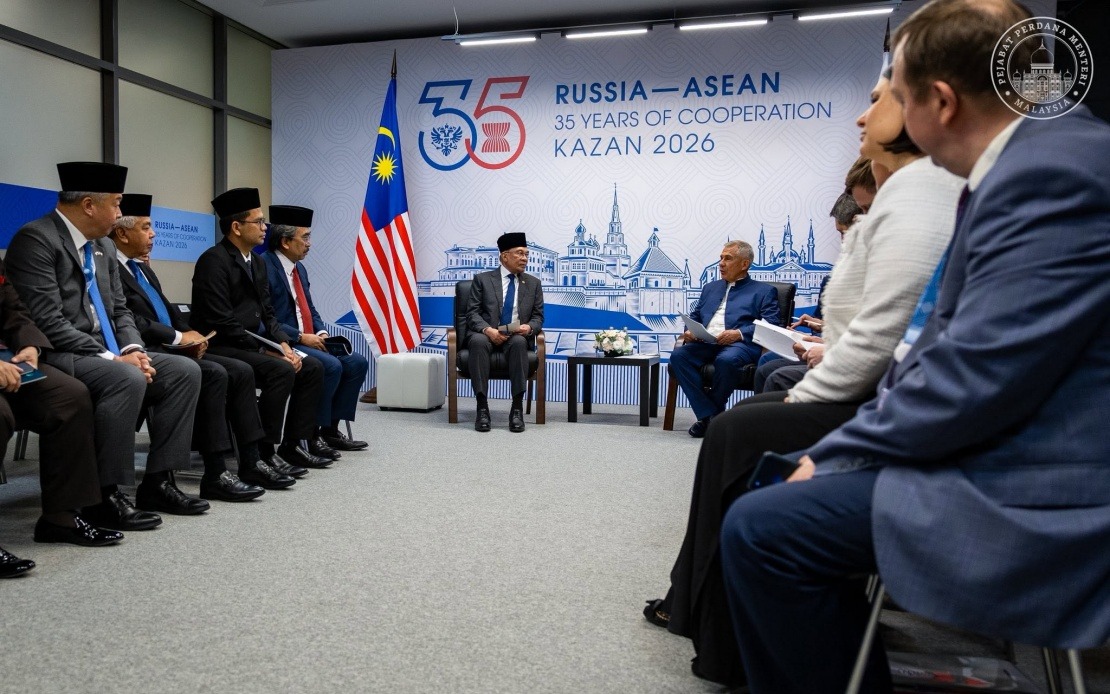
Prime Minister Datuk Seri Anwar Ibrahim has signalled Malaysia's readiness to deepen economic and strategic ties with the Republic of Tatarstan, identifying an expansive range of sectors where both regions can build mutual prosperity. During a bilateral meeting with Tatarstan's leader Rustam Minnikhanov shortly after arriving in Kazan on Tuesday, Anwar highlighted trade, investment, education, tourism, the halal industry, technology and human capital development as priority areas for collaboration, setting the stage for a more substantive partnership between Malaysia and this Russian region.
The energy sector emerged as a primary focus of the discussions, reflecting Tatarstan's significance as a major petroleum producer within Russia's economy. Anwar and Minnikhanov explored concrete pathways for Malaysian involvement in Tatarstan's hydrocarbon value chain, particularly through downstream refining and petrochemical operations that could leverage Malaysia's established expertise in these areas. This dialogue is strategically important for Malaysia's long-term energy security and industrial development, as it opens possibilities for technology transfer, joint ventures and supply chain integration across crucial sectors of both economies.
Beyond the energy sphere, both leaders recognised the Kazan Forum as a vital platform for strengthening commercial linkages and identifying fresh opportunities in emerging sectors. The discussion extended to innovation ecosystems, digital economy applications and strategic investment mechanisms that could attract Malaysian capital and expertise to Tatarstan while positioning the region as a gateway for Malaysian enterprises into Russia and Eurasian markets. This bilateral engagement reflects a broader strategic calculation by Kuala Lumpur to diversify its external partnerships and reduce excessive reliance on traditional trading blocs in Southeast Asia and East Asia.
Anwar's visit to Kazan carries symbolic significance beyond immediate trade discussions. The Prime Minister explicitly acknowledged Kazan's designation as the Islamic World Cultural Capital 2026 by the Islamic World Educational, Scientific and Cultural Organisation, underscoring the city's evolving role as a centre of Islamic scholarship and cultural innovation. This recognition positions Kazan as an important node within the global Islamic economy and creative sectors, areas where Malaysia possesses considerable competitive advantages and institutional capacity. The halal industry, which featured prominently in Anwar's discussion with Minnikhanov, represents a natural bridge for Malaysian businesses to establish operations and standards within Russia and adjacent markets.
Anwar also commended President Vladimir Putin's initiative in establishing the Strategic Vision Group, positioning it as a crucial mechanism for building dialogue between Russia and the Islamic world. This institutional framework reflects Moscow's strategic interest in deepening engagement with Muslim-majority nations and organisations beyond traditional geopolitical alignments. For Malaysia, participation in such dialogue structures offers an avenue to amplify its voice on global economic and political issues while demonstrating commitment to bridge-building and multilateral cooperation. The elevation of Russia-Islamic world relations creates openings for Malaysian policymakers and businesses to shape regional and international conversations.
Anwar arrived in Kazan accompanied by a substantial delegation including Investment, Trade and Industry Minister Datuk Seri Johari Abdul Ghani, Economy Minister Akmal Nasrullah Mohd Nasir, and senior officials from the Prime Minister's Office and Foreign Ministry. The composition of this travelling group underscores the Malaysian government's seriousness in pursuing tangible commercial outcomes from the visit, signalling that discussions extend beyond diplomatic pleasantries to focus on actionable business opportunities and policy coordination. The presence of trade and investment ministers ensures that identified partnerships can rapidly translate into concrete agreements and institutional mechanisms.
The visit's timing coincides with the ASEAN-Russia Commemorative Summit, representing the apex of engagement between the ten-member Association of Southeast Asian Nations and the Russian Federation. This summit embodies a relationship that has matured considerably since formal dialogue commenced in 1991, with Russia's designation as a full ASEAN Dialogue Partner in 1996 followed by elevation to Strategic Partnership status in 2018. These institutional frameworks encompass political and security dimensions, economic cooperation initiatives and cultural and social exchanges that collectively define a comprehensive partnership spanning multiple domains and policy areas.
Kazan itself occupies an important position within Russia's geopolitical and cultural landscape, situated at the confluence of the Volga and Kazanka rivers approximately 800 kilometres east of Moscow. With a population approaching 1.3 million inhabitants, the city functions as Russia's unofficial third capital after Moscow and Saint Petersburg, commanding significant administrative, cultural and economic influence within the broader Russian federation. Its millennium-spanning history and established reputation as a major centre of Islamic culture and heritage make it an ideal venue for engagements focused on cultural diplomacy, interfaith dialogue and economic cooperation frameworks that prioritise inclusivity and civilisational understanding.
For Malaysian readers and policymakers, this bilateral engagement carries several important implications. First, it demonstrates Anwar's commitment to geographic diversification of Malaysia's external relations, moving beyond traditional Asia-Pacific anchors to establish substantive partnerships with Eurasian powers. Second, the focus on energy cooperation addresses Malaysia's ongoing need to secure stable, diversified energy sources whilst leveraging its downstream capabilities in refining and petrochemicals. Third, the emphasis on halal industries and Islamic cultural partnership positions Malaysia to capitalise on growing global interest in Islamic-compliant products and services, particularly as Kazan gains prominence within Islamic world networks.
The economic dimensions of the Malaysia-Tatarstan relationship should not be understated. Tatarstan's substantial hydrocarbon reserves, advanced refining infrastructure and strategic location within Russia's economy create substantial opportunities for Malaysian firms seeking entry into Russian and Eurasian markets. Conversely, Tatarstan's interest in Malaysian expertise across digital economy, halal certification and Islamic finance suggests reciprocal benefits where both regions can gain through technology transfer and knowledge exchange. The bilateral meeting thus represents not merely diplomatic protocol but genuine recognition of complementary capabilities and mutual economic interests.
The broader context of Russia-ASEAN relations also merits attention. Despite geopolitical tensions affecting global diplomacy, ASEAN's principled stance of engagement and dialogue with major powers continues to generate opportunities for Southeast Asian nations including Malaysia. The ASEAN-Russia Commemorative Summit reinforces this tradition whilst providing venues for bilateral discussions like those between Anwar and Minnikhanov. For Malaysia, maintaining balanced, productive relationships across multiple global partners remains consistent with its strategic doctrine of non-alignment and pragmatic engagement.
Moving forward, the statements and commitments emerging from this Kazan visit will likely influence Malaysia's broader approach to Eurasian partnerships during the remainder of Anwar's tenure as Prime Minister. The identification of concrete cooperation areas, from energy to education to technology, provides a roadmap for government ministries and private sector actors to pursue collaborative ventures. The emphasis on mutual benefit and inclusive growth reflects Malaysia's commitment to partnerships grounded in genuine complementarity rather than power asymmetries, positioning both Malaysia and Tatarstan as equals contributing distinctive capabilities toward shared prosperity.