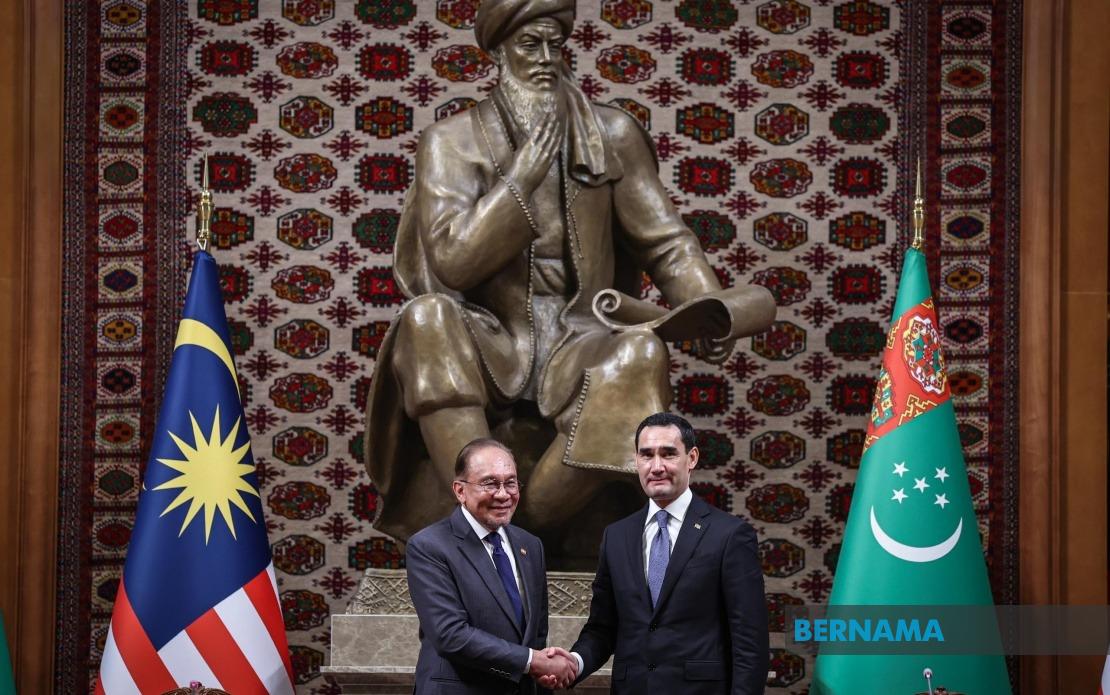
Prime Minister Datuk Seri Anwar Ibrahim has signalled Malaysia's intention to forge a substantially closer relationship with Turkmenistan, moving beyond diplomatic niceties to establish what both nations characterise as a disciplined, forward-looking partnership grounded in mutual strategic advantage. The commitment emerged from formal bilateral discussions held at the Presidential Palace in Ashgabat on Friday, where Anwar and Turkmenistan President Serdar Berdimuhamedov oversaw the formalisation of multiple cooperative frameworks designed to translate political goodwill into tangible economic and institutional outcomes across the coming years.
The breadth of the formal agreements signed during the encounter underscores the ambition underpinning this diplomatic engagement. Malaysia and Turkmenistan exchanged four principal documents: an Air Services Agreement establishing direct aviation connectivity between the two nations; a memorandum of understanding between Malaysia's Institute of Diplomacy and Foreign Relations and Turkmenistan's Institute of International Relations, intended to deepen diplomatic coordination; a separate understanding between Malaysia's Ministry of Transport and Turkmenistan's State Service focused on transportation infrastructure and logistics; and finally, an accord between Malaysia's Academy of Sciences and its Turkmenistan counterpart facilitating collaborative research and scientific advancement. Each document targets a distinct dimension of bilateral engagement, suggesting a comprehensive rather than selective approach to relationship-building.
Energy cooperation represents perhaps the most strategically significant dimension of this emerging partnership. Turkmenistan possesses substantial natural gas reserves and maintains significant hydrocarbon export infrastructure, positioning it as a potentially valuable supplier to Malaysia's energy-hungry economy. As Malaysia navigates the global transition toward cleaner energy sources whilst managing immediate industrial and domestic power demands, diversification of energy sourcing and technology partnerships with gas-rich Central Asian states offers both supply security and knowledge transfer opportunities. Anwar's explicit mention of energy cooperation in the bilateral discussions reflects recognition of this mutual interest, though concrete contract details remain undisclosed.
Trade and investment pathways formed a central focus of the two leaders' substantive discussions. Malaysia's established position as a regional financial and trading hub, combined with its reputation for transparent regulatory frameworks and strategic location along global shipping corridors, holds considerable appeal for Turkmenistan seeking to expand commercial reach beyond traditional post-Soviet trading blocs. Conversely, Central Asian resource wealth and emerging manufacturing capabilities present investment opportunities for Malaysian firms exploring geographic diversification. The establishment of clear cooperative mechanisms through formal agreements creates institutional scaffolding necessary for private sector engagement, reducing transaction costs and regulatory uncertainty that typically impede commercial ventures between geographically distant partners.
The Islamic finance and halal industry dimensions of this partnership reflect Malaysia's distinctive positioning as a leading centre for Shariah-compliant financial services and halal product certification. Turkmenistan, with a Muslim-majority population and growing interest in Islamic banking infrastructure, represents an emerging market for Malaysian expertise in these sectors. Malaysian financial institutions and halal certification bodies possess both technical capability and international credibility that Turkmenistan seeks as it develops parallel financial systems and positions itself within broader Islamic economic networks. This cooperation carries implications extending beyond bilateral commerce, potentially elevating Malaysia's influence within Central Asian economic structures.
Educational and scientific collaboration, formalised through the academies' understanding, addresses longer-term capacity-building. Malaysian universities and research institutions have established regional reputations in fields ranging from tropical agriculture to advanced manufacturing. Access to Malaysian educational frameworks and scientific partnerships benefits Turkmenistan's knowledge economy development. Simultaneously, Malaysian institutions gain exposure to Central Asian research initiatives and student recruitment opportunities from underexplored geographic markets. Such academic exchanges generate soft power benefits transcending immediate economic calculation, cultivating generations of professionals with familiarity and goodwill toward partner nations.
The Air Services Agreement carries particular significance for practical connectivity. Direct air routes between Malaysia and Turkmenistan remain limited, with most travel requiring transit through intermediate hubs. Formalised aviation agreements lower regulatory barriers to route establishment and fare negotiations, potentially enabling Malaysian carriers to operate services that would expand tourism flows, business travel, and people-to-people contact. For Malaysian travellers seeking Central Asian experiences and for Turkmen visitors exploring Southeast Asia, improved connectivity translates into genuine convenience gains rather than procedural advantage.
Anwar's emphasis on transparent and disciplined implementation of agreed frameworks suggests attention to a persistent pattern within bilateral cooperation initiatives: ambitious signing ceremonies often precede implementation delays or institutional friction. By explicitly committing both governments to structured, disciplined execution, Malaysia signals seriousness about translating agreements into functioning partnerships. This rhetorical commitment, whilst not guaranteeing execution, establishes accountability benchmarks against which progress can be measured and deficiencies identified.
The timing and composition of Anwar's delegation merit analytical attention. Accompanying the Prime Minister were the Minister of Investment, Trade and Industry, the Minister of Economy, and senior government officials—a selection emphasising commercial and economic dimensions over diplomatic protocol. This configuration indicates that Malaysia approaches the partnership as substantially transaction-oriented rather than primarily geopolitical. The inclusion of investment and trade ministers signals governmental intention to facilitate private sector engagement and leverage bilateral frameworks for commercial advantage.
For Malaysia's regional positioning, this partnership contributes to a diversified diplomatic footprint across Asia's geographic breadth. As regional powers pursue multi-directional foreign policies—cultivating partnerships with Near Eastern states, ASEAN neighbours, and emerging powers—relationships with Central Asian nations provide additional leverage and alternative cooperation channels. Turkmenistan's relative isolation within its region and limited integration with Western structures creates particular interest in Southeast Asian partners perceived as neutral and commercially pragmatic. Malaysia's own experience navigating complex regional dynamics and maintaining constructive relationships across ideological divides enhances its attractiveness to Central Asian counterparts.
The substantive content of Anwar's first official visit to Turkmenistan since assuming the premiership reflects deliberate relationship prioritisation. Rather than settling for pro-forma diplomatic courtesy, both governments committed resources to negotiating detailed frameworks spanning multiple sectors. This investment in formalising cooperation structures suggests both leaders regard the partnership as possessing genuine strategic value extending beyond symbolic gesture. Whether implementation matches diplomatic ambition will determine whether this visit represents a meaningful inflection point in Malaysia-Turkmenistan relations or functions primarily as another example of bilateral theatre lacking concrete follow-through.

