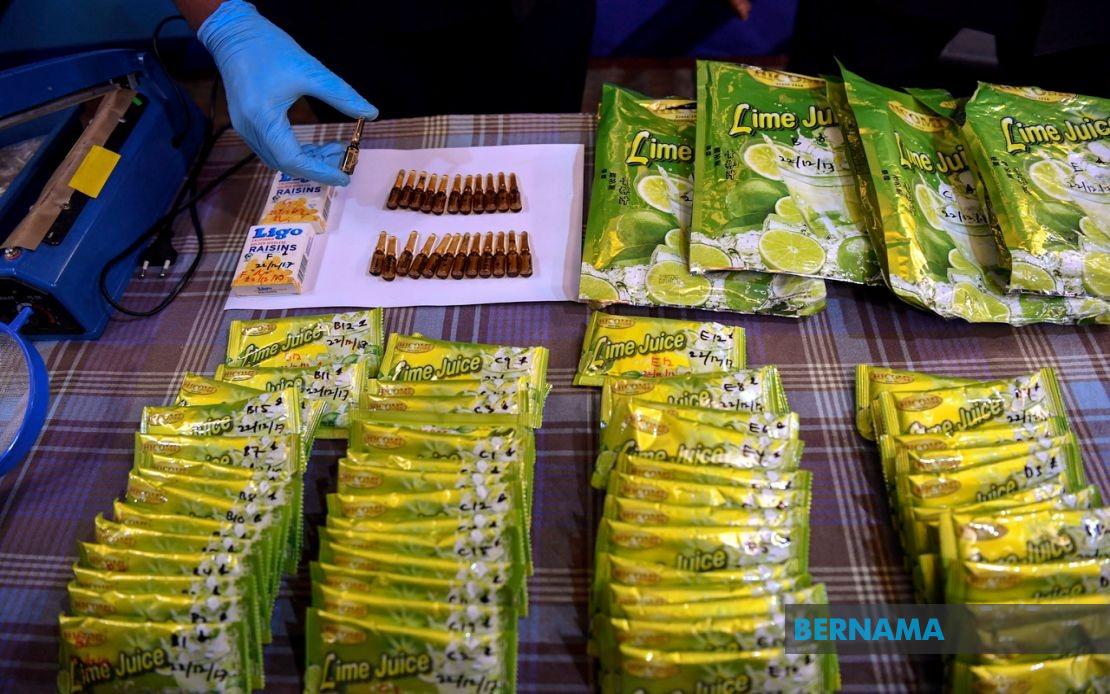
The escalating menace of synthetic drugs has prompted Malaysia's Home Ministry to intensify a nationwide enforcement campaign, signalling the gravity with which authorities now view the evolving narcotics landscape. Datuk Seri Saifuddin Nasution Ismail, the Home Minister, has flagged methamphetamine, fentanyl, and locally nicknamed "piu-piu" psychoactive pills as increasingly serious public health and security concerns, having recently surfaced in the domestic market with alarming frequency.
The synthetic drug phenomenon represents a significant departure from traditional drug trafficking patterns in the region. These substances carry substantially higher addiction risks and overdose fatality rates compared to conventional narcotics, creating a compounding crisis that affects not only users but strains healthcare systems and law enforcement resources across Malaysia. The connection between synthetic drug abuse and rising crime rates has become sufficiently evident that the government has elevated this issue to parliamentary prominence, with the Home Minister providing detailed operational updates to lawmakers.
Statistics underscore the scale of the challenge. Between 2023 and June 2026, the Royal Malaysia Police documented 238,704 arrests nationwide connected to synthetic drug offences across multiple categories. This figure represents a substantial law enforcement mobilisation, though it also suggests that despite intensified operations, supply chains remain operational and accessible to consumers. The sheer volume of arrests indicates that the problem has achieved critical mass, demanding coordinated responses that extend beyond traditional enforcement frameworks.
Operational responses have become increasingly sophisticated. The police have deployed Operation Tapis and Operation Tapis Khas across diverse geographic settings, from urban commercial hubs to isolated rural and remote territories. This geographic reach is particularly significant for Southeast Asia's scattered populations, where drug distribution networks have historically exploited inadequate enforcement presence in peripheral areas. Collaboration with the National Anti-Drugs Agency and the Royal Malaysian Customs Department represents a consolidation of institutional resources, recognising that no single agency possesses sufficient capacity to address the problem independently.
Technological integration has become central to modern drug enforcement strategy. Malaysian authorities now deploy drones and surveillance camera networks to monitor trafficking corridors and distribution points, moving beyond conventional detective work. This technological dimension reflects broader global law enforcement trends, where sophisticated supply chains require equally sophisticated interdiction methods. The investment in surveillance infrastructure, however, also raises questions about resource allocation and whether similar intensity is applied to demand-reduction programmes.
Sarawak, Malaysia's largest state, presents a particular focus. Between January and early June 2026, authorities arrested 7,097 individuals within the state, subdivided into 342 traffickers, 1,314 drug possession cases, and 5,441 users. During this six-month window, enforcement operations recovered 418.01 kilogrammes of drugs valued at RM53.73 million, a substantial seizure reflecting either significant trafficking volumes or concentrated enforcement operations. Additionally, 13 individuals faced detention under preventive measures legislation, while 131 hardcore addicts received enforcement-based interventions under specific statutory provisions. Asset confiscations totalling RM1.95 million targeted syndicate financial infrastructure, attempting to disrupt economic incentives for trafficking.
Legislative enhancement constitutes another pillar of the government's response strategy. The Home Ministry is considering amendments to the Dangerous Drugs Act 1952 to formally incorporate newly emerged synthetic drugs and New Psychoactive Substances into statutory schedules. This legal adaptation addresses a persistent enforcement challenge: rapid pharmaceutical innovation creates designer drugs that technically fall outside existing legislative frameworks, creating temporary windows where substances remain marketable despite being functionally identical to controlled drugs. Updating legislation remains perpetually reactive to chemical innovation, yet remains essential for maintaining regulatory coherence.
Foresight regarding forensic capabilities indicates recognition that scientific detection must evolve alongside drug chemistry. Enhanced laboratory profiling systems now specifically track fentanyl analogues and synthetic opioids, enabling identification of chemical signatures and emerging trends. This scientific dimension becomes increasingly critical as traffickers synthesise novel opioid variants that circumvent existing detection methods. The investment in forensic modernisation acknowledges that enforcement ultimately depends on analytical capacity to prove chemical identity in prosecution proceedings.
Community-based prevention programming provides a complementary strategy to enforcement. Between 2023 and June 2026, authorities conducted 1,144 drug prevention programmes nationwide, representing substantial public engagement efforts. These initiatives target awareness, education, and behavioural modification across diverse communities. Preventive programming recognises an uncomfortable reality: enforcement alone cannot address demand-side factors that drive abuse. Without reducing appeal and accessibility at community level, seizures and arrests represent perpetual symptom management rather than systemic solutions.
The synthetic drug challenge carries particular resonance for Southeast Asian policymakers, as the region's geography, nascent regulatory frameworks, and proximity to major production centres create structural vulnerabilities. Malaysia, positioned along trafficking corridors between producing regions and consuming markets, experiences both transit trafficking and domestic market development. The emergence of designer pills with local nomenclature suggests establishment of domestic manufacturing capacity or repackaging operations, indicating the problem has advanced beyond simple import-and-distribute models.
Moving forward, the sustainability of current enforcement intensity remains uncertain. Coordinated operations require substantial resource commitment, and synthetic drug production remains economically attractive to traffickers given high profitability margins. Without addressing upstream production sources in cooperation with regional and international partners, Malaysia faces perpetual enforcement challenges regardless of domestic operational intensity. The parliamentary updates reflect serious governmental commitment, yet the structural dynamics of global pharmaceutical innovation and illicit synthesis suggest this will remain a long-term challenge requiring sustained political will and resource allocation.

