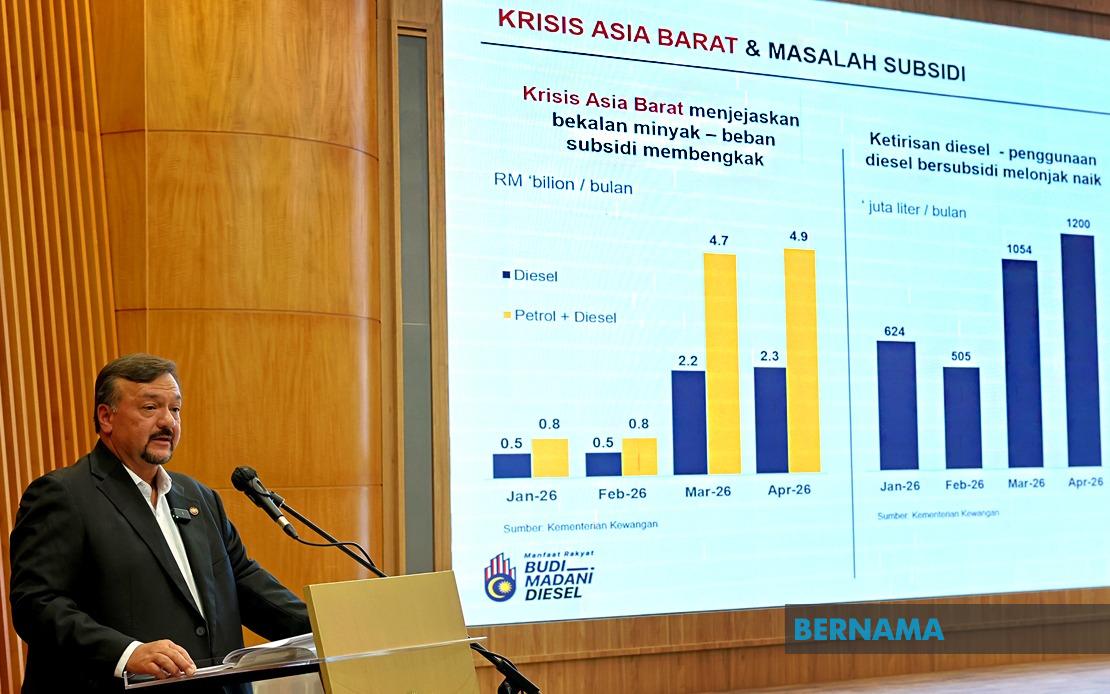
The Malaysian government has decided to maintain the current BUDI MADANI RON95 subsidy quota of 200 litres per month rather than immediately reverting to the previous 300-litre cap, citing the need to assess how recent diplomatic developments in West Asia will influence international oil markets. Finance Minister II Datuk Seri Amir Hamzah Azizan made the announcement in Putrajaya on June 22, emphasising that the administration will adopt a cautious wait-and-see approach until the implications of the newly announced ceasefire become clearer and more predictable.
The decision reflects the government's concern that premature policy changes could expose Malaysia's petrol subsidy programme to market volatility stemming from ongoing geopolitical tensions in the Middle East. Amir Hamzah stressed that the recent ceasefire agreement signed between the United States and Iran requires a 60-day negotiation window before a final accord can be reached, making it premature to commit to expanding fuel subsidies while the outcome remains uncertain. This cautious stance allows policymakers breathing room to evaluate whether the diplomatic breakthrough will stabilise or destabilise global crude prices in the coming weeks.
The finance minister underscored that the reduction from 300 to 200 litres has not created unmanageable hardship for Malaysians, with nearly 80 per cent of BUDI95 subsidy recipients consuming less than 200 litres of petrol monthly. This data-driven observation suggests that the current cap adequately covers the fuel consumption patterns of the vast majority of eligible users, making the distinction between the two quotas less critical than initially perceived. For motorists whose consumption falls comfortably below the threshold, the policy change has had minimal practical impact, though it does affect higher-usage households and commercial users who rely on private vehicles.
The government's communication strategy includes encouraging Malaysians to adopt fuel-conservation practices, framing consumption reduction as both an individual responsibility and a collective contribution to economic stability. Amir Hamzah referenced workplace initiatives such as remote working arrangements that naturally reduce petrol demand, whilst also calling for general prudence in vehicle usage. This multi-pronged approach aims to ease pressure on the subsidy programme from the demand side, reducing the fiscal burden without abruptly cutting benefits to vulnerable populations dependent on the scheme.
Prime Minister Datuk Seri Anwar Ibrahim had previously expressed cautious optimism about the peace negotiations, viewing the preliminary agreement as a potential pathway to de-escalation and regional stability. The Memorandum of Understanding between the US and Iran contains 14 key points addressing conflict resolution mechanisms, with international media reporting that US President Donald Trump and Iranian President Masoud Pezeshkian endorsed the framework. Anwar's measured tone reflected recognition that whilst the agreement signals positive diplomatic momentum, final ratification within the stipulated 60-day timeframe remains uncertain.
For Malaysian consumers and businesses, the implications are substantial. The petrol subsidy scheme represents a significant government expenditure aimed at controlling inflation and supporting lower-income households whose livelihoods depend on affordable fuel access. By maintaining the current quota rather than hastily restoring it, the administration balances fiscal responsibility with social protection, avoiding the risk of expanding subsidies only to face a sudden oil price surge that would force painful reversals. This approach also allows the government to preserve policy flexibility, responding to changed circumstances rather than being locked into commitments made under uncertain conditions.
The broader context involves Malaysia's longstanding vulnerability to global oil price fluctuations. As a petroleum-producing nation, Malaysia benefits from higher oil prices in terms of government revenue but bears the cost of subsidising domestic consumption when prices rise beyond predetermined thresholds. The current geopolitical uncertainties in the Middle East—a region critical to global oil supply—heighten the stakes of fuel subsidy policy. Any major disruption to production or shipping in the Persian Gulf could trigger sharp price increases that would render generous subsidy quotas unsustainable without massive fiscal transfers.
The decision also reflects lessons learned from previous subsidy adjustments. When the government previously reduced the BUDI95 quota from 300 to 200 litres, public reaction was mixed, with concerns raised about impact on rural communities and small business operators. However, the subsequent data showing that most users consume below the new threshold has validated the policy's targeting efficiency. This evidence-based approach to subsidy management demonstrates that careful monitoring and adjustment based on actual usage patterns yields better outcomes than either maintaining universally generous quotas or imposing overly restrictive limits.
Looking forward, the government's conditional stance opens the possibility of policy reversal if circumstances warrant. Should the US-Iran ceasefire prove durable and lead to broader Middle East stability, downward pressure on oil prices could follow, making subsidy expansion more fiscally feasible. Conversely, if negotiations collapse and tensions reignite, maintaining the lower quota becomes even more critical as protection against commodity price shocks. This flexibility positions Malaysia to respond appropriately to evolving conditions rather than being constrained by premature commitments.
The 200-litre quota framework also incentivises more systematic and conscious fuel consumption patterns among Malaysians. Unlike a fully unlimited subsidy that encourages wasteful usage, the capped system creates awareness of consumption thresholds, potentially driving behavioural changes toward energy efficiency. Combined with government messaging about remote work and prudent fuel use, the subsidy design contributes to gradual cultural shifts toward more sustainable transport practices, aligning with longer-term environmental and fiscal objectives.
For Southeast Asia more broadly, Malaysia's measured approach to managing fuel subsidies amid global uncertainty offers a cautionary example. Several regional economies face similar tensions between supporting domestic affordability and maintaining fiscal sustainability, particularly as energy markets remain vulnerable to geopolitical shocks. Malaysia's willingness to gather data, monitor external developments, and adjust policy based on evidence rather than political pressure demonstrates governance discipline that other nations grappling with subsidy burdens might consider emulating.
The government's announcement effectively communicates to markets and citizens that policy decisions will be driven by tangible developments rather than speculation or wishful thinking. By explicitly linking the decision to observable external factors—the US-Iran ceasefire timeline and its market implications—Amir Hamzah provided a transparent rationale that, while disappointing those hoping for immediate restoration of the higher quota, establishes credible benchmarks for future policy reconsideration. This approach builds public trust in government economic management by demonstrating that subsidy decisions serve legitimate policy objectives rather than reflecting fiscal constraints alone.

