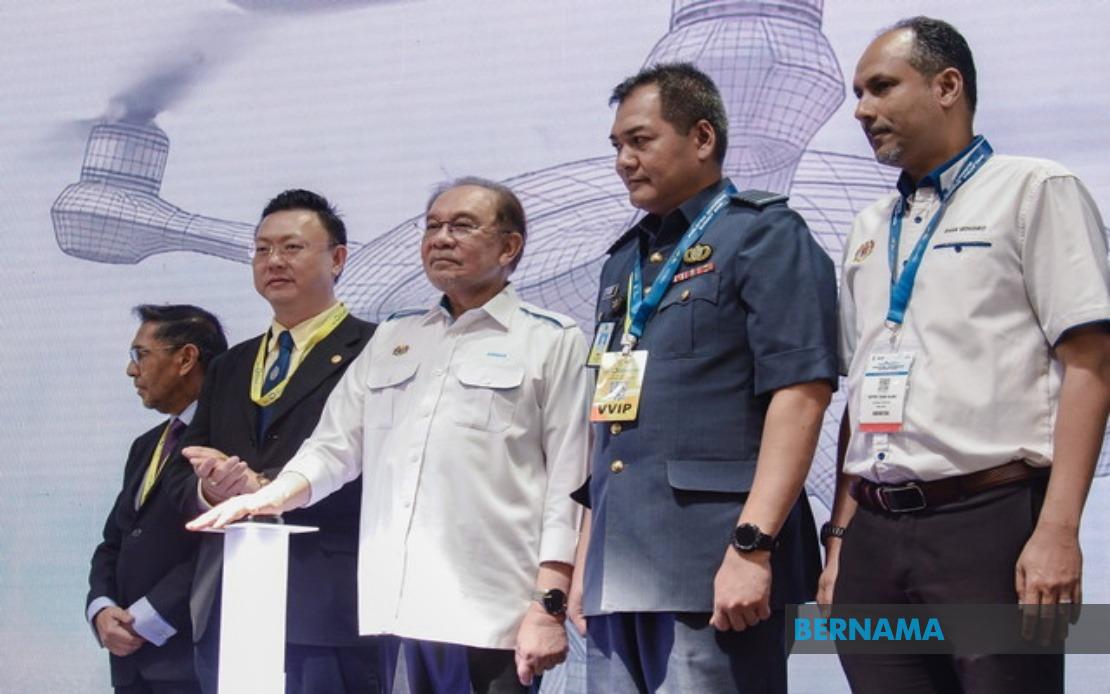
Prime Minister Datuk Seri Anwar Ibrahim has intensified calls for Malaysia to prioritise the development of unmanned aerial vehicle and drone technologies, positioning them as essential to the nation's economic advancement and global competitiveness. Speaking at the closing ceremony of MyDrone Expo 2026 in Sepang, Anwar underscored that Malaysia cannot afford to lag in emerging technological fields if it aspires to strengthen its position in the global economy. The remarks reflect growing recognition within government circles that the drone sector represents a transformative opportunity spanning defence, agriculture, logistics and numerous other domains that could reshape Malaysia's economic landscape.
The Prime Minister emphasised that the drone industry does not operate in isolation but rather forms part of a broader technological ecosystem encompassing artificial intelligence and digital transformation. These interconnected fields, he argued, act as multipliers for innovation and productivity gains that extend far beyond the aviation sector itself. By developing competency in unmanned systems, Malaysia could create spillover benefits across manufacturing, software development, data analytics and other high-value industries. This systems-thinking approach suggests government strategy is moving beyond narrow sectoral interests toward comprehensive ecosystem development that leverages complementary technological domains.
A significant catalyst for Anwar's emphasis on drone technology urgency is the projected scale of global market opportunity. The worldwide UAV market is anticipated to exceed USD55 billion by 2030, a figure that underscores the commercial stakes involved. Beyond this headline figure, the low-altitude economy is emerging as an increasingly significant investment frontier, with applications ranging from precision agriculture to infrastructure inspection and urban logistics. For a nation like Malaysia with substantial agricultural operations and rapidly expanding urban centres, these applications hold particular relevance. The window for establishing competitive advantage in this space remains open, but only if Malaysia acts decisively within the next few years.
Recognising the scale of necessary transformation, Anwar has directed Cabinet ministers, policymakers, research institutions and relevant agencies to provide comprehensive regulatory and ecosystem backing to drone industry stakeholders. This top-down mandate signals serious political commitment beyond rhetorical support, suggesting resource allocation and policy prioritisation will follow. The directive encompasses not only military and defence applications but explicitly extends to civil uses including agricultural productivity enhancement, where Malaysian planters operate at scale and could benefit substantially from precision monitoring and treatment technologies.
The government's commitment extends to fundamental infrastructure improvements necessary for industry growth. Enhanced regulatory frameworks will establish clearer rules for commercial drone operations, addressing existing ambiguities that have constrained market expansion. Increased research funding will enable domestic institutions to contribute meaningfully to technological advancement rather than remaining purely as technology adopters. Improved testing and certification processes will reduce time-to-market for local companies and create quality assurance standards that facilitate international market access.
A particularly noteworthy dimension of the government's approach involves building human capital through educational ecosystem development. Anwar has specifically advocated for closer collaboration between private sector entities, government research establishments and universities to construct a sustainable talent pipeline. This mirrors existing institutional frameworks in artificial intelligence and quantum computing, where Malaysia has already begun establishing educational infrastructure. By replicating this model for drone technologies, the nation can develop indigenous expertise rather than perpetually relying on imported technical skills and overseas knowledge transfer.
The MyDrone Expo 2026 itself demonstrated substantial industry momentum and international engagement. The three-day event featured more than 100 exhibition booths and attracted thousands of industry delegates from 46 countries, exceeding organisers' expectations. This turnout indicates international confidence in Malaysia's potential as a regional hub for drone technology development and commercialisation. Co-organised by the World UAV Federation Malaysia Chapter and the Malaysia UAV Development Association, the expo reflected collaborative governance structures that bridge private sector, international bodies and domestic industry associations.
For Malaysian policymakers and industry observers, the implications are multifaceted. The drone sector offers pathways for downstream industries to increase efficiency and profitability, potentially improving competitiveness in global markets. Agricultural producers, one of Malaysia's significant economic sectors, could achieve substantial productivity gains through precision application technologies and crop monitoring capabilities enabled by drone systems. Manufacturing and logistics operators similarly face pressure to adopt autonomous systems or risk competitive disadvantage, making domestic capability development strategically important.
Regionally, Malaysia's efforts to establish drone industry leadership create opportunities for Southeast Asian positioning. As neighbouring nations grapple with similar technology adoption challenges, Malaysian expertise and manufacturing capacity could serve broader ASEAN markets. This could establish Malaysia as a regional innovation hub, generating exports of both physical systems and technical expertise. The development trajectory adopted in the coming years will substantially influence whether the nation captures this regional opportunity or sees technological leadership default to more advanced economies.
The government's clearly articulated policy direction provides businesses with confidence for investment in drone-related ventures. Regulatory clarity and committed public sector support reduce commercial risk and encourage private capital deployment. However, translating policy commitment into tangible outcomes will require consistent implementation, adequate funding allocation and sustained focus despite competing priorities. The coming months will prove telling regarding the seriousness of government commitment and the ability of Malaysian institutions to mobilise resources effectively.

