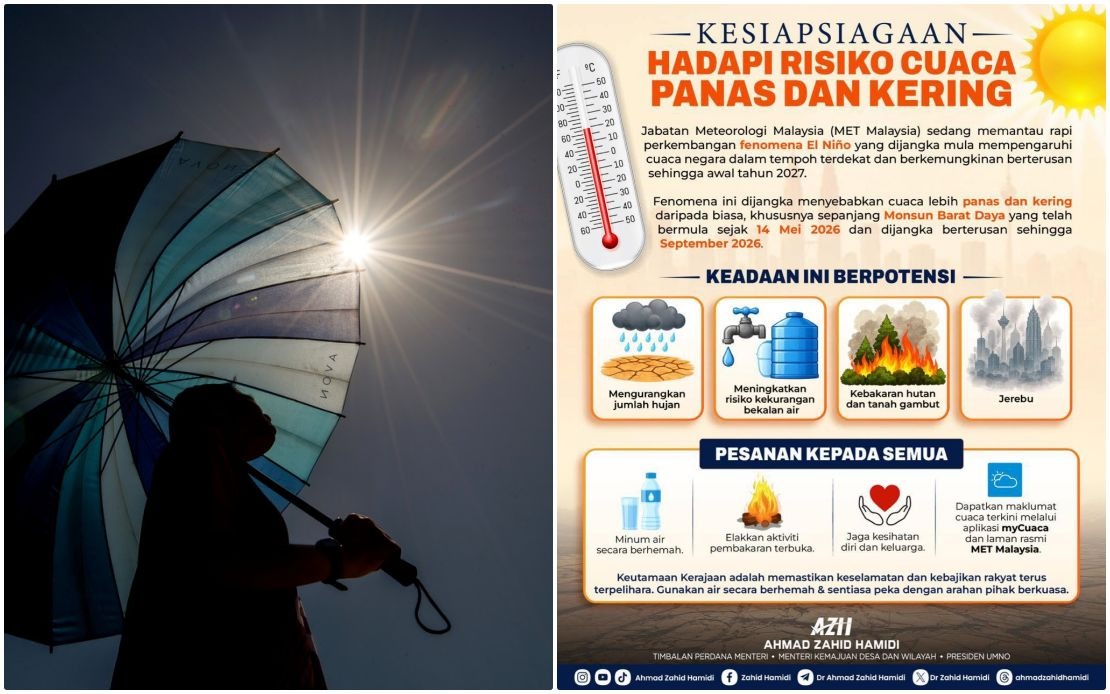
Malaysia's top leadership has sounded the alarm over an approaching El Nino weather system that threatens to bring sustained heat and aridity to the nation, potentially lingering until the first quarter of 2027. Deputy Prime Minister Datuk Seri Dr Ahmad Zahid Hamidi, who chairs the Central Disaster Management Committee, issued the advisory as government agencies prepare contingency measures to mitigate the phenomenon's cascading effects across the country.
The El Nino pattern is poised to coincide with the Southwest Monsoon, which commenced on May 14 and will extend through September, creating compounded weather stress during the crucial agricultural and water management seasons. According to Dr Mohd Hisham Mohd Anip, director-general of the Malaysian Meteorological Department, conditions will deviate significantly from seasonal norms, with rainfall expected to diminish across multiple regions. This convergence presents a complex challenge for water resource planners, farmers, and disaster management authorities who must coordinate responses to protect both urban and rural communities.
The implications extend beyond mere discomfort. Extended drought conditions historically catalyze a cascade of secondary hazards that have previously affected Malaysia and the broader Southeast Asian region. Water supply systems, particularly in urban centres where demand spikes during heat waves, face potential strain. Reservoir levels that replenish gradually during monsoon seasons could dip to critical thresholds, necessitating restrictions on non-essential consumption and industrial allocation. Agricultural productivity stands vulnerable, as crops dependent on conventional rainfall patterns may underperform, potentially impacting food security and farmer livelihoods in rural districts.
Forest and peatland fire risk represents perhaps the most visible and politically sensitive consequence of prolonged dryness. The 2015 Southeast Asian haze crisis, triggered by uncontrolled fires in peatland areas across the region, demonstrated how regional weather patterns can precipitate transnational air quality crises affecting millions. Malaysian peatlands, concentrated in Sarawak and Sabah, are particularly prone to ignition and contain vast carbon stores that, when burned, release enormous quantities of greenhouse gases. Ahmad Zahid's specific mention of fire risk signals acute awareness of this precedent and the potential for international criticism should Indonesian or Malaysian peatlands ignite during the El Nino window.
Haze formation and transboundary air pollution emerged as implicit concerns within the government's advisory. During the 2015 episode, air quality indices across Malaysia, Singapore, and Indonesia's major cities reached hazardous levels, causing respiratory illness spikes, school closures, and economic disruption from reduced visibility affecting transportation and tourism. The coming El Nino period could similarly trigger such events, particularly if agricultural burning in neighbouring Sumatra coincides with atmospheric conditions that push smoke toward Malaysia. This regional dimension requires diplomatic coordination and cross-border fire management protocols, adding complexity to Malaysia's unilateral preparations.
Water security emerges as a central policy concern. Malaysia's water infrastructure, while generally reliable in urban areas, depends heavily on rainfall replenishment cycles. States like Selangor, which supply the economic heartland around Kuala Lumpur, have experienced periodic supply constraints during previous drought episodes. Desalination capacity exists but remains limited and energy-intensive, raising operational costs during periods of reduced hydroelectric generation—itself a consequence of lower water levels in dam reservoirs. Broader adoption of rainwater harvesting and recycled water systems in commercial and residential settings could buffer against shortages, though such infrastructure requires advance planning and investment.
The public health dimension, particularly concerning vulnerable populations, warrants emphasis. Elderly residents, young children, and individuals with respiratory or cardiovascular conditions face heightened risk during sustained heat exposure. Heat-related illness, dehydration, and exacerbation of chronic conditions typically rise during prolonged hot periods, straining healthcare facilities. Ahmad Zahid's explicit call for residents to prioritise family health reflects this concern and signals that healthcare providers should anticipate increased demand during the El Nino window.
The government has positioned information access as central to public preparedness. The myCuaca application, operated by the Malaysian Meteorological Department, provides granular weather data and forecasts that residents can consult for daily planning. MetMalaysia's official channels similarly disseminate authoritative information, reducing reliance on speculative social media commentary. However, digital access remains uneven across Malaysia's socioeconomic spectrum, suggesting that community-level awareness campaigns and traditional media outreach remain necessary complements to app-based information sharing.
Responsible action at individual and institutional levels underpins the government's mitigation strategy. Ahmad Zahid's appeal for water conservation and avoidance of open burning reflects the reality that top-down regulation, while important, proves insufficient without collective behavioural adjustment. Agricultural communities that traditionally clear land through controlled burning must shift practices; households must moderate consumption; industrial operators must optimize water use. Such transitions require education, incentives, and enforcement—a combination of strategies rather than exhortation alone.
The government has committed to continuous monitoring and adaptive response protocols. This declaratory stance suggests pre-positioning of emergency resources, coordination with state governments and relevant agencies, and readiness to implement water rationing or fire suppression deployment if conditions deteriorate. The Central Disaster Management Committee's involvement indicates that El Nino response has been elevated to whole-of-government status, potentially activating contingency budgets and inter-agency task forces.
Looking ahead, the extended timeline through early 2027 underscores the need for sustained rather than episodic action. Short-term crisis response must be paired with medium-term resilience building—investment in water infrastructure, reforestation programmes to reduce fire fuel loads, and agricultural diversification toward drought-tolerant crops. The El Nino episode, while challenging, presents an opportunity for Malaysia to stress-test its climate adaptation systems and identify institutional or infrastructure gaps requiring attention before future weather extremes arrive.
Ultimately, Ahmad Zahid's advisory represents an attempt to shift public consciousness from passive acceptance of weather events toward active preparation. Whether Malaysians respond with sustained vigilance or momentary attention will determine how effectively the nation navigates the coming hot, dry years.