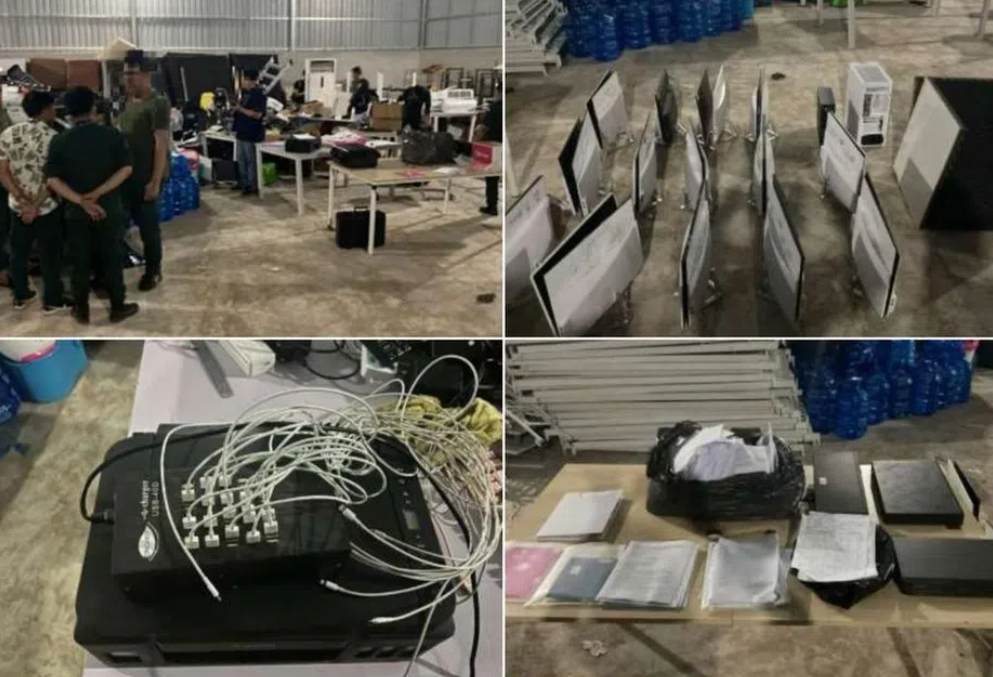
A 30-year-old Malaysian has been sentenced to over 16 months in prison for his membership in an organised crime syndicate based in Phnom Penh that orchestrated an elaborate fraud scheme targeting Singaporeans. Yip Chee Ming pleaded guilty on Friday to a single charge of belonging to a criminal organisation, with an additional cheating charge considered during sentencing, underscoring how swiftly authorities have moved to dismantle the transnational operation that caused widespread financial devastation across the region.
The scam enterprise operated with remarkable sophistication and scale. Between September 2024 and September 2025, the syndicate was linked to at least 528 reported fraud cases, inflicting approximately S$52.5 million in losses on unsuspecting Singaporean victims. The group specialised in impersonating government officials, a deceptive tactic that exploited public trust and created a false sense of legitimacy that made victims vulnerable to manipulation. This particular scam type has since become increasingly prevalent, reflecting a troubling trend that law enforcement agencies across the region are working to contain.
Yip's path into the criminal enterprise began innocuously when his acquaintance, identified only as Jason, approached him in October 2024 with an employment proposition. Jason, who had already become involved with the syndicate, sought companionship in the venture and convinced Yip to join him. Their introduction to the operation came through Tang Soon Wah, identified as a key leader within the syndicate's hierarchy, who extended an invitation for both men to visit the criminal compound in Cambodia to assess the working conditions. This recruitment approach—leveraging personal relationships and providing tangible glimpses of facilities—reflects the sophisticated methods these organisations employ to enlist new members.
The Phnom Penh compound itself was a fortified five-storey structure guarded by security personnel, revealing the substantial infrastructure backing these operations. When Yip and Jason travelled to Cambodia on November 21, 2024, they were being integrated into a hierarchically organised system with clearly defined roles and responsibilities. The syndicate maintained strict operational layers: senior leadership overseeing strategic direction and commission distribution, supervisors and trainers managing day-to-day caller activities, and money laundering specialists tasked with converting stolen funds into cryptocurrency. Court documents indicated at least 78 individuals were implicated in the network, suggesting a sprawling enterprise with considerable reach and complexity.
Yip commenced his employment on November 22, 2024, with compensation structured to incentivise productivity: US$1,800 monthly plus 1 per cent commission from each successful fraud. His assignment required impersonating a bank officer during telephone calls to prospective victims. The syndicate provided detailed scripts and coaching sessions, with trainers offering specific tactical guidance—including instruction on adopting Singaporean accents—to enhance persuasiveness. Yet Yip proved singularly unsuited to the deception trade. Despite faithfully adhering to provided scripts on his first day, he failed to deceive a single victim. When he attempted to replicate his efforts on November 23, his futility became undeniable. Tang, observing Yip's incompetence, terminated his employment after merely one day of actual work and expunged their digital communications.
Yip's departure from the syndicate remains incompletely documented in court records, with no specified account of his return to Malaysia following his dismissal. Yet his involvement, however abbreviated, placed him squarely within the criminal apparatus. Authorities apprehended him in Singapore on September 9, 2025, during a coordinated enforcement operation between Singapore Police and the Cambodian National Police. This joint operation, conducted against the wider syndicate, resulted in charges against 12 alleged members, including Yip.
Among those charged were nine Singaporean nationals: Deon Tan Ke Yuan, 25; Lester Ng Jing Hai, 29; Christy Neo Wei En, 29; Heiqal Lee, 30; Tay Jun Xiang, 32; Ng Wei Kang, 33; Zachary Lee Jia An, 35; Melvin Tan Wenzheng, 35; and Lau Haoxiang, 39. The remaining accused comprised Malaysian Muhamad Asyraf Anuar, 29, and Filipina De Villar Rizalyn Panganiban, 34. The multinational composition of the accused reflects the transnational character of organised fraud networks, which routinely recruit operatives across Southeast Asian borders to amplify their operational capacity and complexity.
The government official impersonation scam category has emerged as an urgent law enforcement concern throughout the region. Paradoxically, whilst Singapore reported an overall decline in fraud cases during 2025, official impersonation schemes surged dramatically, more than doubling from 1,504 cases in 2024 to 3,363 the following year. This escalation demonstrates how criminal organisations continuously adapt their methodologies in response to public awareness campaigns and enforcement activities, shifting emphasis toward schemes that leverage systemic authority and institutional credibility. The scam type now ranks as the fifth most prevalent fraud category in Singapore, displacing previously dominant schemes and signalling a strategic recalibration by criminal enterprises.
For Yip's conviction of organised crime membership, Singapore's criminal code prescribes penalties ranging up to five years imprisonment and S$100,000 in fines. His sentence of 16 months and two weeks reflects judicial consideration of his peripheral role and minimal direct harm—he orchestrated no successful frauds—balanced against the seriousness of knowingly participating in a large-scale criminal apparatus. His case illustrates an uncomfortable reality: even incompetent participation in transnational crime networks carries substantial legal consequences, and geographical boundaries provide minimal protection for those implicated in cross-border criminal operations.
The syndicate's dismantling represents significant progress in regional law enforcement cooperation, yet the persistence and adaptability of such networks underscores the ongoing challenge confronting Southeast Asian authorities. Malaysian and Singaporean law enforcement agencies must maintain heightened vigilance regarding recruitment activities within their territories, as organised crime groups continue targeting vulnerable individuals with promises of overseas employment. For Malaysian readers, Yip's case serves as cautionary example: involvement in foreign criminal enterprises, however temporary or unsuccessful, can result in prosecution and incarceration in jurisdictions beyond national borders, with minimal recourse once overseas authorities assert investigative control.

