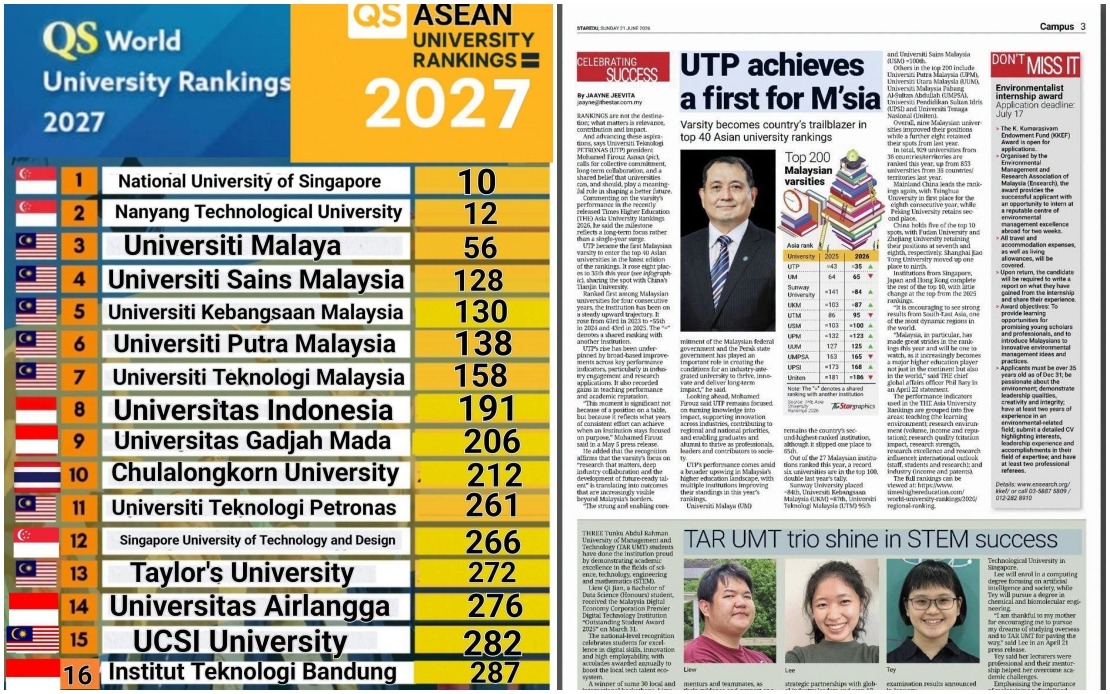
Malaysia's commitment to building a world-class higher education system is gaining international recognition, with the country's universities securing increasingly competitive positions in prestigious global rankings. The latest Times Higher Education Asia University Rankings 2026 underscores this trajectory, showcasing the collective achievements of Malaysia's diverse institutional landscape spanning both public and private universities. Higher Education Minister Datuk Seri Dr Zambry Abd Kadir highlighted these developments as validation of the nation's strategic push to position itself as a destination of choice for students and researchers across Asia, reflecting years of investment in academic excellence and research infrastructure.
The standout achievement in this year's rankings comes from Universiti Teknologi Petronas (UTP), which has become the first Malaysian university to break into Asia's exclusive top 40, securing 35th place. This represents a significant jump from UTP's 43rd position in the previous rankings cycle, demonstrating accelerated progress that signals the institution's growing research output and international reputation. For a petroleum-focused engineering university to achieve such prominence among the region's most competitive academic institutions reflects both the quality of its faculty and the relevance of its research to pressing global energy and sustainability challenges. UTP's breakthrough sets a new benchmark for Malaysian higher education and provides a template for how specialised institutions can achieve global competitiveness.
The breadth of Malaysia's performance extends well beyond UTP's headline achievement. A total of 27 Malaysian institutions earned places in the 2026 rankings, demonstrating that excellence is not concentrated in a single institution but distributed across the country's higher education ecosystem. This diversity is particularly significant for Southeast Asia, where brain drain to universities in Australia, the United Kingdom, and North America remains a persistent challenge. The expanded representation of Malaysian universities creates more opportunities for students to pursue high-quality education domestically, potentially reducing the outflow of talent and contributing to the nation's human capital development.
Among the standout performers are the nation's flagship universities: Universiti Malaya (UM), Universiti Kebangsaan Malaysia (UKM), Universiti Teknologi Malaysia (UTM), and Universiti Sains Malaysia (USM), all of which have maintained or improved their standing in the latest cycle. The inclusion of research-intensive institutions like Universiti Putra Malaysia (UPM) and specialist universities such as Universiti Pendidikan Sultan Idris (UPSI) and Universiti Tenaga Nasional (UNITEN) demonstrates the strength of Malaysia's institutional diversity. Private sector contributions are also notable, with Sunway University maintaining its competitive position alongside public institutions, showing that the country's mixed model of higher education delivery is producing internationally credible outcomes.
The numerical achievements speak to sustained institutional improvement. A record six Malaysian universities have secured positions within Asia's top 100 universities, while 11 local institutions now rank among the region's top 200. These thresholds matter because they represent international peer recognition and typically correlate with research funding opportunities, recruitment of international faculty, and attraction of high-calibre graduate students. Breaking into the top 100 in Asia puts Malaysian universities on par with leading institutions in Singapore, Hong Kong, and South Korea, fundamentally changing the competitive dynamics of regional higher education.
Minister Zambry emphasised that while international rankings should not be viewed as the sole measure of university quality, they serve as meaningful indicators of institutional competitiveness and reputation. This balanced perspective is important for Malaysian policymakers and university leaders who must navigate between pursuing ranking improvements and maintaining commitment to broader educational missions such as nation-building, community engagement, and social mobility. The minister's acknowledgement that rankings reflect "collective efforts of lecturers, researchers, students, alumni, staff and industry partners" highlights the ecosystem approach necessary to sustain improvements—rankings cannot be gamed through short-term initiatives but require genuine institutional commitment to research quality and teaching excellence.
The implications for Malaysia's economy and strategic positioning extend beyond prestige. Universities that rank highly in international tables attract research collaborations with leading global institutions, secure more competitive grant funding, and enhance their ability to commercialise intellectual property. For Malaysia, which aspires to transition toward a high-value knowledge economy, the presence of internationally competitive universities strengthens the country's innovation ecosystem and provides anchors for technological advancement. Multinational corporations increasingly base their regional research and development operations near strong universities, making educational ranking improvements directly relevant to foreign investment decisions.
The regional context amplifies Malaysia's achievement. Southeast Asia faces significant competition from East Asian economies that have invested heavily in higher education over the past two decades. Thailand, Indonesia, and the Philippines all feature universities in major international rankings, but Malaysia's concentrated strength—with six institutions in the top 100—represents particular progress. This positions Malaysia as a viable alternative to more expensive study destinations like Singapore and Australia, potentially capturing regional market share among students who value quality but require affordable tuition fees and living costs.
However, sustaining this momentum requires continued strategic investment. International rankings are driven by metrics including research output (particularly highly cited publications), faculty credentials, student-to-staff ratios, international student and faculty diversity, and international research partnerships. Malaysian universities must maintain focus on expanding research capacity, particularly in high-impact disciplines, while enhancing internationalisation without compromising accessibility for domestic students. The challenge intensifies as regional competitors continue their own university development programmes, meaning Malaysian institutions cannot rest on current achievements.
The ministry's recognition of institutional diversity in congratulating both public universities like UM, UKM, UTM, USM, UPM, UUM, and UMPSA, alongside private and specialist institutions such as Sunway University, UPSI, and UNITEN, underscores an important strategic principle: excellence in higher education is not the preserve of traditional research universities. Teaching-focused institutions and those with specialised mandates can achieve international recognition by excelling within their designated roles. This supports Malaysia's need to develop a differentiated, multi-tiered higher education system that serves diverse student populations and economic needs rather than driving all institutions toward a single model of research intensity.
Government policy will be crucial in maintaining this trajectory. Continued adequate funding for research infrastructure, competitive salaries to retain and attract academic talent, streamlined governance to allow universities greater autonomy in strategic decisions, and partnerships with industry to ensure relevance of research are all essential. Malaysia's success in higher education rankings ultimately depends less on any single policy intervention and more on systemic commitment to quality and sustained institutional investment across multiple institutions.
The 2026 rankings results suggest Malaysia is successfully executing its strategic vision of becoming a regional education hub. With UTP's entry into Asia's top 40 and the expanding representation of local institutions in the top 100 and top 200, the nation demonstrates that consistent investment in human capital and research infrastructure yields measurable international recognition. For Malaysian students, these rankings validate the quality of domestic education options; for policymakers, they provide evidence that the nation's higher education strategy is working; and for the economy, they signal that Malaysia's knowledge base is strengthening at a pace competitive with regional peers.

