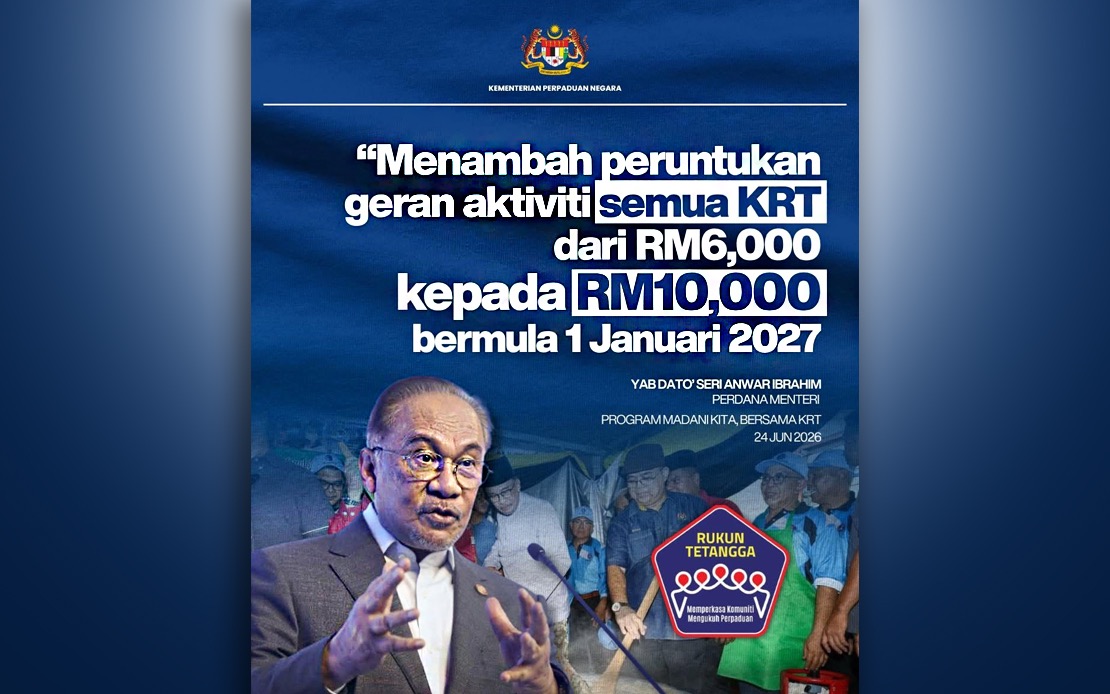
Malaysia's government has announced a significant financial boost for its neighbourhood watch network, with all 8,615 KRT (Kawasan Rukun Tetangga) groups nationwide receiving a 67 percent increase in their annual operational grants. The funding level will rise from RM6,000 to RM10,000 per group, with disbursements beginning on January 1, 2027. National Unity Minister Datuk Aaron Ago Dagang framed the decision as recognition of these grassroots organisations' critical contributions to maintaining social cohesion and community welfare across Malaysia's diverse population.
Prime Minister Datuk Seri Anwar Ibrahim announced the funding increase during a MADANI KITA programme event held in Dataran Segamat, Johor, signalling the administration's commitment to strengthening community-level institutions. The timing of the announcement underscores the MADANI Government's stated priority of empowering grassroots movements as fundamental pillars of national development. For neighbourhood groups operating on modest budgets, the RM4,000 annual increase per KRT represents a meaningful expansion of their capacity to initiate and sustain local programmes.
The neighbourhood watch system has evolved into one of Malaysia's most extensive grassroots networks, encompassing approximately 250,000 active members who collectively reach more than 12 million citizens. During the past year alone, these groups orchestrated over 100,000 community activities, demonstrating their extensive reach and operational scope. The funding increase reflects governmental recognition that these organisations serve functions far beyond traditional security concerns, functioning as hubs for social integration, economic cooperation, and welfare support in their respective areas.
Aaron explained that the enhanced grant allocation will enable KRT groups to expand and improve their programming across several dimensions. Unity activities designed to bridge ethnic and religious divides will have better financial backing, while community development projects addressing local infrastructure and quality-of-life concerns can be pursued with greater ambition. Educational initiatives, neighbourhood security enhancements, voluntary service schemes, and local economic empowerment programmes all stand to benefit from the expanded funding base available to individual groups.
The announcement carries particular significance in the Malaysian context, where neighbourhood-level social cohesion directly influences national harmony. Malaysia's success as a multicultural society depends substantially on positive interactions and trust-building among neighbours of different ethnic and religious backgrounds. KRT groups function as formalised structures for fostering these relationships, creating spaces where residents collaborate on practical issues affecting their daily lives, regardless of their communal identities. The funding boost acknowledges this role as foundational to Malaysia's stability and development.
For many KRT groups, particularly those in smaller towns and rural areas, the expanded budget will enable programme diversification that was previously constrained by limited resources. Community centres can be better maintained, welfare assistance programmes can reach more vulnerable residents, and youth engagement initiatives can be expanded. The additional funding also permits groups to hire temporary staff or provide honorariums to key volunteers, addressing a chronic challenge faced by many neighbourhood organisations dependent on unpaid labour.
Minister Aaron emphasised that the government remains committed to ensuring optimal utilisation of the additional funding, suggesting that accountability mechanisms and performance monitoring will accompany the financial increase. This approach reflects a broader strategy within the MADANI framework to strengthen grassroots institutions while maintaining standards of governance and demonstrating measurable community benefits. The ministry plans to track programme outcomes and community impact across the network to validate the investment and refine support structures.
The KRT system represents a distinctly Malaysian approach to community organisation, operating through a hierarchical structure that connects individual neighbourhood groups with state-level coordination bodies and national oversight. This architecture enables policy dissemination and resource distribution while preserving local autonomy in programme design and implementation. The funding increase flows through this established channel, meaning groups can access resources according to established procedures without requiring new institutional arrangements.
For Malaysian policymakers, the decision reflects growing recognition that grassroots social infrastructure requires sustained financial investment. As urbanisation accelerates and traditional community structures face pressures from modernisation, formalised neighbourhood organisations increasingly bear responsibility for maintaining the social bonds that prevent fragmentation and conflict. The 67 percent funding increase signals confidence that investing in these institutions generates returns across multiple domains: improved public safety, enhanced social welfare, strengthened national unity, and more resilient local communities.
The implementation timeline extending to January 2027 provides neighbourhood groups with approximately eighteen months for planning and preparation. KRT leaders can use this period to develop more ambitious programme proposals, strengthen administrative capacity, and coordinate with local government counterparts on integrated community initiatives. The advance notice also allows civil society organisations and local authorities to align complementary programmes with KRT activities, maximising the impact of the increased resources available at the neighbourhood level.

