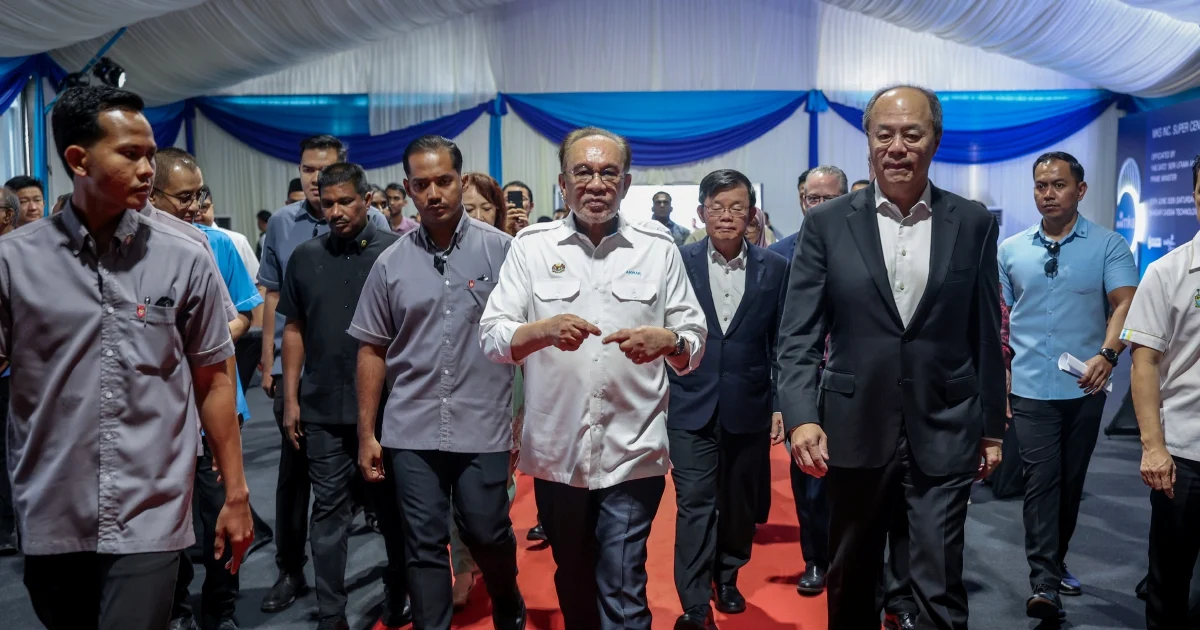
Prime Minister Datuk Seri Anwar Ibrahim has underscored the strategic advantage Malaysia derives from its deliberate stance of diplomatic engagement across the geopolitical spectrum while preserving institutional independence. Speaking in Batu Kawan, Anwar articulated how this measured approach to international relations has become a significant draw for foreign capital, particularly as multinational corporations seek stable and predictable operating environments amid heightening global tensions.
The government's refusal to align rigidly with competing power blocs represents a calculated economic strategy as much as a foreign policy position. By maintaining equidistant relationships with major trading partners and strategic powers, Malaysia positions itself as a credible, low-risk destination for investment. This neutrality carries tangible commercial value: investors from China, the United States, Europe, Japan, and India can operate in Malaysia without fearing sanctions exposure, supply chain disruption, or geopolitical retaliation tied to their home countries' bilateral relations.
The Prime Minister's emphasis on this positioning reflects a hard-won lesson from Malaysia's post-colonial experience. Unlike some Southeast Asian neighbours that have occasionally found themselves caught between competing pressures or forced to choose sides, Malaysia's historical commitment to non-alignment—rooted in the Non-Aligned Movement principles of the 1960s—has evolved into a contemporary advantage. This consistency offers multinational corporations and institutional investors the reassurance that policy framework shifts driven by external pressure are unlikely.
From an investor perspective, Malaysia's balanced approach reduces several categories of risk. Portfolio managers monitoring geopolitical exposure assess which countries are vulnerable to sudden policy reversals triggered by superpower competition. Malaysia's demonstrated restraint in avoiding military entanglement and its pattern of sustained engagement with all trading powers—regardless of their conflicts elsewhere—provide a comparative advantage over nations perceived as gravitating toward one bloc or another.
The economic implications extend beyond foreign direct investment into portfolio flows, technology partnerships, and manufacturing decisions. Companies evaluating regional headquarters locations, semiconductor facilities, and digital infrastructure increasingly factor in political stability and diplomatic independence. A nation actively courting relationships with both Beijing and Washington, while maintaining strong ties to regional partners and traditional allies, offers a unique value proposition in an era of rising protectionism and bifurcating global supply chains.
Anwar's articulation of this strategy also addresses domestic audiences concerned about external pressure. By framing neutrality as an engine of prosperity rather than merely a defensive posture, the government reinforces public support for policies that maintain diplomatic flexibility. This domestic consensus around foreign policy independence becomes itself a form of stability that investors reward.
The timing of Anwar's remarks carries significance amid broader regional developments. Southeast Asia has become increasingly central to great power competition, with the United States, China, Japan, and India all competing for influence. Vietnam, for instance, has faced mounting pressure to take clearer stances on South China Sea disputes and semiconductor supply chains, while the Philippines has navigated tensions between security partnerships and trade dependency. Against this backdrop, Malaysia's consistent messaging around non-alignment provides a distinct positioning.
Moreover, Malaysia's credibility on neutrality rests on demonstrated actions rather than mere rhetoric. The country has declined to join AUKUS and other alliance structures explicitly designed to contain Chinese influence. Simultaneously, it has maintained robust defence relationships with Western partners and participates meaningfully in regional security arrangements. This balancing act, though occasionally criticized by hardliners in various capitals, has proven commercially successful.
Investors further benefit from Malaysia's geographic and demographic characteristics that complement its diplomatic positioning. Situated along crucial maritime trade routes and serving as a gateway to Southeast Asia, Malaysia attracts companies seeking to establish regional operations. The availability of skilled English-speaking workforces, relatively developed infrastructure, and established financial markets create practical advantages that diplomatic neutrality enhances rather than replaces.
The Prime Minister's emphasis on this dimension of economic policy also reflects responses to recent global developments. Supply chain realignments accelerated by trade tensions have driven companies to diversify production and sourcing locations. Countries demonstrating ability to work constructively with major economies regardless of their mutual tensions become natural candidates for these investments. Malaysia's track record of maintaining trade relationships with diverse partners, even during periods of heightened US-China tension, positions it favourably for capturing such opportunities.
Foreign policy independence also bolsters Malaysia's credibility in regional forums and bilateral negotiations. Nations that avoid excessive alignment can mediate disputes and facilitate dialogue more effectively. This soft power dimension translates into commercial opportunities as well, as Malaysia's role as a trusted interlocutor enhances its capacity to broker deals and attract companies seeking neutral ground for regional operations.
Looking ahead, sustaining this advantage requires careful navigation. Malaysia must resist pressure to abandon its balanced approach while demonstrating that neutrality does not mean indifference to international rules, regional security, or investment protections. The Prime Minister's ongoing articulation of how this policy framework drives prosperity serves this purpose, embedding foreign policy independence within a broader economic narrative that resonates with both domestic constituencies and international investors assessing where to deploy capital in an increasingly fragmented world economy.

