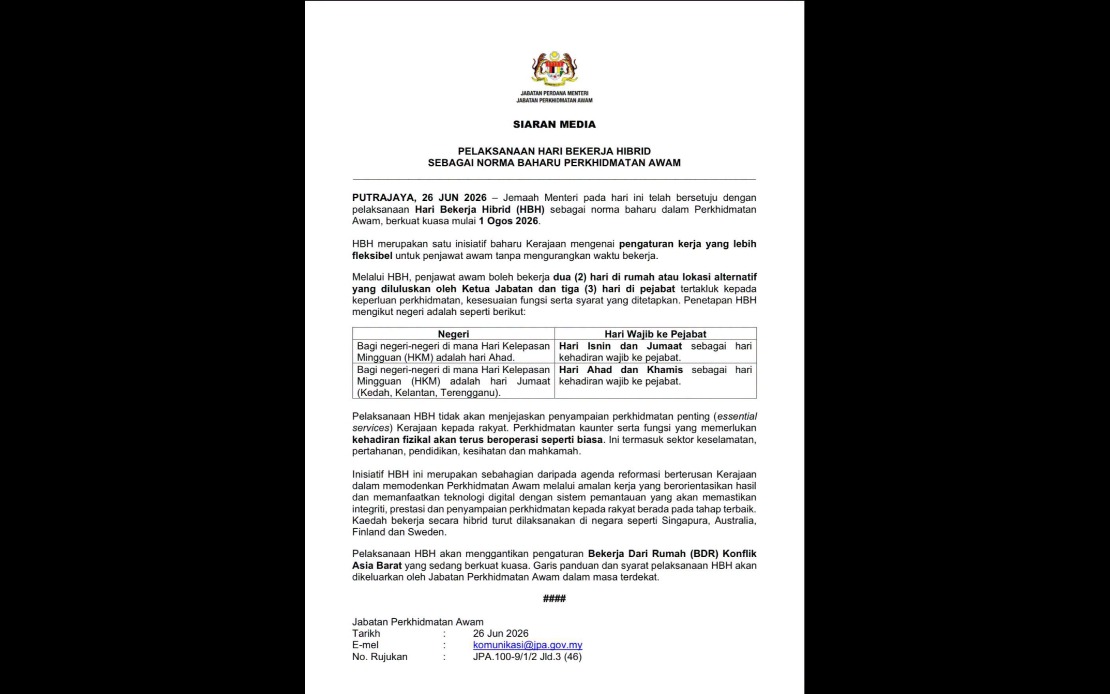
Malaysia's Cabinet has formally approved a shift toward hybrid working arrangements across the civil service, marking a significant departure from pandemic-era work practices. The Public Service Department announced the decision on June 26, confirming that the new Hybrid Work Day framework will take effect on August 1. This development represents a calculated middle ground between the remote work flexibility that became widespread during Covid-19 lockdowns and the traditional five-day office requirement that preceded them.
Under the new structure, civil servants nationwide will spend two days working remotely—either from home or at an alternative location designated by their departmental head—while committing the remaining three working days to office-based duties. The arrangement applies broadly across government departments, though the Public Service Department has carefully calibrated the policy to account for varying job functions and sectoral requirements. Critically, the framework carries the caveat that implementation must align with established service requirements and functional suitability assessments, meaning not all positions will necessarily qualify for the full two-day remote allowance.
The transition will formally retire the existing Work From Home arrangement that has governed remote work practices in recent years. Officials framed this evolution as part of a modernisation agenda designed to enhance operational efficiency rather than simply maintain pandemic-era concessions. The government emphasises that the hybrid model introduces greater flexibility without reducing total working hours, suggesting that the shift aims to preserve productivity while acknowledging changing workplace expectations among government employees. This framing may prove important for public perception, given ongoing scrutiny of civil service efficiency and public spending.
Geographic variations in Malaysia's religious observances have necessitated careful scheduling provisions within the hybrid framework. States that observe Sunday as their weekly rest day—the majority of Malaysia—will have Monday and Friday designated as mandatory office attendance days, with the flexible work window opening on other weekdays. By contrast, the three states of Kedah, Kelantan, and Terengganu, which observe Friday as their weekly holiday, will have Sunday and Thursday locked as compulsory office days. These specifications underscore the complexity of implementing nationwide policies within Malaysia's decentralised federal structure.
The Public Service Department has explicitly assured that essential public services will sustain full operational capacity despite the implementation of hybrid arrangements. Counter services, security functions, defence operations, educational institutions, healthcare facilities, and judicial offices will continue maintaining their present staffing patterns and physical presence requirements. This safeguard reflects government acknowledgment that certain government functions—particularly those involving direct citizen interaction or national security—cannot operate effectively through remote arrangements. The distinction between support functions that can accommodate hybrid work and frontline services that cannot demonstrates nuanced policy design.
The initiative represents a calculated response to evolving global workplace norms and domestic workforce expectations. The Public Service Department cited examples from developed economies including Singapore, Australia, Finland, and Sweden as evidence of international validation for hybrid models. By anchoring the policy within a broader international context, Malaysian officials have positioned the reform as aligned with modern work practices rather than as a purely domestic concession. This framing may assist in managing potential criticism from those who view remote work sceptically or who question whether government productivity has been affected by post-pandemic flexibility measures.
The hybrid framework explicitly incorporates monitoring mechanisms designed to maintain performance standards and service delivery benchmarks. The Public Service Department indicated that surveillance systems will track both individual and departmental-level metrics to ensure that the flexibility granted does not translate into diminished output or accountability. This emphasis on measurement and oversight suggests that the government views hybrid working as contingent upon demonstrated sustained performance, with implied risk that the arrangement could be restricted if monitoring reveals problematic trends.
Implementation will occur through detailed guidelines that the Public Service Department has committed to releasing in the coming weeks. These operational specifications will clarify which job categories qualify for the full two-day remote allowance, how departments should assign specific remote work days, and what technical infrastructure or approval procedures will apply. The staggered timeline between today's Cabinet announcement and the August 1 implementation date—roughly five weeks—provides civil service managers with adequate transition time to adjust scheduling systems, audit departmental role requirements, and communicate protocols to affected staff.
For Malaysia's broader civil service workforce, the policy carries substantial implications for work-life balance and commuting pressures. Government employees in major metropolitan areas like Kuala Lumpur and Selangor stand to benefit significantly from two days weekly avoiding rush-hour commutes and expensive parking arrangements. However, the policy's effectiveness in delivering promised flexibility will depend substantially on departmental implementation quality and whether managers genuinely embrace the hybrid model or instead create informal pressures for office attendance on nominally remote days. In contexts where workplace culture emphasizes visible presence as a proxy for commitment, the policy's stated flexibility may prove more theoretical than practical.
The decision also carries implications for Malaysia's wider economic and property landscape. Reduced daily office occupancy will likely affect central business district traffic patterns, parking demand, and consumption at office-proximate restaurants and retail establishments. Conversely, suburban residential areas may experience increased daytime economic activity as workers operating remotely contribute to local service industries. Real estate developers and commercial property owners will need to reassess assumptions about sustained demand for premium office space, particularly as flexible working models potentially reduce employer appetite for large centralized headquarters.
The reform sits within a stated broader public service modernisation agenda that the government claims prioritises results-based accountability and digital technology integration. By implementing hybrid arrangements while simultaneously emphasising performance monitoring, Malaysian officials are attempting to construct a model where flexibility operates within a framework of robust measurement and accountability. Whether this balance ultimately proves achievable remains to be demonstrated, but the approach reflects recognition that contemporary government workforces expect modern working conditions while taxpayers demand undiminished service quality and operational efficiency.
The August 1 implementation date marks a formal acknowledgment that pandemic-era workplace disruptions have catalysed lasting changes in how organisations structure work. For Malaysia's civil service, the hybrid model represents neither a wholesale return to pre-pandemic arrangements nor an indefinite continuation of maximum flexibility, but rather an attempt at establishing a sustainable middle ground. The policy's ultimate success will ultimately hinge on whether the monitoring mechanisms deliver genuine transparency about performance outcomes, whether departmental leaders genuinely respect the flexibility framework, and whether public service delivery standards remain uncompromised by reduced office presence.

