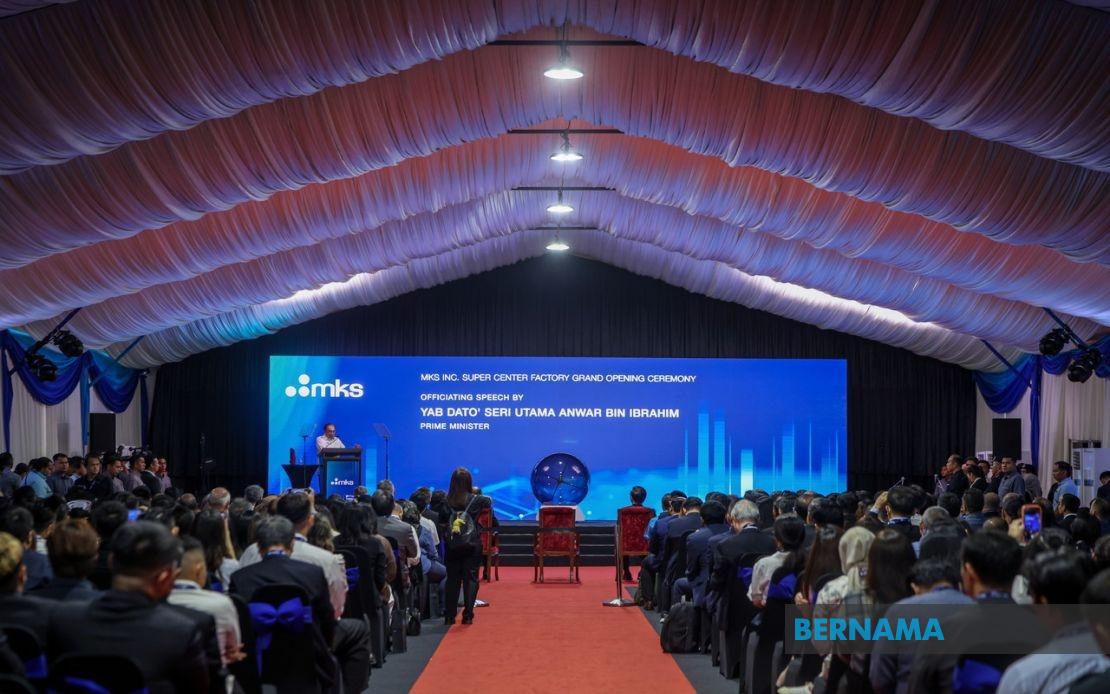
Prime Minister Datuk Seri Anwar Ibrahim has articulated Malaysia's strategic positioning as a decisive advantage in an increasingly fractured global order, arguing that the nation's ability to maintain independent relations across competing power blocs has translated directly into tangible commercial gains. Speaking at the MKS Super Centre factory opening in Bandar Cassia Technology Park in Batu Kawan, Anwar underscored how Malaysia's refusal to align rigidly with any single geopolitical bloc has enhanced international confidence in the country and opened fresh avenues for economic cooperation.
The Prime Minister's remarks reflect a carefully calibrated diplomatic doctrine that has become central to Malaysia's foreign and trade policy under his administration. Rather than viewing geopolitical competition as a constraint, the government has repositioned Malaysia's historical non-aligned tradition as a competitive asset in attracting investment and securing business deals from nations across ideological and strategic divides. This approach acknowledges the reality that major economies—whether the United States, China, India, or Russia—continue to seek reliable commercial and diplomatic partners despite broader strategic rivalries.
Anwar highlighted the practical manifestations of this strategy by referencing high-level engagements with diverse leaders, including former United States President Donald Trump during his visit to Malaysia last year, alongside deepening cooperation with China and India. More recently, expanding relations with Russia have further demonstrated Malaysia's commitment to maintaining channels with nations facing international isolation or sanctions. Each of these relationships has generated specific economic dividends, though the Prime Minister particularly emphasised the significance of Petronas's latest agreement in Turkmenistan as evidence that Malaysia's neutral posture directly enables national champions to secure resource partnerships that might be unavailable to countries perceived as hostile to rival blocs.
The Petronas deal represents more than a routine commercial transaction; it symbolises how Malaysia's refusal to impose ideological litmus tests on business partners allows the state-owned energy corporation to operate in jurisdictions and negotiate with counterparts that Western-aligned nations might hesitate to approach. For a country whose economy depends substantially on energy exports and investment in hydrocarbon exploration, maintaining open commercial relationships across geopolitical lines has direct implications for national revenue streams and employment. The Turkmenistan agreement signals that Malaysia remains a preferred partner for Central Asian energy suppliers seeking outlets that are not subject to external diplomatic pressure.
Anwar's framing of Malaysia's position as one of "centrality" is deliberate and strategically significant. Rather than describing the country as peripheral or forced to choose sides, the Prime Minister presents Malaysia as occupying a unique hub-like status in global commerce and diplomacy. This framing resonates with Malaysian audiences and international investors because it suggests that the country's geographic location in Southeast Asia, combined with its political stability and economic sophistication, makes it an indispensable venue for cross-bloc engagement. When competing powers view Malaysia as neutral ground for business, they are more inclined to offer favourable terms and to channel investment through Malaysian entities.
The event in Penang, attended by Chief Minister Chow Kon Yeow and Deputy Minister of Investment, Trade and Industry Sim Tze Tzin, underscores the government's effort to translate diplomatic strategy into visible economic development. The MKS Super Centre, a manufacturing facility, exemplifies the kind of foreign and domestic investment that Malaysia's neutral posture is intended to attract. Companies looking to position themselves in Southeast Asia without risking entanglement in US-China tensions or other geopolitical disputes find Malaysia an appealing location precisely because the government has explicitly committed to welcoming investors from all nations.
Anwar's articulation of Malaysia's willingness to "express our position on more contentious issues affecting the world" while simultaneously welcoming participation from all parties represents a nuanced diplomatic stance. This suggests that Malaysia reserves the right to speak on international concerns—whether human rights, regional security, or environmental matters—without allowing such positions to foreclose relationships or economic opportunities with nations that may disagree. The formulation provides political cover for addressing domestic constituencies concerned about ethical foreign policy while maintaining the commercial relationships that drive economic growth.
For Southeast Asia more broadly, Malaysia's model offers a template that other regional nations are monitoring closely. As great power competition intensifies and countries face mounting pressure to choose sides, Malaysia's demonstrated ability to derive economic benefit from neutrality provides a counterweight to arguments that alignment is inevitable. The success of this approach depends critically on maintaining credibility—Malaysia must be perceived as genuinely independent rather than as a proxy for any major power. Anwar's emphasis on Malaysia's engagement with diverse partners appears designed to reinforce this perception.
The Prime Minister's comments also implicitly acknowledge that Malaysia's strategic value resides partly in what it is not. Malaysia is not a frontline state in any major geopolitical conflict; it is not perceived as threatening to any major power's core interests; and its government maintains sufficient internal stability that international partners can reliably execute long-term commercial agreements. These characteristics, combined with the nation's developed infrastructure, skilled workforce, and regulatory frameworks, make Malaysia an attractive destination for businesses seeking to hedge geopolitical risk through diversified supply chains and investment portfolios.
Looking forward, Anwar's repeated emphasis on neutrality and balanced engagement suggests that Malaysia intends to double down on this strategic positioning even as global polarisation intensifies. The government appears confident that the international business community will continue rewarding countries that refuse to impose ideological constraints on commerce. Whether this approach remains viable if great power competition escalates into direct conflict, or if major powers begin demanding that smaller nations choose explicit sides, remains an open question. For now, however, Malaysia's leadership is betting that neutrality remains not only a moral or diplomatic principle but a sound economic strategy.

