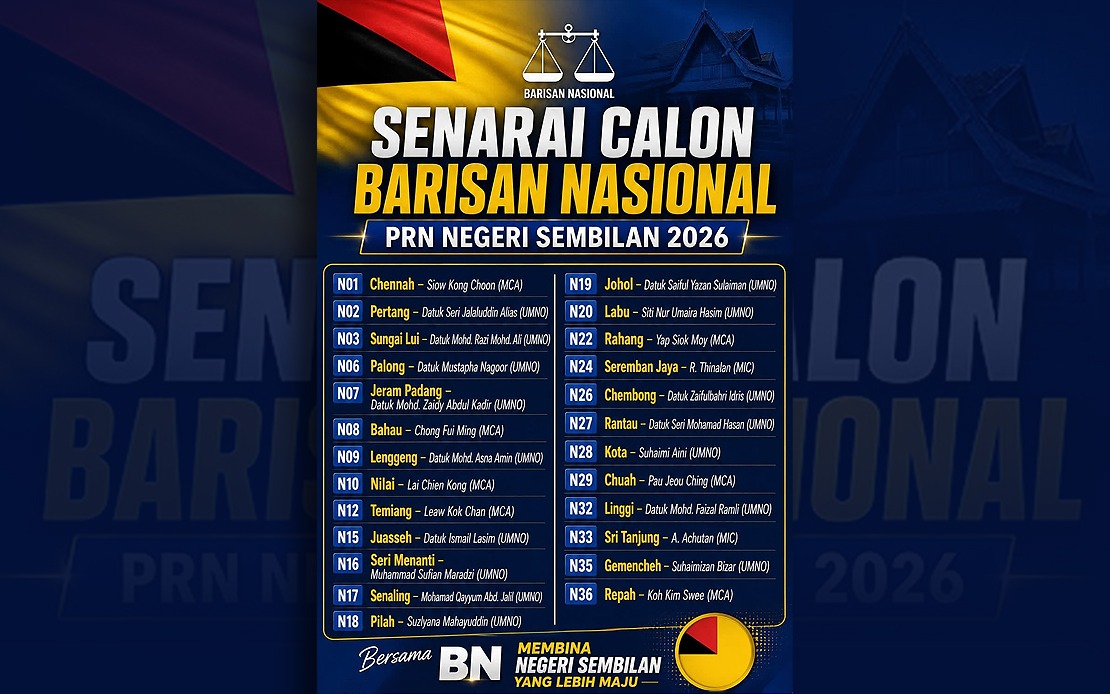
Barisan Nasional is fielding a combined 11 candidates from its Chinese and Indian component parties in the Negeri Sembilan state election, with MCA contesting seven seats and MIC four seats, according to BN chairman Datuk Seri Dr Ahmad Zahid Hamidi. The allocation reflects the coalition's continued reliance on its traditional ethnic-based party structure, with seat distributions determined through an assessment of individual candidate performance potential in their respective constituencies. Ahmad Zahid, who doubles as Deputy Prime Minister, oversaw the candidate vetting process and secured written commitments and personal pledges of allegiance from all prospective contenders at a meeting held in Seremban.
The seat allocation methodology, while standard practice across Malaysian electoral contests, underscores the mechanics of BN's power-sharing arrangements among its constituent parties. Rather than employing a uniform nationwide formula, the coalition conducts constituency-level analysis to determine which candidates possess the strongest likelihood of securing victory. This targeted approach has become increasingly important given the competitive nature of contemporary Malaysian state politics, where marginal constituencies can determine overall election outcomes. Ahmad Zahid's emphasis on candidate vetting reflects growing pressure within BN to field only those contenders with genuine electoral credibility, a response to previous electoral setbacks where weak candidates undermined coalition performance.
The Negeri Sembilan election represents a significant test for the BN-led federal government under Prime Minister Datuk Seri Anwar Ibrahim. The coalition suffered a considerable defeat in the previous 15th state election, winning only 14 of 36 seats while Pakatan Harapan secured 17 and Perikatan Nasional captured five. This outcome left Negeri Sembilan as a state where BN's traditional dominance has been substantially eroded, with the opposition controlling the state government. A substantial recovery in the forthcoming poll would provide momentum ahead of potential federal elections and demonstrate that the coalition has arrested its declining electoral fortunes.
The participation of MCA and MIC in this election highlights the ongoing structural importance of these parties within BN's electoral architecture, despite their reduced electoral representation in recent years. MCA, traditionally the coalition's second-largest component, continues to field candidates in significant numbers, while MIC's allocation of four seats reflects the party's continuing but more limited electoral footprint. Both parties have faced sustained internal challenges and declining membership, yet remain integral to BN's outreach strategy among non-Malay-Muslim communities. Their presence in the Negeri Sembilan contest signals BN's commitment to maintaining a multi-ethnic coalition structure, even as the political landscape has shifted toward more ethno-religious polarization.
The nomination process is proceeding on schedule following the Election Commission's timeline, with nomination day set for July 18. Early voting is scheduled for July 28, permitting those unable to vote on polling day to cast their ballots in advance. The main polling day on August 1 will determine control of the state assembly, with all 36 seats contested. This compressed election calendar typical of Malaysian state polls means campaigns operate at intensity, with candidate announcements typically generating immediate media focus and public discussion. Ahmad Zahid's scheduled presentation of the full BN slate at Stadium Tuanku Abdul Rahman Paroi represents the formal launch of the coalition's Negeri Sembilan campaign.
The election carries implications extending beyond Negeri Sembilan's state politics, functioning as a barometer for federal-level coalition dynamics. A strong BN performance would validate the current leadership structure and seat-sharing arrangements, while a disappointing result could prompt internal recriminations and demands for formula adjustments. MCA and MIC, in particular, will scrutinize their electoral performance relative to seat allocations, potentially using results to argue for enhanced positioning in future contests. For voters in the state, the election offers an opportunity to evaluate state government performance under Pakatan Harapan, weigh the opposition's track record against BN's promises, and consider whether Perikatan Nasional can consolidate or expand its recent electoral gains.
The transition of competitive electoral dynamics within Negeri Sembilan reflects broader Southeast Asian trends toward more fluid coalition politics and reduced dominant-party hegemony. States and regions that once represented safe electoral strongholds now exhibit genuine electoral competition, forcing established parties to invest resources, campaign intelligently, and field stronger candidates. For Malaysia, this pattern has manifested across multiple state-level contests over the past five years, gradually reshaping the political map. Negeri Sembilan exemplifies this transformation, as what was once considered a bastion of BN support is now genuinely contested terrain.
The Barisan Nasional's decision to emphasize candidate quality in the Negeri Sembilan selection process suggests organizational lessons drawn from previous electoral disappointments. Rather than automatically nominating party loyalists or candidates lacking genuine prospects, the coalition has implemented more rigorous assessment criteria. This shift, while overdue, indicates adaptation to electoral realities where voter preferences have become less predictable and traditional party loyalty carries less weight. For MCA and MIC specifically, fielding viable candidates represents essential validation of their continuing relevance within the coalition and their ability to mobilize their respective communities.
The forthcoming Negeri Sembilan election will be closely monitored by political analysts, journalists, and stakeholders across Malaysia and Southeast Asia as an indicator of contemporary coalition politics in action. The contest will test whether traditional multi-ethnic coalition arrangements remain electorally viable in increasingly polarized political environments, whether younger voters continue supporting established parties, and whether development performance translates into electoral support. Results will likely inform strategy adjustments for both BN and opposition coalitions ahead of the next federal election cycle, making this state poll substantially more significant than isolated regional contests.

