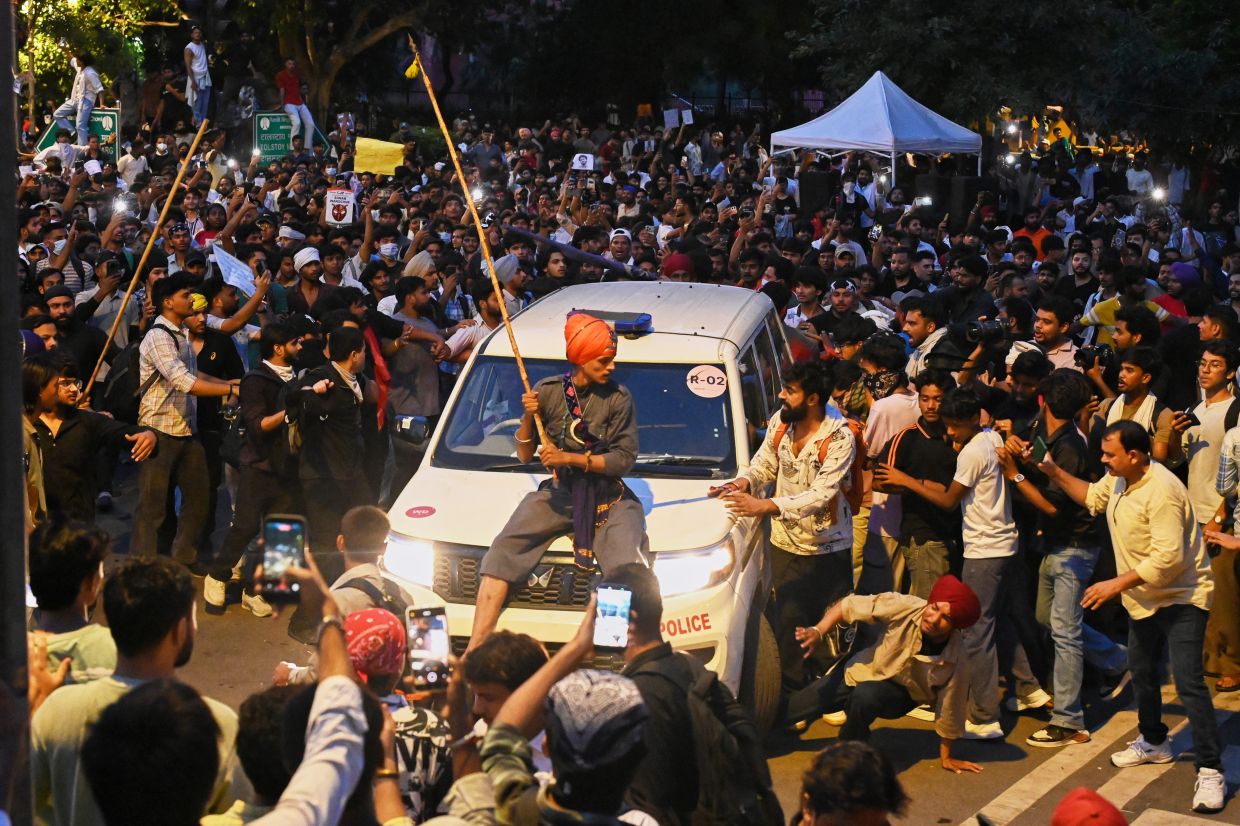
Prime Minister Narendra Modi broke his silence on India's student-led unrest on Thursday, pledging "stringent punishment" for those involved in widespread exam fraud that has sparked some of the most significant protests challenging his government since his third-term election in 2024. His remarks came as a direct acknowledgement of the mounting pressure from demonstrations that have swept across major Indian cities, with the capital New Delhi emerging as the epicentre of youth anger over systemic failures in the national examination system.
Thousands of protesters converged on New Delhi on Wednesday under the banner of the Cockroach Janta Party (CJP), a social media-driven movement that has evolved from satirical origins into a broad-based coalition demanding accountability in education. The rally descended into violent confrontations with police, resulting in late-night clashes at Jantar Mantar and prompting internet shutdowns across parts of the capital. According to police reports, at least 178 people, including security personnel, sustained injuries in the escalating violence, underscoring the intensity of public frustration with the government's handling of the crisis.
The examination fraud controversy erupted when multiple high-profile breaches compromised the integrity of India's most critical entrance examinations. A leaked medical entrance question paper forced over two million candidates to retake the test at considerable personal and financial cost, while disputes surrounding the digital marking of nearly two million high school examination scripts have compounded public distrust in the testing apparatus. These cascading failures have crystallized broader concerns among young Indians about the credibility of meritocratic pathways and the government's capacity to safeguard educational standards.
Modi sought to demonstrate responsiveness by announcing plans to establish fast-track courts specifically tasked with prosecuting those implicated in question paper leaks and related examination fraud. "Nothing is more important than the welfare and future of our youth," he stated in a social media post, attempting to reframe the crisis narrative and position his administration as protective of student interests. However, the apparent contradiction between such reassurances and the violent police response to peaceful assemblies on Monday, which featured tear gas and baton charges as demonstrators sought to march to parliament, has only deepened skepticism about the government's commitment to genuine reform.
The CJP movement itself represents a fascinating evolution in Indian political activism. Originating in May as a satirical reaction to Chief Justice Surya Kant's remarks comparing young people to "cockroaches" and "parasites" during court proceedings, the organization has successfully leveraged social media platforms to mobilize millions of followers. What began as irreverent commentary on judicial overreach has matured into a comprehensive critique of governance failures, encompassing unemployment, lack of economic opportunities for youth, and what adherents characterize as increasingly authoritarian governance under Modi's leadership.
Opposition parties have seized upon the examination fraud scandal as a vehicle for broader political challenges to the ruling coalition. Congress party leader Rahul Gandhi has directly attributed responsibility to Modi for permitting "the total capture and destruction of our education system" and for protecting officials complicit in systemic corruption. Such interventions have transformed what might have remained a sectoral grievance into a full-scale political confrontation, with opposition MPs disrupting parliamentary proceedings and demanding an apology from the Prime Minister for Monday's security response.
The geographic spread of dissent underscores the depth of nationwide frustration. Demonstrations have erupted beyond Delhi in major metropolitan centres including Mumbai, Bengaluru, and Patna, indicating that examination fraud concerns transcend regional boundaries and reflect genuine anxiety about educational quality and opportunity distribution across the Indian subcontinent. The decentralized nature of the protest movement, coordinated primarily through social media networks rather than traditional institutional structures, presents novel governance challenges for authorities accustomed to managing opposition through conventional political channels.
Regional developments amplify the significance of India's youth unrest. In neighbouring Bangladesh, students have organized solidarity actions, with a planned torch rally scheduled for Thursday evening to demonstrate support for their Indian counterparts. This cross-border solidarity gains particular resonance given Bangladesh's recent experience, where youth-led protests in 2024 successfully toppled the government of Sheikh Hasina and precipitated her removal from office. The invocation of the Bangladesh precedent carries implicit warning for Indian policymakers about the transformative potential of sustained student mobilization when institutional grievances intersect with broader dissatisfaction regarding governance and opportunity.
The examination fraud crisis reveals deeper structural vulnerabilities within India's educational administration. The sheer scale of affected candidates—millions across multiple examination cycles—suggests that these breaches represent not isolated security lapses but rather symptomatic failures of institutional oversight and quality assurance mechanisms. For Malaysian observers monitoring regional educational governance, the Indian situation illustrates the critical importance of maintaining robust examination security protocols and public confidence in meritocratic selection processes, particularly as Southeast Asian nations increasingly compete within a globalized knowledge economy.
Modi's initial response attempting to project decisiveness through punitive measures may prove insufficient to address the underlying legitimacy crisis. The apparent disconnect between his promises of justice and the aggressive security response that preceded his statement risks reinforcing narratives about the government prioritizing order over genuine accountability. The movement's continued expansion and the involvement of opposition parties suggest that examination fraud has catalyzed a more fundamental reckoning with questions of governance quality, institutional integrity, and the government's responsiveness to youth concerns—issues that will likely persist beyond whatever legal consequences befall individual wrongdoers.

