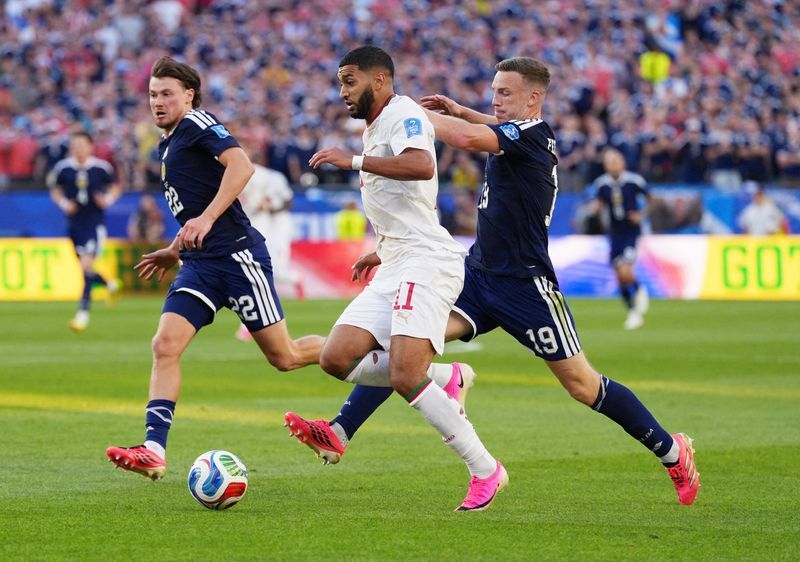
Morocco's ruthless opening strike set the tone for a thoroughly dominant display against Scotland on Friday evening, with the North Africans securing a 1-0 triumph that places them at the summit of Group C with one match still to come. The quickest goal of the tournament—struck by Ismael Saibari after just 71 seconds—proved decisive in a match where the final scoreline barely captured the gulf in class between the two sides.
Scotland arrived in Massachusetts riding high following their historic 1-0 breakthrough against Haiti in their opening fixture, marking their first World Cup victory in more than three and a half decades. That confidence, however, evaporated almost immediately when Saibari collected a Brahim Diaz cross after Scotland's central defender Grant Hanley ventured too far forward, leaving the Moroccan attacker with a simple finish that would become the earliest goal of this tournament. The strike exposed fundamental defensive vulnerabilities that Scotland struggled to rectify throughout the subsequent ninety minutes of play.
With four points accumulated from their opening two contests, Morocco have positioned themselves favourably ahead of their Wednesday encounter with Haiti, while Scotland's three-point tally leaves them needing a positive result when they face five-time champions Brazil on the tournament's final group-stage day. The mathematical reality of qualification—with the top two teams in each group earning automatic progression to the knockout round, supplemented by the eight strongest third-placed finishers—means Scotland retain realistic hopes despite this setback, though their task has become considerably more demanding.
The Moroccans, who remarkably reached the semi-finals in Qatar four years ago, demonstrated precisely why they are considered genuine contenders in this competition. Beyond Saibari's clinical finishing, the team's overall approach was characterised by intelligent pressing, swift transitions, and an ability to consistently penetrate Scotland's defensive structure. While another goalmaking opportunity materialised when Azzedine Ounahi cut the ball back from the left flank, with two Moroccan players unable to convert the resulting chance, the frequency of Morocco's chances underscored their comprehensive superiority.
Saibari's performance added another compelling subplot to the match. The player not only scored in Morocco's earlier 1-1 draw against Brazil but has since undergone medical examinations ahead of a reported transfer to Bayern Munich, one of Europe's elite institutions. His emergence as a two-goal contributor in two consecutive appearances has positioned him alongside Egypt's Mohamed Salah as only the second African player to achieve such a feat in the tournament's history, a distinction that reflects both the player's individual talent and Morocco's broader attacking capabilities.
The evening proved considerably more testing for Scotland, who managed not a single shot—on or off target—until well into the first-half stoppage period, a statistic that vividly illustrates their defensive preoccupation and lack of attacking incisiveness. The Scottish midfield and forwards found themselves constantly on the back foot, scrambling to regain possession rather than dictate play, with Bilal El Khannouss particularly troublesome, firing over the bar following another flowing Moroccan attack in the 36th minute.
Scotland's predicament intensified after the interval, with the team facing a barrage of Moroccan pressure that rarely abated. Saibari threatened the woodwork with a deflected effort, while El Khannouss generated a crucial save from Scotland goalkeeper Angus Gunn following a glancing header. Despite late pressing by the Scots, who sensed the urgency of their situation, they could manufacture no equalising moment and departed the field comprehensively beaten.
The broader context of this Group C battle carries significance extending beyond immediate qualification mathematics. Morocco's semi-final appearance in Qatar established them as a genuine regional powerhouse, and their performance here suggests that showing was no anomaly. For Scotland, the loss represents a sharp reality check after their emotional breakthrough against Haiti, forcing them to confront uncomfortable truths about their current standing relative to established contenders.
One complicating factor throughout Friday's contest was the contentious backdrop involving Morocco captain Achraf Hakimi, who faced booing from sections of the Scottish support amid his involvement in an ongoing rape trial. The captain, nonetheless, carried himself professionally throughout the evening, though such distractions underscore the complex circumstances surrounding modern international football.
Looking ahead, Morocco's clash with Haiti provides an opportunity to further solidify their position, potentially securing progression regardless of Brazil's result. Scotland's encounter with the five-time champions will likely prove decisive, and their ability to regroup psychologically following this disappointment may well determine their tournament trajectory. For Malaysian and Southeast Asian observers, Morocco's resurgence and Scotland's struggles offer a reminder that established football hierarchies continue to shift, with smaller nations demonstrating growing capacity to compete at the highest level.

