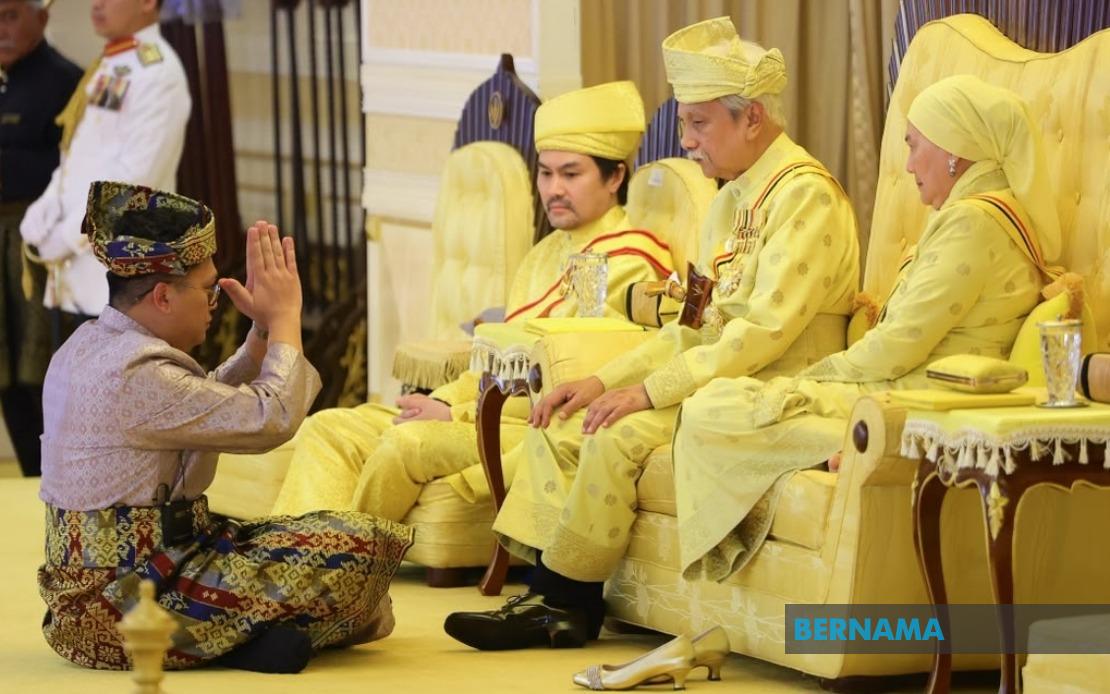
Yang Dipertuan Besar of Negeri Sembilan, Tuanku Muhriz Tuanku Munawir, has formally inaugurated Muhammad Faris Johari into his historic role as the 11th Undang of Luak Sungei Ujong during an elaborate ceremonial occasion held at Istana Besar Seri Menanti in Kuala Pilah. The appointment marks a significant moment in the state's hierarchical customary governance structure, where the Undang serves as the paramount chief overseeing one of Negeri Sembilan's four traditional luaks, or divisions.
The installation proceedings followed customary protocol with considerable ceremonial gravity. Senior palace officials known as the Orang Empat Istana formally sought Tuanku Muhriz's approval before the rituals commenced, establishing the formal consent of the reigning monarch for the succession. Muhammad Faris then participated in the traditional pledge of fealty, publicly reaffirming his commitment to serve under the Yang Dipertuan Besar's authority whilst upholding the sultanate's constitutional position and cultural heritage.
Following these ritualistic preliminaries, Tuanku Muhriz officially proclaimed Muhammad Faris as the 11th Undang and bestowed upon him the hereditary title Datuk Klana Petra, a designation historically reserved for leaders of Sungei Ujong. This conferment of title carries profound symbolic weight within Negeri Sembilan's adat system, connecting the new chief to centuries of customary tradition and linking him to his predecessors in a direct genealogical and institutional lineage.
In his address to assembled dignitaries and state officials, the Yang Dipertuan Besar articulated his expectation that the solemn commitments made during the ceremony would be maintained with unwavering sincerity and intellectual honesty. He particularly emphasised the importance of personal accountability and ethical conduct, virtues he deemed essential for anyone entrusted with leadership responsibilities within the state's customary framework.
Tuanku Muhriz expanded his remarks to encompass the broader relationship between the hereditary rulers and the Orang Kaya, or traditional chieftains, who constitute the secondary tier of Negeri Sembilan's governance hierarchy. The Yang Dipertuan Besar enjoined these customary leaders to remain steadfastly devoted to his institution and to cultivate diplomatic protocols with both himself and the palace apparatus, underscoring the critical importance of institutional coherence.
The ruler further illuminated his vision for preserving Negeri Sembilan's unique constitutional and cultural identity, arguing that relationships grounded in reciprocal esteem, interpersonal trust, and collaborative decision-making represent the foundational pillars necessary for safeguarding the state's monarchical system. He situated this argument within the broader context of maintaining indigenous customary traditions and fostering the state's sustained prosperity and social cohesion.
Tuanku Muhriz appealed directly to the broader populace to engage constructively with customary leadership structures whilst simultaneously ensuring the perpetuation and safeguarding of Adat Perpatih, the matrilineal customary law system distinctive to Negeri Sembilan. This ancient legal and social framework, transmitted across generations through oral and institutional means, represents a living heritage requiring deliberate effort to preserve against modernisation pressures.
Muhammad Faris arrives at this position as a relatively young custodian of tradition. Born on October 30, 1997, he pursued formal tertiary education in commerce and accounting, graduating with a bachelor's degree from Universiti Teknologi MARA and subsequently completing the rigorous professional credentials offered by the Association of Chartered Certified Accountants in 2022. His wife is Sharifah Amirah Syed Ismail Ash-Shahab, establishing familial connections within the hereditary elite circles.
The twenty-eight-year-old's accession to the Undang position reflects a broader pattern observable across Malaysia's sultanate states, where younger, professionally qualified individuals are increasingly assuming customary leadership roles traditionally held by their predecessors. This generational transition raises intriguing questions about how contemporary educated leaders will navigate the balance between preserving ancestral institutions and adapting customary governance to evolving societal expectations.
The investiture ceremony encompassed attendance from prominent members of Negeri Sembilan's royal household, including Tunku Ampuan Besar Tuanku Aishah Rohani Tengku Besar Mahmud, Tunku Besar Seri Menanti Tunku Ali Redhauddin Tuanku Muhriz, and Tunku Panglima Besar Tunku Zain Al-'Abidin. State government leadership was represented by Menteri Besar Datuk Seri Aminuddin Harun alongside bureaucratic heads, reflecting the intertwining of hereditary and representative democratic structures that characterise Malaysia's constitutional arrangement.
The significance of this installation extends beyond ceremonial spectacle. It represents the practical continuity of Negeri Sembilan's distinctive customary governance model, which has survived modernisation and structural changes to Malaysia's political landscape since independence. The Undang system, rooted in pre-colonial political organisation, continues functioning as an administrative and cultural anchor.
A second formal audience was scheduled for later that same day to formalise the installation of the 22nd Undang of Luak Rembau, indicating that the state's succession processes were proceeding systematically through the established hierarchical apparatus. This dual ceremonial agenda underscores the ongoing vitality of Negeri Sembilan's adat governance institutions and the meticulous attention devoted to maintaining proper ceremonial observance.

