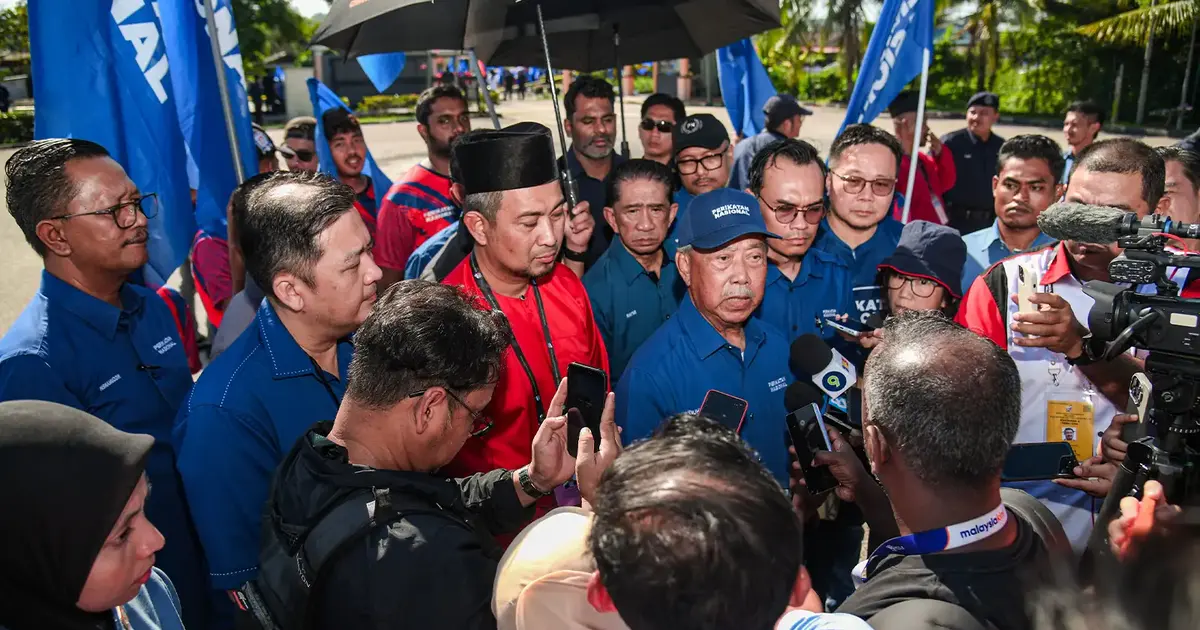
Perikatan Nasional possesses sufficient political leverage to establish control of state governments through strategic partnerships that extend beyond its formal coalition structure, according to Bersatu party president Muhyiddin Yassin. The statement reflects a broader coalition strategy aimed at consolidating power across Malaysia's territorial administration, particularly in states where neither PN nor its rivals command an outright majority in the state assembly.
Muhyiddin's confidence hinges on the existence of potential political allies willing to work alongside PN without formally joining the coalition framework. Among these external partners, the Malaysia United Democratic Alliance (Muda) has emerged as a significant potential collaborator. The inclusion of Muda represents a calculated broadening of PN's political reach, enabling the coalition to assemble viable governing majorities even in states where traditional support bases prove insufficient.
This approach underscores a fundamental shift in Malaysian coalition politics, where rigid formal membership gives way to flexible, issue-specific or state-level arrangements. Rather than demanding full integration into PN's ranks, prospective partners like Muda can maintain organisational independence while providing critical parliamentary support when needed. Such flexibility has become increasingly valuable in Malaysia's fragmented political landscape, where state-level arithmetic frequently diverges from national political patterns.
The strategic positioning of PN reflects lessons learned from Malaysia's recent electoral history. Following the 2022 general election and subsequent state-level contests, the coalition recognised that rigid coalition structures sometimes alienate potential partners or create unnecessary friction with regionally significant parties. By explicitly acknowledging that alliances need not require formal membership, Muhyiddin signals PN's willingness to negotiate pragmatically with parties that share particular policy objectives or regional interests.
For Malaysian readers and political observers, this development carries substantial implications for state governance outcomes across the federation. States where either Pakatan Harapan or PN currently governs face the possibility of political realignment if Muhyiddin's coalition can successfully recruit external partners. The flexibility of such arrangements means governments could prove more volatile, as external allies might withdraw support if their specific demands go unmet. Conversely, the expanded pool of potential partners increases PN's mathematical chances of forming administrations in states currently beyond its reach.
Muda's position as a potential external collaborator merits particular attention. The relatively new political party has cultivated an image as a non-traditional political force focused on specific demographic constituencies and policy areas. Its willingness to engage with PN through partnership agreements rather than coalition membership could provide both entities with mutual benefits—PN gains parliamentary numbers while Muda preserves institutional identity and negotiating leverage over specific ministerial portfolios or policy implementation.
The regional dimension adds another layer of complexity to PN's coalition strategy. Southeast Asia's political landscape includes several nations where similar coalitional arrangements have proven effective or problematic. Thailand's experience with shifting legislative alliances offers cautionary examples of how fluid political partnerships can undermine governmental stability. Malaysia's coalition politics, however, operates within a constitutional framework more amenable to minority governments and parliamentary nuance than some regional counterparts.
For the opposition Pakatan Harapan coalition, Muhyiddin's statements represent both strategic opportunity and challenge. If PN successfully attracts external partners and consolidates state-level control, PAH must develop counter-strategies to protect or recover support in contested constituencies. The existence of available alliance partners beyond formal coalition membership means even states with fractious voting patterns might still result in PN-led administrations rather than hung state assemblies requiring fresh elections.
Muhyiddin's confidence merits careful interpretation within Malaysia's current political context. The statement functions simultaneously as genuine strategic assessment and coalition messaging designed to project strength and inevitability. By publicly identifying specific allies like Muda, Muhyiddin effectively demonstrates that PN possesses concrete pathways to power beyond its formal membership. This confidence-building exercise serves important functions for internal coalition cohesion and external partner recruitment.
The practical application of such arrangements will ultimately determine their political durability. State governments formed through external partnerships require ongoing negotiation and compromise, particularly regarding budget allocations, ministerial appointments, and policy priorities. States where PN governs with support from non-coalition members may experience different governance dynamics compared to states with single-party or fully integrated coalition majorities.
Looking forward, Malaysian state politics will increasingly reflect these flexible partnership models. The explicit acknowledgment that viable governing coalitions need not require formal structural unity represents a maturation of Malaysia's coalition politics beyond the binary choice between comprehensive political partnerships and electoral competition. This evolution creates new possibilities for both governing and opposition coalitions, though it simultaneously introduces novel uncertainties regarding governmental stability and long-term policy consistency across Malaysia's federal states.

