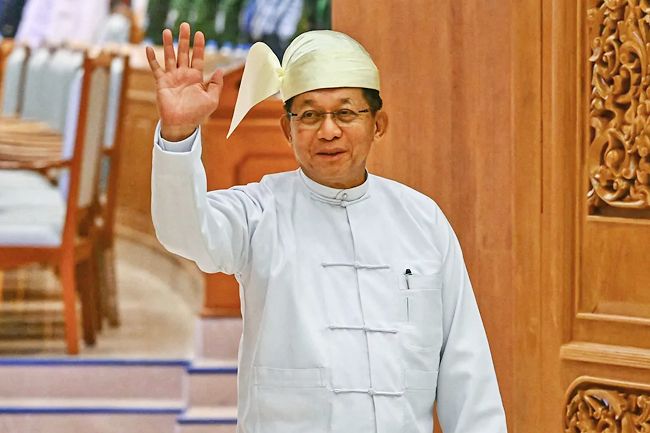
Myanmar's military leader Min Aung Hlaing is scheduled to hold talks with Thai Prime Minister Anutin Charnvirakul during a visit to Bangkok on August 6 and 7, Thailand's Foreign Minister Sihasak Phuangketkeow confirmed on Tuesday. The planned engagement comes as Bangkok continues its diplomatic push to reintegrate Myanmar into the Association of Southeast Asian Nations, a position that has generated considerable friction within the regional bloc since the junta's 2021 coup dismantled the country's democracy and ousted Aung San Suu Kyi's elected government.
Sihasak made the announcement after participating in discussions with fellow ASEAN foreign ministers in Manila, where he characterised the bloc's internal deliberations as unusually frank. The conversation reflected growing tensions over how the ten-member organisation should respond to Myanmar's ongoing political crisis and its international isolation. Despite Myanmar technically remaining an ASEAN member state, it has been formally barred from attending the bloc's high-level meetings for nearly three years, a diplomatic limbo that underscores the severity of the Myanmar question within the regional grouping.
Thailand's position on Myanmar reintegration stands apart from several other ASEAN members, shaped by its unique geopolitical circumstances. As the nation sharing the longest border with Myanmar and hosting several million refugees from the conflict, Bangkok has compelling strategic and humanitarian reasons to seek a normalisation of relations. Thailand's advocacy for bringing Myanmar back into ASEAN's formal processes has exposed deep divisions within the organisation, with some members viewing the move as premature accommodation of a military regime that seized power through violence.
The upcoming bilateral visit represents part of what Thailand describes as a "dual-track approach" to the Myanmar question. Sihasak explained that Bangkok intends to address immediate practical concerns that directly affect Thailand's national interests, including transnational crime, illegal scamming operations originating from Myanmar, and drug trafficking across shared borders. These issues have become increasingly urgent as organised criminal networks exploit Myanmar's state collapse and weak governance to expand illicit operations throughout Southeast Asia, creating spillover security challenges for neighbouring countries.
However, Thailand's diplomatic engagement also aims to maintain forward momentum on ASEAN's formal position toward Myanmar without abandoning the regional bloc's established five-point peace framework. This balancing act reflects Bangkok's effort to act as a bridge between ASEAN's hawks and doves while pursuing pragmatic bilateral interests. Sihasak acknowledged that measuring progress toward Myanmar's eventual reintegration requires realistic benchmarks rather than ambitious ideals, suggesting that incremental gains should be recognised as meaningful steps rather than waiting for comprehensive democratic transformation.
When ASEAN foreign ministers gathered in Bangkok with Myanmar's Foreign Minister Tin Maung Swe, Sihasak proposed concrete criteria for assessing progress toward normalisation. He suggested that allowing ASEAN's special envoy access to detained ousted leader Aung San Suu Kyi would constitute meaningful movement, as would any reduction in military violence particularly along the volatile Thai-Myanmar border where ongoing conflict has created humanitarian emergencies and refugee flows. These specific metrics represent a departure from the previous approach of demanding wholesale systemic change before considering reintegration.
Sihasak's comments underscore Thailand's recognition that Myanmar's military government shows no sign of abandoning power or returning to democratic governance, at least in any foreseeable timeframe. Rather than imposing unrealistic demands, Bangkok's strategy involves identifying achievable improvements that might gradually shift the trajectory of Myanmar's crisis while maintaining Myanmar's connection to ASEAN structures and regional diplomatic processes. This pragmatic approach assumes that complete isolation has failed to produce meaningful leverage over Myanmar's junta and that selective engagement might prove more effective.
The Thai foreign minister also suggested that Myanmar's recent elections, despite their heavily constrained nature and widespread recognition as non-credible, might create opportunities for expanded dialogue between the junta and Myanmar's armed ethnic minority groups and democratic opposition factions. He specifically noted that Thailand might facilitate discussions with ethnic armed organisations positioned along the Thai-Myanmar border, framing such mediation as foundational work that could eventually support broader national reconciliation processes. This represents an attempt to construct incremental progress through subnational engagement.
Parallel to bilateral Thai-Myanmar initiatives, the broader ASEAN bloc is contemplating institutional reforms to its Myanmar strategy. Philippine Foreign Minister Theresa Lazaro acknowledged that the current system of rotating the special envoy position annually has proven ineffective, creating continuity gaps that undermine diplomatic progress. The Philippines is now considering establishing a permanent, long-term envoy position dedicated specifically to Myanmar, recognising that sustained engagement with a complex crisis requires institutional consistency rather than annual changeovers.
The proposed permanent envoy position would represent a significant institutional shift within ASEAN, suggesting that the bloc is settling into a prolonged engagement with Myanmar's crisis rather than expecting near-term resolution. This acknowledgment of failure in the rotational system reflects broader frustration within ASEAN about the limited impact of its diplomatic efforts to date. A permanent envoy would provide continuity of relationship-building and strategic thinking across multiple annual cycles, potentially enhancing ASEAN's ability to identify and seise opportunities for progress.
For Malaysia and other Southeast Asian nations, Myanmar's status remains consequential given ongoing refugee flows, security challenges, and concerns about the country's potential destabilisation of regional stability. Thailand's approach of selective engagement while maintaining ASEAN coordination reflects broader regional interest in preventing Myanmar's complete collapse or transformation into a failed state hosting transnational criminal networks and radical groups. The upcoming Bangkok visit and broader diplomatic initiatives suggest that ASEAN is adopting a long-term strategy of incremental pressure combined with limited engagement, even as divisions persist about whether this approach represents pragmatism or premature accommodation.

