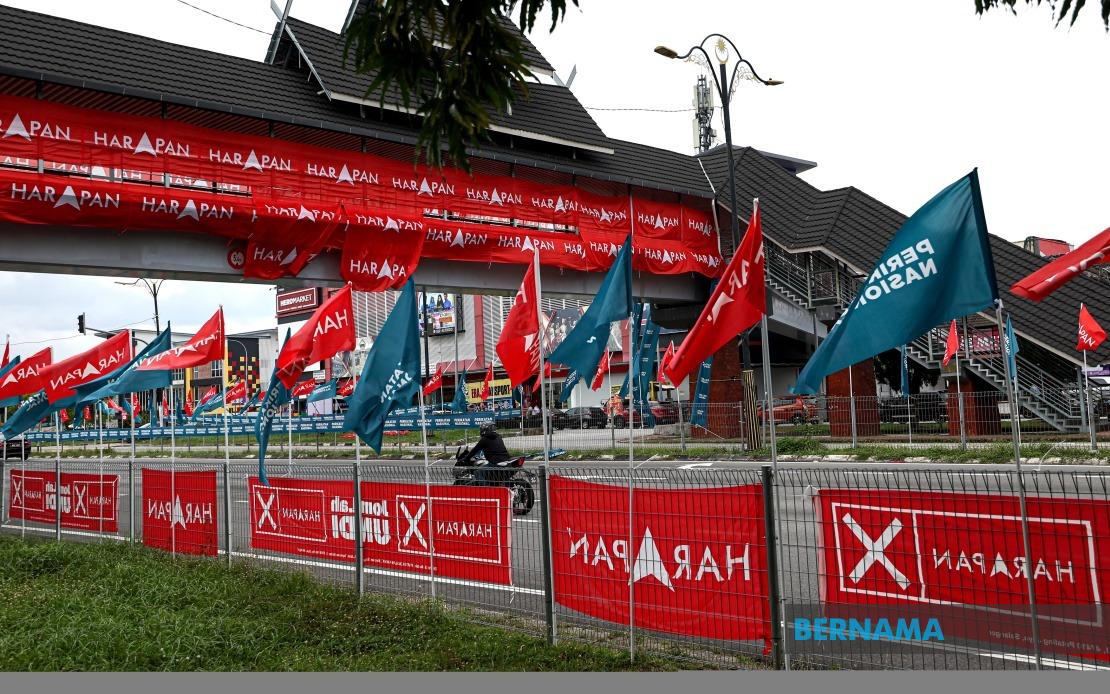
Political campaigns across Negeri Sembilan have operated at a measured tempo during their opening seven days, with major parties conserving energy ahead of what observers expect to be a more frenetic closing fortnight. The 16th Negeri Sembilan State Election, scheduled to conclude with voting on August 1, has thus far lacked the visual spectacle and organisational fervour that typically characterises the middle and final phases of Malaysian electoral contests. Flag displays, normally a barometer of campaign intensity, remain subdued and confined to conventional spots such as community centres, village lanes and major roads rather than commanding the full urban landscape.
Candidates across the coalition and independent camps have adhered to ground-level strategies centred on personal voter contact, with house visits and one-on-one conversations forming the backbone of their outreach. Religious congregations have also served as venues for candidate appearances, reflecting the cultural contours of political engagement in the state. Simultaneously, all camps recognise that digital channels now constitute an essential complement to traditional face-to-face campaigning, allowing contenders to maintain visibility and amplify messaging beyond the physical constraints of walking tours and public events. This hybrid approach mirrors broader shifts in how Malaysian voters encounter political messaging.
The involvement of national-level figures has thus far been selective rather than overwhelming. Prime Minister Datuk Seri Anwar Ibrahim, who leads Pakatan Harapan, has made two campaign visits to the state during the first week, underlining the coalition's determination to retain control of a state legislature it currently dominates. Deputy Prime Minister Datuk Seri Dr Ahmad Zahid Hamidi, representing Barisan Nasional, has stepped up his presence with three separate trips, signalling BN's intent to mount a credible challenge. These high-profile visits, however, remain episodic rather than continuous, suggesting that national leaders are calibrating their involvement to coincide with specific campaign moments rather than maintaining permanent on-the-ground positions.
Menteri Besar Datuk Seri Aminuddin Harun, who holds the Linggi seat and fronts the Pakatan Harapan slate, has framed the opening campaign phase as one focused on granular voter engagement through what campaign strategists term micro-campaigning. This technique emphasises conversations with small groups of constituents rather than large-scale public rallies, enabling candidates to address local concerns directly and tailor their messaging to specific community demographics. Aminuddin acknowledged that while Pakatan Harapan intends to ramp up efforts in the coming days, predicting seat counts remains premature given the volatile nature of mid-term electoral contests and the phenomenon of late-deciding voters.
Barisan Nasional's approach, articulated by deputy chairman Datuk Seri Mohamad Hasan, prioritises consolidating organisational strength across all contested seats. Hasan, himself defending the Rantau assembly position while serving as Foreign Minister, emphasised that BN campaign workers must maintain momentum through continuous grassroots engagement. This messaging suggests BN recognises that victory margins may depend less on dramatic campaign swings than on systematic voter mobilisation and the retention of support in constituencies where the coalition holds traditional advantages. BN's strategy appears calibrated toward efficiency and organisation rather than spectacle.
The Jelebu parliamentary region has emerged as a particular focus for BN operations, according to UMNO liaison chairman Datuk Seri Jalaluddin Alias, who is defending the Pertang seat. Candidate outreach efforts in this zone have reportedly gained momentum, with parties attempting to maximize their reach across dispersed voter populations. The concentration of campaign activity in specific regions reflects the traditional Malaysian approach to electoral competition, wherein certain constituencies are treated as more contested or more strategically valuable than others based on demographic composition and historical voting patterns.
Electoral trends are becoming discernible only now, according to Dr Mujibu Abd Muis, a political science lecturer at Universiti Teknologi MARA's Seremban campus. The contest has crystallised around a two-coalition confrontation between Pakatan Harapan and Barisan Nasional, with Perikatan Nasional still laboring to establish a coherent campaign narrative and voter base. Pakatan Harapan's deployment of targeted micro-campaigning strategies reflects its confidence in direct voter persuasion and its candidate roster. This tactical choice carries implications for how campaigns will evolve; rather than seeking to mobilise large crowds or dominate public space through symbol and spectacle, Pakatan Harapan is betting on the cumulative effect of multiple personalised voter interactions.
Dr Mujibu observes that voter behaviour has undergone measurable evolution, with electors increasingly evaluating candidates on the basis of personal visibility and demonstrated community engagement rather than rhetorical prowess or party affiliation alone. This transformation suggests that the personalisation of politics in Malaysia has reached a point where individual candidate performance and accessibility may outweigh institutional party loyalty. The implications for campaign strategy are profound; campaigns that neglect ground-level presence in favour of mediated messaging or that fail to present candidates as accessible and responsive risk losing ground to competitors who maintain robust local engagement.
The final campaign week, beginning after early voting takes place on July 28, typically becomes the period when undecided voters crystallise their preferences and fence-sitters commit to choices. Campaign dynamics during this closing phase often determine outcomes in marginal constituencies where vote margins are measured in hundreds rather than thousands. Political observers anticipate that once national party machinery shifts into higher gear and state leaders intensify their campaign schedules, the subdued opening phase will give way to more visible and energetic electoral competition.
The field encompasses 103 candidates competing for 36 state assembly seats, with Pakatan Harapan fielding the largest slate at 36 nominees, followed by Barisan Nasional with 25 candidates, Bersatu with 24 candidates, and Perikatan Nasional with 11 candidates. Smaller parties including Barisan Jemaah Islamiah Se-Malaysia, Parti Orang Asli Malaysia, and Parti Sosialis Malaysia have each fielded single candidates, while four independent contenders complete the roster. This distribution of candidates suggests that Pakatan Harapan, the incumbent, is fully contesting the state, while BN, PN and other parties have opted for more selective candidacy, concentrating resources on seats deemed winnable.
The election cycle itself remains compressed, with early voting scheduled for July 28 and polling day arriving just four days later on August 1. This compressed timeline limits the window for campaign evolution and may advantage parties with pre-existing organisational infrastructure and voter databases. For parties attempting to build momentum from a standing start, the tight schedule constrains the time available for persuasion and mobilisation. The intensity expected during the second and third weeks must therefore be sustained within a narrower overall campaign window than voters might experience in federal elections or other state contests.
Separating the second-week surge from early voting by only four days creates a dynamic wherein campaign climaxes relatively early, leaving minimal time for events subsequent to intense campaigning to reshape voter sentiment. This structure may favour candidates and parties that have already consolidated voting intentions among their base, as the rush to early voting stations and then to polling day itself leaves little opportunity for late-breaking events or revelations to alter outcomes. For Malaysian observers tracking this contest, the Negeri Sembilan election serves as a microcosm of contemporary electoral patterns, demonstrating how micro-targeted engagement, social media sophistication, and candidate-centric strategies are reshaping campaign mechanics in Malaysia's federal system.

