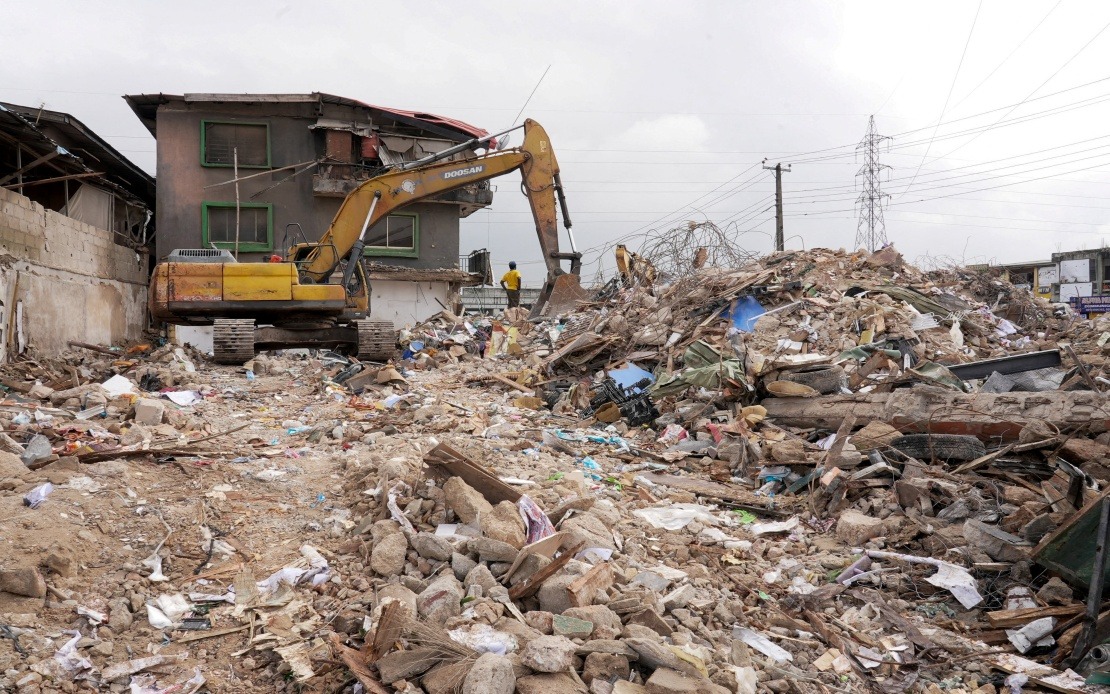
A three-storey shopping complex in Alakija, a rapidly developing town along the Lagos-Badagry Expressway in southwestern Nigeria, collapsed on Thursday morning, claiming nine lives and leaving 27 others injured in what authorities described as a harrowing rescue operation. Emergency responders completed their search-and-rescue efforts by Friday after working continuously through the night to extract survivors from beneath the rubble of the commercial building, which housed numerous retail vendors and attracted daily foot traffic from local shoppers.
The tragedy unfolded in the early hours of Thursday as business activities were just beginning at the shopping complex, meaning the structure held a considerable number of occupants when it gave way. Among those trapped were shop owners conducting their regular commerce, customers conducting transactions, and nearby residents who found themselves caught in the debris. The intensity of the rescue challenge was underscored by the commitment of multiple agencies that coordinated their efforts to locate victims in the unstable wreckage and bring them to safety before further deterioration could occur.
Olufemi Oke-Osanyintolu, permanent secretary of the Lagos State Emergency Management Agency, coordinated the response effort and confirmed that rescue teams operated around the clock without respite, methodically working through the collapsed structure to identify survivors and recover those who had not survived. The 27 individuals who were successfully pulled from the debris sustained varying levels of physical trauma, ranging from minor to severe injuries. Medical personnel transported all survivors to nearby healthcare facilities where they began receiving treatment for their wounds.
The response demonstrated a multi-agency coordination that extended beyond traditional emergency services. The China Civil Engineering Construction Corporation, which maintains an active presence in the Lagos area through its involvement in a major railway infrastructure project, contributed personnel and equipment to the rescue effort. This participation highlights how major development projects can mobilise additional resources during emergencies, though it also raises questions about why such commercial-grade resources were not more readily available to Lagos authorities beforehand.
For Malaysian and Southeast Asian observers, the Lagos incident resonates with ongoing concerns about building safety and structural integrity across the developing world. Nigeria, like several nations in the region, grapples with recurring structural failures that claim preventable lives. Experts have consistently pointed to a combination of factors that create dangerous conditions: ageing infrastructure that has not been properly maintained, systematic violations of building codes and regulations, and the widespread use of substandard materials chosen to reduce construction costs. These issues are not unique to Nigeria but represent a broader challenge affecting urban centres across Africa and Asia.
The precise cause of the Alakija collapse remains under investigation by local authorities, who have launched a formal inquiry. This investigative process will likely examine structural engineering records, building permits, and compliance documentation to determine whether negligence, poor maintenance, or inherent design flaws contributed to the disaster. However, preliminary observations already suggest that the building may have suffered from one or more of the chronic problems that plague Nigerian construction: insufficient quality control during the original build, lack of regular safety inspections, or deterioration over time without remedial work.
The frequency of building collapses throughout Nigeria has become a grim constant, with multiple incidents occurring annually across the country's urban centres. Lagos, as the nation's economic and demographic hub with a population exceeding twenty million, experiences disproportionate risk due to rapid, often unplanned urbanisation and intense pressure on the building stock. The city's informal construction sector, which operates largely outside regulatory oversight, compounds the danger by introducing structures built without professional engineering oversight or adherence to safety standards.
This pattern has significant implications for Malaysian policymakers and developers. While Malaysia maintains stronger regulatory frameworks than Nigeria, the underlying pressures driving unsafe construction—rapid urbanisation, cost-cutting incentives, inadequate inspection regimes, and corruption in the permitting process—exist across the developing world. The Lagos collapse serves as a cautionary tale about what occurs when building standards are not enforced consistently and comprehensively, and when economic pressures override safety considerations.
The social and economic impact of such incidents extends far beyond the immediate casualty count. Families lost breadwinners, shops were destroyed, and consumer confidence in the safety of public spaces diminishes. The businesses operating within the collapsed complex represent informal sector livelihoods for numerous families, and their sudden destruction creates economic hardship that ripples through local communities. Moreover, the psychological trauma experienced by survivors and families of the deceased affects the broader social fabric of affected neighbourhoods.
Moving forward, the investigation into the Alakija collapse will likely produce recommendations for regulatory reform, improved inspection protocols, and enforcement mechanisms. However, the challenge remains implementation: turning recommendations into consistent practice requires sustained political will, adequate funding for inspectorates, and willingness to hold developers and contractors accountable regardless of their status or connections. These structural governance issues persist across many developing economies, including several Southeast Asian nations that have similarly experienced preventable building failures.
For Malaysia, the lesson is reinforcement rather than revelation. The nation's relatively stronger track record on building safety reflects decades of investment in professional standards, building codes, and inspection regimes. However, complacency poses risks, particularly in rapid development zones and among informal sector operators. The Lagos tragedy underscores why continuous vigilance, regular audits of ageing structures, and uncompromising enforcement of building standards remain non-negotiable investments in public safety.

