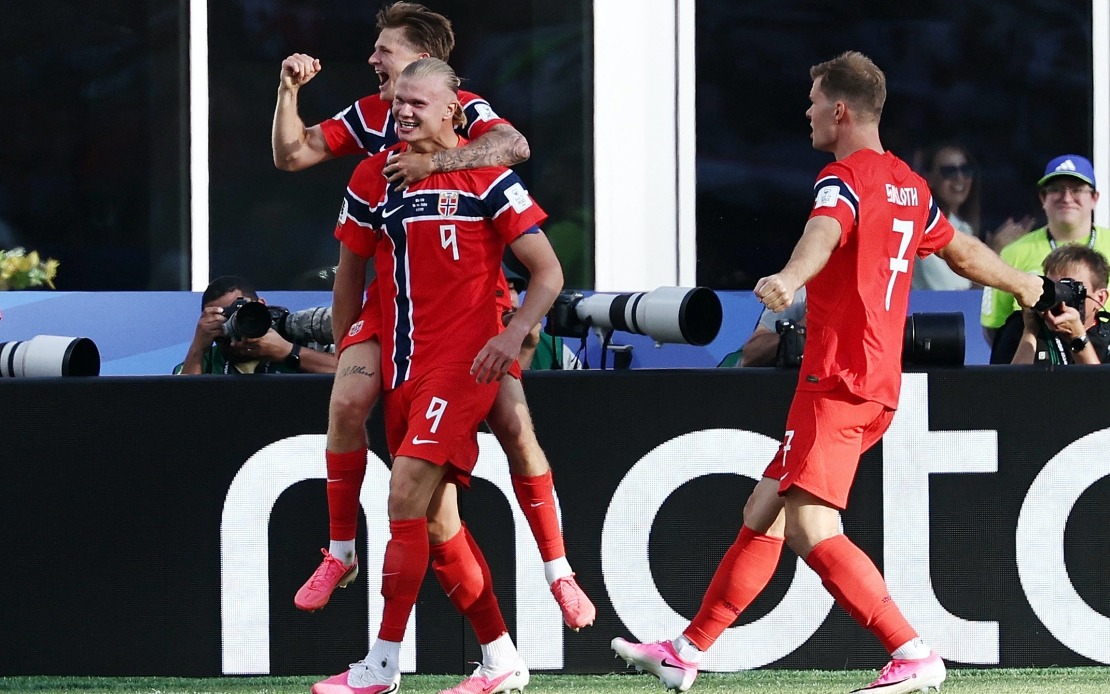
Norway enters a pivotal phase of its World Cup campaign with considerable momentum and a unique narrative threading through the squad. Following an emphatic 4-1 demolition of Iraq in their opening fixture, the Scandinavian nation has positioned itself well in the group stage, yet the psychological weight of family legacy adds another dimension to their pursuit of advancement. Three key players carry the distinction of being sons of footballers who represented Norway in the 1994 World Cup held in the United States—a tournament where their fathers' generation fell short in the group phase. This generational echo gives Erling Haaland, Alexander Sørloth, and Kristian Thorstvedt additional motivation as they attempt to steer their country further than their paternal predecessors managed three decades ago.
Erling Haaland stands as Norway's principal attacking force and the most recognisable face in the squad globally. The Manchester City forward, son of Alf-Inge Haaland who earned caps for his country in 1994, has shown amusement at visual comparisons with his father from that distant era. When presented with photographs from the mid-1990s, Haaland noted the striking physical differences, particularly remarking on his father's fuller head of hair and youthful appearance. Yet beyond the superficial contrasts between decades lie serious football ambitions. Haaland's presence at one of Europe's elite clubs, combined with his proven scoring ability, positions him as the spearhead of Norway's knockout-stage aspirations.
Alexander Sørloth, plying his trade at Atletico Madrid, represents another crucial component of this three-pronged attack on the tournament. His father Gøran Sørloth featured in the 1994 campaign, and the younger Sørloth has articulated the profound honour of participating in a World Cup, framing it as a continuation of his football education. Speaking to media, he emphasised that competing at football's grandest stage mirrors lessons his father imparted throughout his upbringing. The emotional resonance of following a parent into international competition at this level clearly runs deep for Sørloth, who views his World Cup participation as validation of paternal guidance and a chance to vindicate family honour at the tournament.
Kristian Thorstvedt completes this trilogy of second-generation World Cup players. His father Erik Thorstvedt represented Norway in 1994, establishing a template that the younger generation now seeks to improve upon. Thorstvedt's inclusion in the squad demonstrates the depth of attacking talent available to Norway's coaching staff, ensuring that the burden of expectation is distributed rather than concentrated solely upon Haaland's shoulders.
The historical context of 1994 looms large over this campaign. Norway's failure to advance from the group stage that year remains a point of national sporting regret, particularly among those who witnessed it. The three current players possess childhood memories or family stories centred on that disappointment, creating a potent mixture of ancestral motivation and personal determination. For Sørloth specifically, his first World Cup recollection derives from the 2002 tournament in South Korea and Japan, which he experienced while on holiday in Denmark with his family. That formative memory of watching the global spectacle alongside his father clearly implanted the ambition to someday participate himself.
Norway faces Senegal on Monday in a match carrying genuine implications for qualification to the knockout rounds. A positive result would substantially advance their prospects of progressing beyond the initial stage, thereby achieving what their fathers' generation could not accomplish. The fixture assumes heightened significance given the trajectory established by the opening victory over Iraq, suggesting that the group might be within Norway's grasp. Following the Senegal encounter, the group stage concludes with a challenging fixture against France, one of the tournament favourites and a formidable obstacle to further advancement.
The broader cultural context in Norway amplifies the significance of this World Cup campaign. The squad has garnered unprecedented domestic support, transcending typical sporting enthusiasm to incorporate national pride and historical redemption narratives. The Norwegian parliament witnessed cross-party participation in supporter demonstrations, with MPs engaging in traditional Viking-inspired displays of solidarity—a remarkable demonstration of the tournament's grip on the national consciousness. This parliamentary involvement underscores how deeply the World Cup resonates within Norwegian society beyond the purely sporting domain.
Royal patronage further elevates the occasion. Crown Prince Haakon's children, hereditary Princess Ingrid Alexandra and Prince Sverre Magnus, are scheduled to attend the Monday fixture against Senegal in New Jersey, adding ceremonial weight to the proceedings. The presence of senior royals at a World Cup match reflects both the importance assigned to the tournament within Norwegian institutions and the elevated status of the national football team.
For Malaysian and Southeast Asian observers, Norway's campaign illustrates broader patterns within international football where personal and familial narratives intersect with national ambitions. The phenomenon of second-generation footballers attempting to exceed their parents' achievements resonates across cultures and sporting traditions. Moreover, Norway's relatively modest population yet consistent competitive presence at major tournaments offers lessons in talent development and institutional consistency. The emphasis on family legacy and multi-generational participation in football also reflects values recognised throughout Asian sporting cultures, where family honour and intergenerational advancement carry significant weight.
The psychological dimension of carrying parental expectations deserves deeper consideration. Sports psychology research suggests that such narratives can either energise competitors or impose counterproductive pressure. Haaland, Sørloth, and Thorstvedt appear to have channelled their family inheritance into positive motivation rather than debilitating anxiety—a maturity reflected in their performances to date. Their ability to acknowledge and embrace the legacy whilst maintaining focus on current objectives demonstrates psychological resilience that may prove crucial as the tournament intensifies.
Looking forward, should Norway advance further than 1994, the symbolic significance would extend beyond football statistics into the realm of national historical redemption. The three sons would then surpass their fathers' achievements, completing a cycle of family aspiration and competitive realisation that spans decades. Conversely, premature elimination would reinforce the 1994 disappointment rather than resolve it. These stakes, whilst ultimately secondary to the football itself, permeate the tournament atmosphere and contribute to the emotional intensity surrounding Norway's remaining fixtures.
The interplay between individual talent, family legacy, institutional support, and national expectation creates a compelling sporting narrative. Norway's progression in this World Cup will be measured not merely in points and advancing rounds but in whether a new generation of players successfully rewrites their nation's tournament history. As the campaign unfolds, the ghosts of 1994 will gradually recede or crystallise depending on outcomes in matches yet to be played. For Haaland, Sørloth, Thorstvedt, and their teammates, the opportunity to vindicate family honour whilst establishing their own legacies remains entirely within reach.

