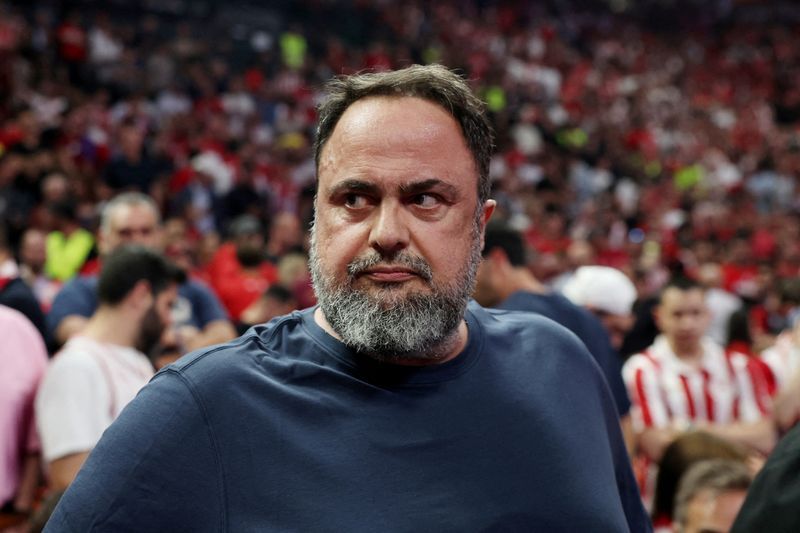
Greek shipping magnate and Nottingham Forest proprietor Evangelos Marinakis initiated libel proceedings against Premier League club Crystal Palace at London's High Court on Monday, in a development that highlights ongoing tensions between rival teams over contentious fan conduct. The case, filed against CPFC Limited and unnamed parties, centres on a provocative banner hoisted by Palace supporters during a match the previous season, according to media reports covering the dispute.
Marinaakis, who acquired Nottingham Forest in 2017 and maintains ownership of Greek football club Olympiacos, has faced repeated accusations from rival supporters and media outlets regarding match-fixing, corruption, and other serious misconduct. The Greek businessman and shipping industry figure has consistently and publicly rejected all such allegations throughout his tenure in professional football.
The specific banner that prompted the legal action depicted Marinakis in a deeply controversial manner, showing him holding what appeared to be a firearm against the head of Nottingham Forest midfielder Morgan Gibbs-White. Accompanying the image was text suggesting the Forest owner was uninvolved in blackmail, match-fixing, drug trafficking, or corruption—language designed to imply the opposite through ironic insinuation. Such supporter-created content represents a form of protest common in English football, though frequently controversial when it crosses into defamatory territory.
Crystal Palace's descent in European competition directly preceded the banner incident and provided the backdrop for supporter frustration. The London club had originally qualified for the UEFA Europa League but was subsequently relegated to the Conference League competition for violating UEFA regulations governing multi-club ownership structures. Nottingham Forest benefited from this administrative rearrangement, claiming Palace's vacated Europa League spot for their own participation in continental competition.
The ownership dispute that triggered Palace's European demotion reflects broader regulatory concerns within European football. Multi-club ownership—where a single individual or entity controls shares in numerous professional football clubs across different nations—has become an increasingly contentious issue for governing bodies. UEFA introduced stricter regulations to limit potential conflicts of interest and prevent manipulation of competition integrity through coordinated club ownership. Marinakis's holdings of both Nottingham Forest and Olympiacos fell within the scope of these regulatory frameworks, though the implications fell primarily on Crystal Palace rather than Forest.
For Malaysian football enthusiasts and Southeast Asian observers, this litigation illustrates how European football governance intersects with broader questions of competition fairness and regulatory enforcement. The incident demonstrates the high stakes involved in European football administration, where administrative decisions can dramatically alter club fortunes and competitive standings. Palace's supporters channelled their frustration toward the individual perceived as benefiting from their club's disadvantage, resulting in provocative public displays now subject to legal challenge.
The relationship between football supporters' legitimate protest activities and legal boundaries around defamation remains contested across jurisdictions. Marinakis's decision to pursue libel action suggests he views the banner's implications as sufficiently serious and defamatory to warrant costly high court proceedings. Whether British courts determine the banner constituted legitimate satirical expression or crossed into actionable defamation will carry implications for supporter conduct across English football.
Neither Marinakis's legal representatives nor Crystal Palace officials provided immediate statements regarding the Monday filing, leaving the formal position of both parties unclear in initial responses. Palace may face decisions about whether to defend the case, settle the dispute, or argue that the banner represented protected expression by supporters acting independently of the club's governance.
The broader context reveals how modern football ownership structures create friction points between established governance rules, supporter sentiment, and individual proprietors' commercial interests. Marinakis's multi-jurisdictional ownership portfolio exemplifies the contemporary football landscape, where wealthy international investors accumulate stakes across multiple clubs. Such arrangements, while legally permissible within most national contexts, generate regulatory complexity and occasionally provoke competitive disadvantages affecting other stakeholders.
From a Southeast Asian perspective, this dispute underscores how European football's commercial and regulatory dynamics differ substantially from regional football governance. The ability of individual supporters to influence club-level disputes through public protest, combined with sophisticated legal frameworks governing defamation claims, reflects the mature institutional infrastructure surrounding European professional football.
The resolution of Marinakis versus Crystal Palace will likely establish clearer boundaries for supporter expression during matches and public gatherings. Courts may need to weigh the distinction between protected satirical criticism and statements crossing into defamatory territory that damages individual reputation. Such determinations carry implications beyond this specific dispute, potentially shaping how English football clubs and supporter communities navigate criticism of club ownership and management going forward.

