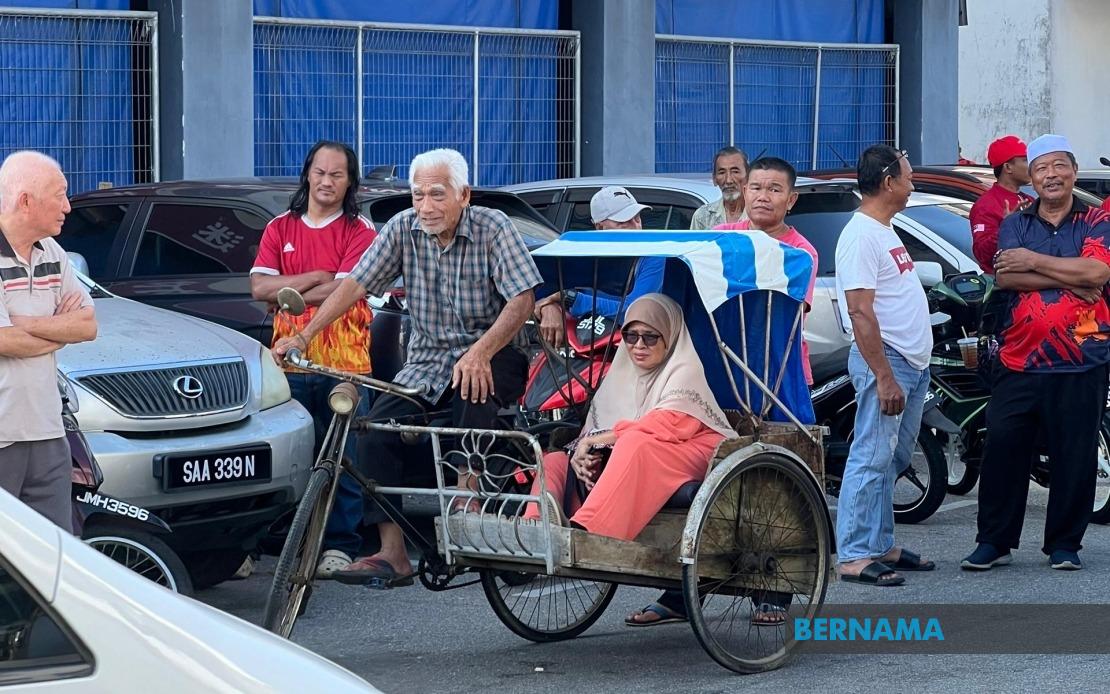
Abdul Razak Pelangga, 87, did not let the intense midday heat stop him from fulfilling his wife's wish. The elderly man pedalled his trishaw nearly a kilometre from their home in Kampung Parit Bugis to Kedai Kopi Hailam Sri Medan in Senggarang, Batu Pahat, determined to give his wife Jamilah Samsudin, 64, a chance to see Prime Minister Datuk Seri Anwar Ibrahim in person. His persistence reflected not mere celebrity-spotting enthusiasm, but rather a deeply personal connection spanning decades—a brief encounter with the leader that had remained etched in his memory.
Abdul Razak's decision to use the trishaw rather than alternative transport revealed both practical wisdom and sentimental choice. Despite having access to a car or motorcycle, he selected the three-wheeled bicycle to circumvent the inevitable parking chaos that accompanies a Prime Ministerial visit to a small Johor town. The choice also allowed the couple to move at a leisurely pace through their neighbourhood, turning what might have been a routine errand into something more ceremonial. For residents of Senggarang, such visits from the nation's leader remain relatively uncommon occurrences, lending the occasion genuine significance.
Abdul Razak, who serves as Imam at Masjid Raudhatul Jannah Parit Bugis, carried with him a memory from before Anwar's ascension to the highest office. Years earlier, the then-not-yet-Prime Minister had visited the mosque to lead prayers. Following the congregational service, the two men had exchanged greetings and shaken hands—a modest interaction that clearly left a lasting impression. Abdul Razak described Anwar as exceptionally approachable and friendly during that encounter, qualities that made the prospect of seeing him again compelling enough to motivate an arduous journey on a hot Johor afternoon.
When word reached Abdul Razak that the Prime Minister would be stopping at the local coffee shop as part of the PMX Meet-and-Greet Programme for the Senggarang state constituency, the decision to bring his wife became immediate. Jamilah had long heard the story of her husband's previous meeting with Anwar, and the opportunity to witness the national leader herself held genuine appeal. The couple understood they might not achieve a direct conversation given the anticipated crowds, but proximity alone would constitute a meaningful experience—far superior to the television appearances that had previously been their only window into seeing their leader.
When they arrived at Kedai Kopi Hailam Sri Medan, the reality of the gathering did not disappoint despite the throngs of people. Though a face-to-face meeting proved impossible due to the crowd density, Abdul Razak and his wife obtained what they sought: a clear viewing of the Prime Minister at relatively close quarters. The couple stood among local residents during the approximately 50-minute breakfast visit, watching Anwar mingle and interact with people from the Senggarang constituency. Accompanying the Prime Minister was Datuk Fahmi Fadzil, the Pakatan Harapan Communications Director and Communications Minister, who added prominence to the occasion.
The timing of this visit coincided with the broader political calendar in Johor, specifically the state election campaign. The 16th Johor state election represented a significant electoral moment, with polling scheduled for July 11 and early voting commencing on July 7. For the ruling coalition, these meet-and-greet sessions served multiple strategic purposes—allowing the Prime Minister to connect directly with constituents, generate positive media coverage, and reinforce the government's presence in key electoral areas. Senggarang, as a state constituency, formed part of the broader Johor political landscape where coalition performance would significantly influence overall results.
Beyond the immediate spectacle of the Prime Minister's visit, Abdul Razak's personal narrative intersected meaningfully with the electoral calendar. The 87-year-old expressed genuine excitement about fulfilling his civic duty on July 11, a date that held double significance—it marked both the state election polling day and his own birthday. Having voted multiple times throughout his life as a Malaysian citizen, he viewed this particular electoral exercise as especially poignant. The convergence of personal milestone and national democratic process invested the upcoming vote with emotional weight that transcended the routine exercise of franchise.
Abdul Razak's reflection on his anticipated vote revealed a mature understanding of democratic participation that extended beyond mere procedural obligation. He articulated a sense of heightened meaning attached to casting his ballot on his birthday, suggesting that citizenship duties assume particular resonance when aligned with personal commemoration. This perspective speaks to how ordinary Malaysians conceptualise their relationship with governance—not as detached administrative requirement, but as meaningful engagement with national direction and leadership. His willingness to undertake a physically demanding journey for a brief glimpse of the Prime Minister demonstrated the emotional investment that many citizens maintain toward their political leadership.
The episode also illuminated the texture of electoral engagement in smaller Malaysian towns where Prime Ministerial visits constitute noteworthy occasions. Senggarang, a relatively modest locality within Batu Pahat district, became temporarily animated by the arrival of the nation's chief executive, drawing residents like Abdul Razak and Jamilah from their homes. Such visits serve important functions in maintaining visible connection between national leadership and constituency-level voters, particularly in areas that might otherwise feel somewhat distant from the machinery of federal governance. The coffee shop setting itself—a casual, informal venue rather than an official government hall—reinforced accessibility and approachability as governing themes.
As Malaysia progresses toward the July 11 polling date, stories like that of Abdul Razak and Jamilah offer insights into how electoral politics intersect with ordinary life narratives. The couple's journey through Batu Pahat's heat to witness their Prime Minister encapsulated fundamental human impulses—connection, recognition, and participation in something larger than oneself. Whether their vote on Abdul Razak's birthday would influence the state election outcome remained unknowable, but their determination to engage with the political process authentically, and the Prime Minister's willingness to spend time in modest coffee shops meeting constituents face-to-face, suggested that electoral democracy in Malaysia retained elements of genuine human connection amid its competitive and sometimes divisive dimensions.

