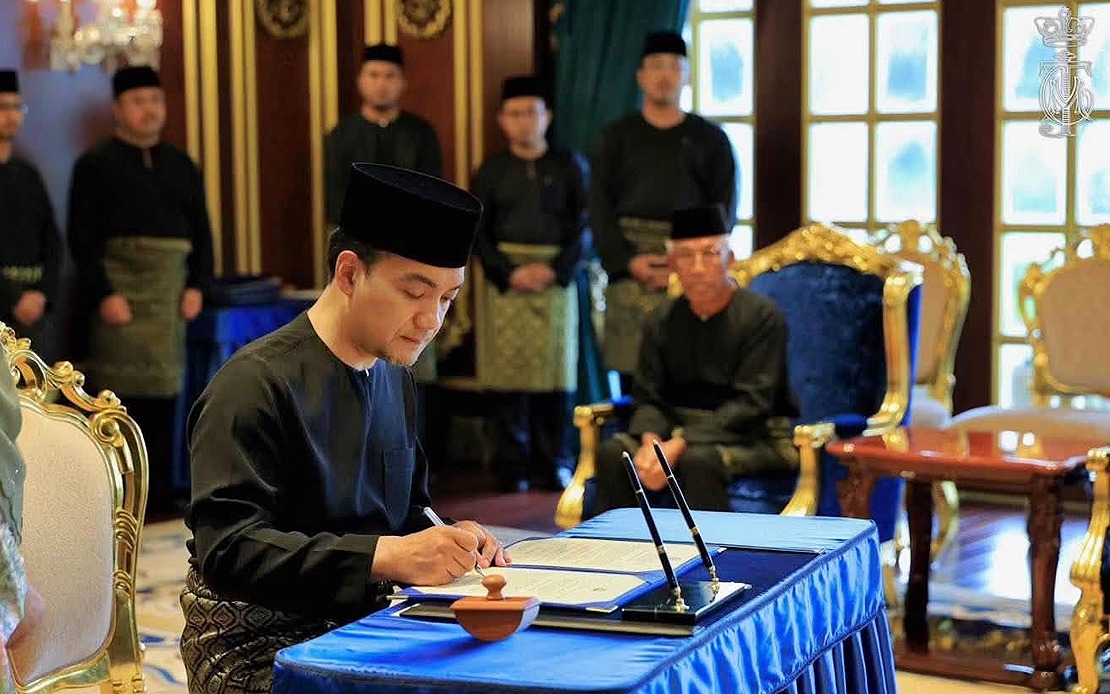
Datuk Onn Hafiz Ghazi has returned to the helm of Johor's government after securing a decisive electoral endorsement, positioning him to pursue an ambitious development roadmap across one of Malaysia's most economically significant states. The 48-year-old leader took his oath before Tunku Mahkota Ismail at Istana Bukit Serene on July 12, solidifying his position as the state's 19th Menteri Besar for a second consecutive term following Barisan Nasional's emphatic performance in the 16th Johor state election.
The coalition's capture of 48 out of 56 available seats represents a substantial improvement over its 2022 performance, when BN secured just 40 seats. This expanded parliamentary majority provides Onn Hafiz with significantly enhanced political capital to navigate Johor's complex governance landscape and advance policy initiatives without the constraints that narrower margins would impose. The scale of this victory underscores voter confidence in the BN-led administration's stewardship of the state's affairs and suggests public receptivity to the leadership direction already established during his inaugural term in office.
Onn Hafiz's ascent to prominence reflects a constellation of political factors unique to contemporary Malaysian politics. His appointment as Menteri Besar in March 2022, following the formation of a BN-led state government, positioned him at a critical juncture when Johor's administrative apparatus required stabilisation and renewed direction. His reelection now validates the governance model he has implemented and the policy framework he has championed, particularly the "Maju Johor 2030" initiative, a comprehensive long-term development strategy designed to catalyse economic expansion and facilitate inward investment flows into the state. This blueprint represents an attempt to position Johor competitively within Malaysia's economic hierarchy while addressing structural challenges that have emerged from regional competition and post-pandemic economic dynamics.
The Menteri Besar's personal trajectory demonstrates a deliberate integration of professional credentials with political ambition. Born on March 2, 1978, Onn Hafiz completed his early education at the Royal Military College before pursuing higher studies in accounting at the University of Hertfordshire in the United Kingdom. This educational foundation subsequently translated into substantive corporate experience, as he spent three years at PricewaterhouseCoopers from 2001 to 2004, then transitioned into broader executive roles spanning the 2005-2013 period. His tenure included positions as director of Chin Well Holdings Berhad and chief executive officer of KMB Sdn Bhd, responsibilities that cultivated an administrative philosophy emphasising operational efficiency, business development and economically-driven governance.
Onn Hafiz's entry into formal political structures occurred gradually, initially through youth-wing participation within UMNO rather than immediate candidacy for elected office. He served as a member of the UMNO Youth executive council and as chief of the Sembrong UMNO Youth division from 2012 to 2018, establishing grassroots credentials while simultaneously functioning as political secretary to the defence minister between 2013 and 2018. This dual track through both party machinery and ministerial support networks provided exposure to high-level policy formulation and executive decision-making processes. His electoral breakthrough arrived in 2018 when he won the Layang-Layang state seat during the 14th General Election, credentials that enabled his appointment as chairman of the Johor Tourism, Youth and Sports Committee from 2019 to 2022.
The 2022 Johor state election proved transformative in Onn Hafiz's political career trajectory. Contesting the Machap state seat, he achieved electoral victory that coincided with BN's recovery of state-level dominance following a period of UMNO-Bersatu competition that had complicated Johor politics. His appointment as Menteri Besar superseded Datuk Hasni Mohammad, signalling a deliberate generational transition within UMNO's Johor machinery. At 44 years old upon assuming office, Onn Hafiz represented a younger cadre of professional administrators who could potentially bridge UMNO's traditional power structures with contemporary economic management expectations.
Within UMNO's internal hierarchy, Onn Hafiz has consolidated influence through structural positions that reinforce his Johor dominance. Since 2023, he has chaired the Johor UMNO Liaison Committee while simultaneously serving as chief of the Simpang Renggam UMNO division, roles that superseded his previous appointment as division deputy chief from 2018 to 2023. These concurrent positions reflect both his party's confidence in his organisational capabilities and his systematic cultivation of intra-party support mechanisms. For Malaysian political observers, such dual-track advancement—simultaneously accumulating elected office responsibilities and party management authority—represents a classic pathway through which politicians consolidate power bases and establish themselves as indispensable figures within their respective party structures.
Onn Hafiz's political standing must also be contextualised through his family legacy, which positions him within Malaysia's broader historical narrative. He is the great-grandson of the late Datuk Onn Jaafar, UMNO's founder and Johor's seventh Menteri Besar, a figure whose historical significance extends well beyond state-level politics. More prominently, he is the grandson of the late Tun Hussein Onn, Malaysia's third Prime Minister, whose tenure from 1976 to 1981 coincided with critical nation-building phases including the integration of Sabah and Sarawak into the national political framework. This genealogical positioning means that Onn Hafiz represents the contemporary manifestation of a political dynasty whose historical roots penetrate deep into both Johor's governance traditions and the Malaysian federation's foundational political structures.
The implications of this lineage deserve careful examination for Malaysian readers contemplating leadership succession and political institutionalisation. While family background provides undeniable advantages in terms of name recognition, established networks, and internalized political knowledge, Onn Hafiz's reelection suggests that voters ultimately weighted his individual administrative performance alongside his hereditary positioning. The expanded BN majority under his leadership indicates that his governance agenda during his initial 2022-2024 term achieved sufficient public validation to warrant reinforced democratic mandate, a distinct political phenomenon from automatic legitimacy granted purely through familial association. This distinction matters considerably for understanding contemporary Malaysian political dynamics, particularly as the nation navigates questions about whether democratic institutions can accommodate hereditary political influence while maintaining substantive merit-based accountability.
Looking forward, Onn Hafiz's strengthened parliamentary position provides latitude for implementing the "Maju Johor 2030" development blueprint with reduced constraints. Johor's economic significance—as the nation's second-largest economy by state domestic product and a critical logistics and manufacturing hub—means that governance decisions made in Johor carry implications extending well beyond the state's borders. The Menteri Besar's capacity to attract investment, streamline administrative processes, and coordinate infrastructure development will influence regional competitiveness and potentially affect Malaysian economic performance at the national level. For Southeast Asian investors and regional policymakers, Johor's trajectory under continued BN administration represents an important variable in calculations regarding investment flows within Malaysia and the broader regional economy.
The broader political significance of Onn Hafiz's reelection extends to UMNO's post-2022 repositioning within Malaysian politics. Following the party's 2018 electoral defeat and subsequent internal upheaval, UMNO has sought to reclaim dominance through state-level governance performance. BN's commanding Johor victory represents a significant achievement in this reconsolidation strategy, demonstrating that the coalition retains capacity to generate substantial electoral support when governance records appear satisfactory. For observers tracking UMNO's longer-term viability as a national political force, Johor's result provides measurable encouragement that the party's traditional support base, while geographically concentrated, remains substantial and mobilisable when appropriate conditions align.

