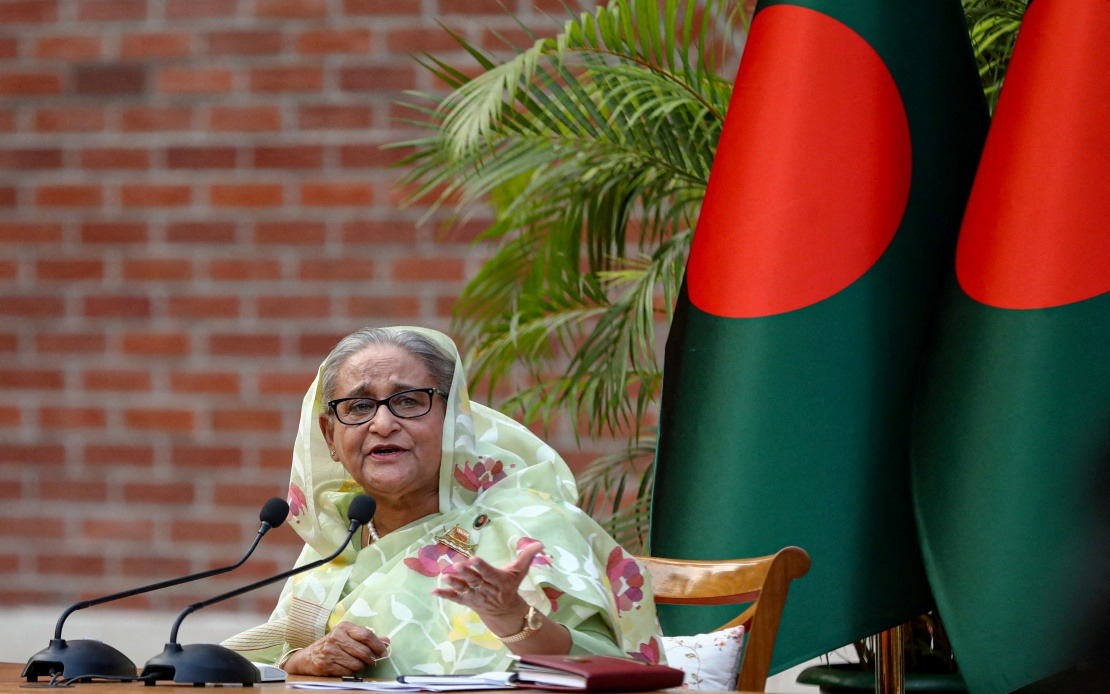
Sheikh Hasina, the 78-year-old former Prime Minister of Bangladesh, has publicly committed to returning to her country and submitting to judicial proceedings, even as she confronts a death sentence and the prospect of imprisonment. In remarks made through a written interview with Kyodo News, Hasina acknowledged the gravity of her situation with striking candour, stating that she understands the authorities may imprison her or attempt capital punishment. Yet she has refused to allow these threats to deter her from what she frames as a moral obligation to face the legal system directly.
Hasina's predicament stems from the turbulent events of 2024, when her government's violent response to student-led protests left thousands dead and injured. The demonstrations initially centred on opposition to a court-mandated 30 percent employment quota for descendants of the 1971 independence war veterans, but evolved into a broader uprising against her administration. Facing mounting pressure and the collapse of institutional support, Hasina resigned in August 2024 and fled to India, where she has resided ever since. Her departure effectively ended a 15-year tenure as Prime Minister during which her Awami League party maintained considerable control over Bangladesh's political machinery.
The consequences of that crackdown have proven severe and enduring. Estimates from the United Nations suggest that as many as 1,400 people were killed during the unrest, predominantly shot by security forces responding to the protests. In November 2025, Bangladesh's war crimes tribunal convicted Hasina in absentia of crimes against humanity related to these killings and sentenced her to death. The trial proceeded without her presence, an approach that has drawn criticism from international human rights organisations including Human Rights Watch, which questioned the legitimacy of proceedings held in the defendant's absence while nevertheless affirming that accountability for atrocities must be pursued.
Hasina has consistently disputed responsibility for the deaths, arguing that the movement was orchestrated by her political adversaries and that she never ordered security forces to open fire on civilians. In her recent statements, she has proposed an unconventional avenue toward establishing truth, suggesting that independent international forensic experts examine each fatality to determine cause of death and weapon origin. This proposal appears designed to reframe the narrative around the violence as potentially more complex than the current judicial findings suggest, and to cast doubt on the straightforward conclusion that her government bears direct culpability.
Meanwhile, Bangladesh's political landscape has undergone dramatic transformation since her departure. An interim government was initially established under Muhammad Yunus, the Nobel Prize-winning economist and microfinance pioneer, who was appointed chief adviser at the behest of student protest leaders. Following a general election in February 2026, the opposition Bangladesh Nationalist Party secured victory, and its leader Tarique Rahman assumed the position of Prime Minister. Under Rahman's watch, all activities of Hasina's Awami League have been formally banned since May 2025, a move that effectively dismantles the party apparatus that sustained her political dominance. The current government has made clear its determination to prosecute Hasina, with Rahman's information adviser stating that authorities intend to bring her back to face trial while guaranteeing her opportunity to mount a defence.
India's role in this unfolding drama remains pivotal and ambiguous. Bangladesh has formally requested that New Delhi extradite Hasina, but India's Ministry of External Affairs has adopted a cautious posture, indicating that the request is under examination in light of legal and judicial considerations. India and Bangladesh share complex relations rooted in their shared history and geographical proximity, and New Delhi's decision regarding extradition will likely reflect broader strategic calculations beyond the immediate legal question. For Malaysia and other Southeast Asian nations watching developments in the Bay of Bengal region, India's handling of Hasina's case carries implications for how the subcontinent manages disputes and political transitions among its neighbours.
Hasina's political biography adds texture to understanding her current predicament. As the daughter of Sheikh Mujibur Rahman, Bangladesh's founding father, she represented a continuity with the nation's revolutionary legacy. Her tenure as Prime Minister spanning five separate periods from 1996 to 2024 positioned her as one of South Asia's most durable political figures, though her governments were frequently characterised by allegations of authoritarianism and extrajudicial action. During her third stint in office, Islamist militants stormed the Holey Artisan Bakery in Dhaka in July 2016, killing 20 hostages including nine Italians, seven Japanese, and citizens of other nations. The incident demonstrated the security vulnerabilities facing Bangladesh even under her administration and the persistent terrorist threat emanating from extremist organisations.
Hasina's appeals to broader South Asian and international stakeholders suggest she recognises the need to rehabilitate her image beyond Bangladesh's borders. She has emphasised that a stable Bangladesh holds significance not merely for its own citizens but for the entire South Asian region, for development partners, and specifically for countries like Japan that have invested substantial resources in Bangladesh's infrastructure projects. This rhetorical repositioning attempts to frame stability and order as universal interests that transcend the particular grievances of her domestic critics. Her invocation of Japan is particularly strategic, given Tokyo's substantial economic engagement with Bangladesh and the emotional resonance of the 2016 bakery attack among the Japanese public.
Central to Hasina's current argument is a distinction between reconciliation and impunity. She has acknowledged that Bangladesh requires healing and national recovery following the tumultuous events of recent years, yet she insists that genuine reconciliation cannot permit those responsible for crimes to escape accountability. This formulation attempts to position her as simultaneously committed to justice while remaining open to broader national healing, a delicate rhetorical balance that appeals to international norms of accountability without necessarily conceding her own culpability. However, critics observe that this position sits uneasily with her denials of ordering the crackdown and her attempts to reframe the narrative through forensic examination.
The political geography of Bangladesh's current predicament reflects broader tensions within South Asian democracies regarding how nations manage cycles of violent protest, authoritarian governance, and electoral contestation. The banning of the Awami League, while perhaps justified by current authorities as necessary for democratic renewal, represents an extraordinary step that some observers view as closure of democratic space. Hasina's commitment to return and stand trial, whether genuine or rhetorical positioning, will test Bangladesh's commitment to due process and judicial integrity. If she does return, the coming trial will constitute a moment of significant regional consequence, as it will demonstrate whether Bangladesh can conduct politically sensitive proceedings with sufficient transparency and fairness to satisfy both domestic stakeholders and international observers.
Looking forward, Hasina has articulated a vision of Bangladesh's potential future centred on recovery and renewal across the coming decade, contingent upon the restoration of genuine democratic practice and authentic popular sovereignty. This formulation implicitly critiques the current trajectory while avoiding direct personal denunciations of the Rahman government. Whether such a vision can materialise depends on myriad factors beyond Hasina's individual agency, including the government's willingness to permit meaningful political competition, the international community's engagement with Bangladesh's institutional development, and the broader regional dynamics that continue to shape South Asia's political economy. For Malaysian observers, the Bangladesh situation underscores the fragility of South Asian democracies and the risks that arise when mass protest intersects with state violence and political succession.

