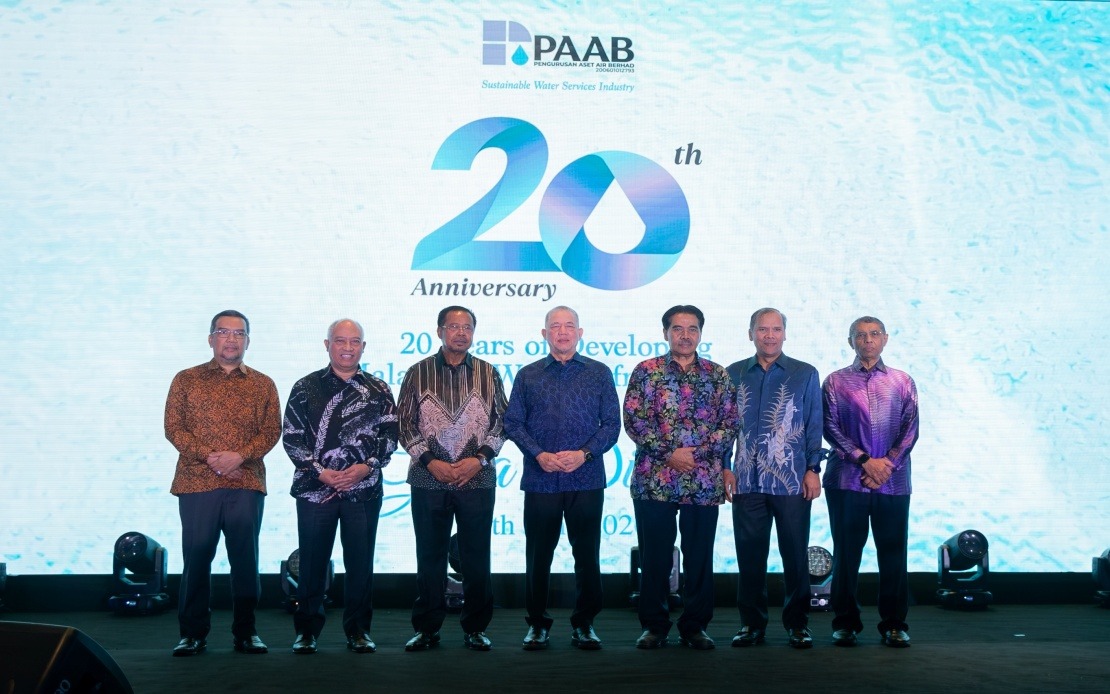
Pengurusan Aset Air Berhad (PAAB), the wholly-owned asset management subsidiary of the Minister of Finance Incorporated, marked two decades of operations this week, underscoring its pivotal contribution to restructuring Malaysia's water services landscape and bolstering supply reliability across the nation. The milestone arrives at a critical juncture as the country grapples with mounting water challenges amid rapid economic development and demographic pressures.
Since its establishment on May 5, 2006, PAAB has become the financial backbone of Malaysia's water sector transformation. The organisation has financed the assumption of water industry debts totalling RM23.04 billion while simultaneously channeling RM23.84 billion into infrastructure modernisation. This combined RM46.88 billion deployment positions PAAB as perhaps the most significant driver of water-related public works in the nation's recent history, fundamentally reshaping how water assets are managed and developed across federal and state jurisdictions.
The restructuring journey reflects a methodical, phased approach designed to improve service delivery and financial sustainability over four decades. PAAB implements the National Water Services Industry Restructuring Plan through a carefully calibrated roadmap: the Migration phase (2008–2020) established foundations for change; the Stabilisation phase (2021–2030) focuses on consolidating gains; Consolidation (2031–2040) will deepen integration; and Full Cost Recovery (2041–2050) targets long-term financial viability. This extended timeline acknowledges the complexity of transforming a sprawling, multi-stakeholder sector while maintaining uninterrupted service to millions of Malaysians.
By December 2025, ten states had committed to the restructuring framework, with tangible outcomes already visible. Infrastructure milestones include twenty-one newly constructed water treatment plants boasting a combined daily capacity of 2,085 million litres, forty-two storage facilities holding 783 million litres, and 3,263 kilometres of upgraded and extended pipelines. These facilities represent more than abstract statistics—they embody the physical foundation enabling Malaysia to supply water reliably to households, farms, and industrial operations across the peninsula.
Deputy Prime Minister Datuk Seri Fadillah Yusof, who also oversees the Energy Transition and Water Transformation portfolio, officiated PAAB's anniversary celebration and delivered a sobering assessment of the sector's ongoing challenges. He highlighted the persistent non-revenue water (NRW) problem, where approximately 40 per cent of treated water dissipates through leakage before reaching consumers. This staggering loss rate underscores the urgency of continued infrastructure investment and maintenance, draining both financial resources and precious water reserves that Malaysia increasingly cannot afford to squander.
Fadillah's remarks signalled mounting frustration with the pace of NRW reduction and called for immediate, coordinated intervention rather than reliance on extended planning horizons. He stressed that a ten-year trajectory remains inadequate for meaningful progress, particularly as Malaysia aggressively competes for foreign investment in water-intensive sectors such as data centres and semiconductor manufacturing. These industries require assurances of stable, abundant water supply—a proposition complicated when nearly half of distributed water vanishes into aging infrastructure before use. Without accelerated remedial action, Malaysia risks losing economic competitiveness to regional rivals offering superior utility reliability.
The financial allocation breakdown reveals PAAB's deployment strategy in action. Of the RM23.84 billion capital expenditure accumulated through December 2025, RM8.33 billion has been expended on completed projects now transferred to operating entities, RM1.84 billion funds works currently under construction, and RM13.67 billion supports schemes still in design and planning phases. This distribution suggests substantial work remains ahead, with the majority of planned investment yet to materialise. The extended project pipeline reflects both the ambitious scope of the transformation agenda and the substantial financial commitments required to modernise Malaysia's water infrastructure systematically.
For Malaysian and Southeast Asian observers, PAAB's trajectory offers instructive lessons about managing critical infrastructure modernisation at national scale. The organisation demonstrates how dedicated financing vehicles, when properly mandated and resourced, can channel substantial capital toward essential public works even amid broader fiscal constraints. The twenty-year operating history provides empirical evidence that sector restructuring involving multiple governmental layers, state entities, and private operators demands patient, sustained institutional commitment rather than ad-hoc interventions.
However, PAAB's anniversary also highlights persistent sectoral vulnerabilities. The 40 per cent NRW rate, while improved from historical levels, remains among Asia's highest and reflects underlying infrastructure decay that capital investment alone cannot quickly resolve. Reducing leakage requires complementary investments in maintenance systems, workforce training, and utility operational efficiency—domains where technical and financial support must extend beyond PAAB's financing mandate. The organisation can fund new treatment plants and pipelines, but cannot independently repair aging networks or overhaul operational practices across diverse state water authorities.
The coming decade will test whether accelerated intervention—as Fadillah advocated—can meaningfully compress the NRW trajectory. Malaysia's water security increasingly depends on whether PAAB and partner agencies can move beyond celebrating infrastructure additions toward demonstrating measurable improvements in system efficiency and water loss reduction. For Malaysia's economic ambitions and population welfare alike, the next twenty years of PAAB's evolution may prove even more consequential than the first.

