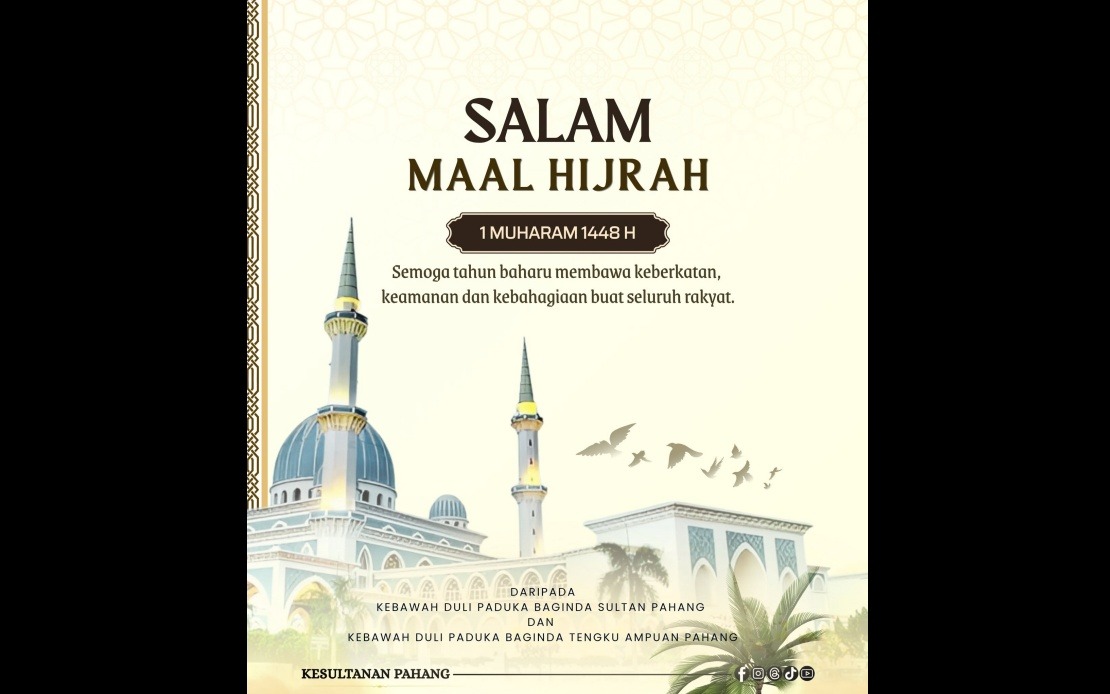
Pahang's reigning monarchs have extended warm wishes to the Muslim community across the state as the Islamic calendar enters 1448H, a significant moment in the religious calendar that encourages reflection and renewal among believers. Through an official announcement released in Kuantan on June 16, Al-Sultan Abdullah Ri'ayatuddin Al-Mustafa Billah Shah and Tengku Ampuan Tunku Azizah Aminah Maimunah Iskandariah jointly conveyed their hopes that the occasion would usher in a period marked by divine favour, tranquility and prosperity for all Pahang residents.
The Islamic New Year, or Maal Hijrah, commemorates the Prophet Muhammad's migration from Mecca to Medina and holds deep spiritual significance across the Muslim world. For Malaysian Muslims, the occasion has traditionally served as a moment for introspection, setting fresh intentions and recommitting to core religious principles. The Pahang sultanate's public message, distributed via their official social media channels, underscored the symbolic importance of this transition, framing it as a catalyst for personal and communal growth.
Menteri Besar Datuk Seri Wan Rosdy Wan Ismail expanded on these sentiments in his own statement, positioning Maal Hijrah as a pivotal juncture for the faithful to reassess their spiritual trajectory. He characterised the new Islamic year as an opportune moment for believers to rekindle their commitment to Islam's core teachings, strengthen their relationship with the Almighty, and channel their energies toward acts of generosity and charity. His remarks reflected a broader theme in Malaysian leadership circles, where major religious occasions are utilised to encourage moral introspection and reinvigorate communal bonds.
The Menteri Besar's message carried particular resonance for Pahang's development agenda. By invoking the spirit of the Prophet Muhammad's Hijrah—a journey that fundamentally transformed Arabian society—Wan Rosdy drew a parallel between historical Islamic migration and contemporary efforts to advance Pahang's prosperity. He called upon residents to embrace transformative change, strengthen social cohesion, uphold ethical standards and deepen their dedication to Pahang's overall advancement and the population's material welfare.
The dual invocation of spiritual renewal and state development reflects how Malaysia's Islamic institutions navigate their role in a multi-dimensional society. Rather than confining religious messaging to purely devotional matters, state leaders frequently interweave faith-based discourse with governance objectives, presenting moral rectitude and collective progress as mutually reinforcing concepts. This approach resonates with voters who view religious identity and national aspiration as complementary rather than competing concerns.
For Pahang specifically, such gestures carry added weight. The state, which serves as home to Malaysia's paramount ruler and retains significant sultanate responsibilities, positions itself as a guardian of Islamic values within the broader Malaysian federation. The Sultan's personal involvement in Maal Hijrah messaging reinforces this custodial role and demonstrates that observance of the Islamic calendar remains embedded in state governance structures and ceremonial functions.
The public circulation of these greetings through Facebook also underscores how traditional monarchical institutions have adapted to digital communication platforms. By disseminating messages through social media rather than relying solely on formal gazette announcements, Pahang's leadership ensured wider accessibility and immediate engagement with younger, digitally-active segments of the Muslim population. This modernisation of messaging channels reflects broader trends across Southeast Asia, where even ceremonial and religious communications increasingly traverse digital networks.
Maal Hijrah observances in Malaysia typically prompt broader conversations about social welfare, ethical commerce and charitable giving. When state leaders encourage heightened charitable activity during the Islamic New Year, they simultaneously reinforce expectations that prosperity should benefit wider society. In Pahang's case, where agricultural and resource-extraction sectors form economic mainstays, such messaging may subtly encourage businesses and landowners to consider their social responsibilities during periods of economic activity.
The timing of these greetings also reflects Pahang's position within Malaysia's Islamic leadership hierarchy. While the federal government issues its own Maal Hijrah statements, state-level monarchs and chief ministers maintain independent platforms for delivering religious messages. This creates a multi-layered Islamic communication ecosystem, where overlapping messages from different levels of government reinforce central themes while allowing regional customisation. Pahang's messaging strategy thus operates both within and alongside federal directives, maintaining state autonomy while participating in nationwide observance.
For Malaysian Muslims generally, such official endorsements of Maal Hijrah carry practical significance. They legitimise the occasion as worthy of public recognition, encourage employers to accommodate religious observance and validate community celebrations. Beyond symbolic affirmation, these statements implicitly signal that Islamic considerations influence state policy frameworks and resource allocation decisions.
The invocation of prayer and divine protection in the Menteri Besar's closing remarks typifies how Malaysian Muslim leaders conclude public statements, embedding religious language into governance discourse. Such conventions, widely accepted across Malaysia's diverse society, reflect the nation's constitutional role as a Muslim-majority federation with Islam woven into institutional frameworks at multiple governance levels.
Moving forward, the significance of Pahang's Maal Hijrah messaging extends beyond immediate ceremonial observance. It sets expectations for how the state will integrate Islamic principles into policymaking throughout the coming year, potentially influencing decisions regarding education, commerce, welfare distribution and community development. For Pahang residents, whether Muslim or non-Muslim, these statements offer insight into the values and priorities that guide state leadership during a significant religious transition.