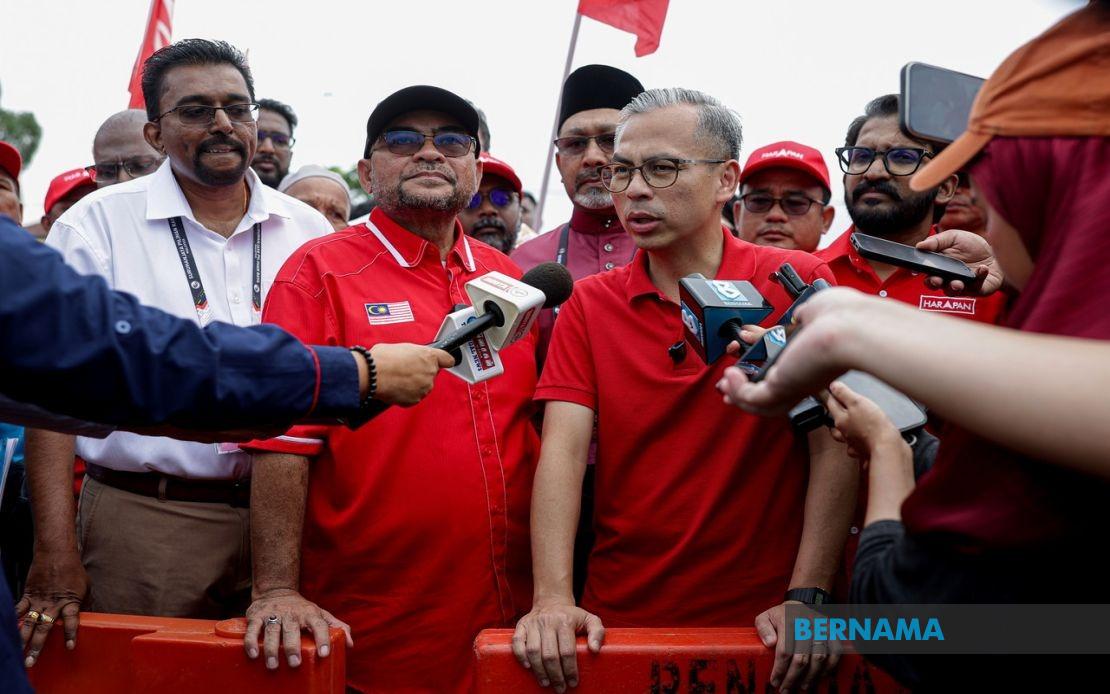
Pakatan Harapan's bid to retain control of Negeri Sembilan will rest heavily on the economic credentials of incumbent Menteri Besar Datuk Seri Aminuddin Harun, party communications chief Datuk Seri Fahmi Fadzil declared after nomination day proceedings in Jempol. The coalition's campaign strategy pivots on showcasing what party strategists view as a six-year record of effective governance, arguing that electoral continuity remains the surest path to sustained prosperity in the state.
Fahmi, who doubles as the federal Communications Minister, outlined how the campaign narrative will emphasise tangible economic metrics accumulated under Aminuddin's stewardship since 2018. The Menteri Besar's administration has presided over improved zakat collections and stronger revenue streams flowing to state coffers, whilst simultaneously attracting sustained flows of foreign direct investment that have materialised in concrete infrastructure projects. The construction of a new port facility represents perhaps the most visible symbol of this investment inflow, a physical testament that the party plans to leverage throughout the campaign period.
The coalition's strategic choice reflects a broader confidence in incumbent performance rather than appeals to partisan loyalty or ideological positioning. In a competitive electoral environment where voters increasingly scrutinise tangible delivery of public goods and economic opportunity, PH believes the administration's demonstrated capacity to generate revenue and attract capital investment provides substantive arguments against change. This approach carries particular resonance in Negeri Sembilan, where the state economy depends significantly on manufacturing, tourism, and agricultural sectors that benefit from both investor confidence and government spending.
Forcing the message through specific constituencies becomes the mechanics of this broader campaign design. In the keenly contested Jeram Padang seat, where PH faces a four-way battle, the party has fielded G. Manivannan, a lawyer and political secretary to Prime Minister Datuk Seri Anwar Ibrahim. The campaign will address employment anxieties that particularly preoccupy younger voters in the constituency, positioning newly planned economic opportunities across the state as tangible responses to youth concerns about job availability and career prospects. This targeted micro-level campaigning represents an attempt to translate macro-level economic achievements into constituency-specific voter benefits.
The Jeram Padang contest exemplifies the complexity of contemporary Malaysian electoral politics. Manivannan will contest against three opponents: incumbent Datuk Mohd Zaidy Abdul Kadir representing Barisan Nasional, R. Sri Sanjeevan fielded by Perikatan Nasional's coalition partner Bersatu, and Dayana Dal contesting as Asli's sole Orang Asli candidate. This four-cornered configuration fragments the opposition vote whilst simultaneously complicating PH's path to victory, demanding sophisticated campaign targeting and message discipline.
Nomination proceedings across the four Jempol parliamentary constituency seats unfolded without disruption, clearing the path for a formal two-week campaign period culminating in polling day on August 1st. Three seats will witness three-cornered contests whilst Bahau will feature a straight fight between PH's incumbent DAP member Teo Kok Seong and MCA's Chong Fui Ming representing Barisan Nasional. In Serting, PH's Yaacob Mahmood challenges incumbent Mohd Fairuz Mohd Isa of Perikatan Nasional and Bersatu's Muhammad Noraffendy Mohd Salleh. Palong pits BN incumbent Datuk Mustapha Nagoor against PH's Muhammad Zahin Zinal Abidin and Bersatu's Rebin Birham.
The electoral arithmetic across these constituencies will substantially determine whether PH retains the state government. The coalition's confidence in incumbency advantage and economic track record must translate into sufficient seat gains to maintain its majority, a calculation that becomes more challenging in multi-cornered contests where opposition vote splitting cannot be guaranteed. Perikatan Nasional's presence, particularly through Bersatu, introduces a further complication by splintering the non-PH vote in several constituencies, potentially benefiting either PH or Barisan Nasional depending on local voting patterns.
Fahmi simultaneously issued guidance to all campaign participants regarding conduct standards during the two-week period preceding polling day. As Communications Minister, he publicly committed to monitoring media practitioner welfare throughout the campaign whilst urging all parties to maintain dignity and restraint in their electioneering activities. His explicit warnings against campaign materials touching upon sensitive subjects—the constitutional provisions regarding religion, race, and the institution of the rulers—and his emphasis on avoiding disinformation reflect heightened official concern about maintaining electoral integrity and social harmony during the campaign period.
These admonitions carry particular weight in contemporary Malaysian politics, where social media platforms facilitate rapid dissemination of unverified claims and inflammatory content, sometimes deliberately designed to inflame communal sensitivities. The Communications Minister's public commitment to monitoring campaign conduct signals federal government determination to ensure that state-level electoral competition remains bounded within constitutional and ethical limits. This stands as consistent with broader efforts to regulate online political discourse and prevent the weaponisation of religious or communal issues for partisan advantage.
The timing of the Negeri Sembilan election follows escalating political ferment in other states, creating a test case for coalition stability at sub-national level. With early voting scheduled for July 28th and polling day set for August 1st, the compressed campaign timeline forces parties to maximise their message efficiency through concentrated media engagement and ground mobilisation. For Pakatan Harapan, this necessitates rapid translation of Aminuddin's administrative record into persuasive campaign narratives capable of convincing sufficient voters that continuity outweighs change.
The election unfolds against a backdrop of significant structural changes in Malaysian coalition politics. The involvement of Bersatu across multiple constituencies signals the complex realignments reshaping political competition following the 2022 general election and subsequent state government formations. Whether PH's emphasis on demonstrable economic governance proves sufficiently compelling against these fractured opposition formations remains uncertain, though the nomination of experienced candidates like Manivannan suggests the coalition takes the competition seriously and recognises that complacency poses genuine risks to incumbent retention.

