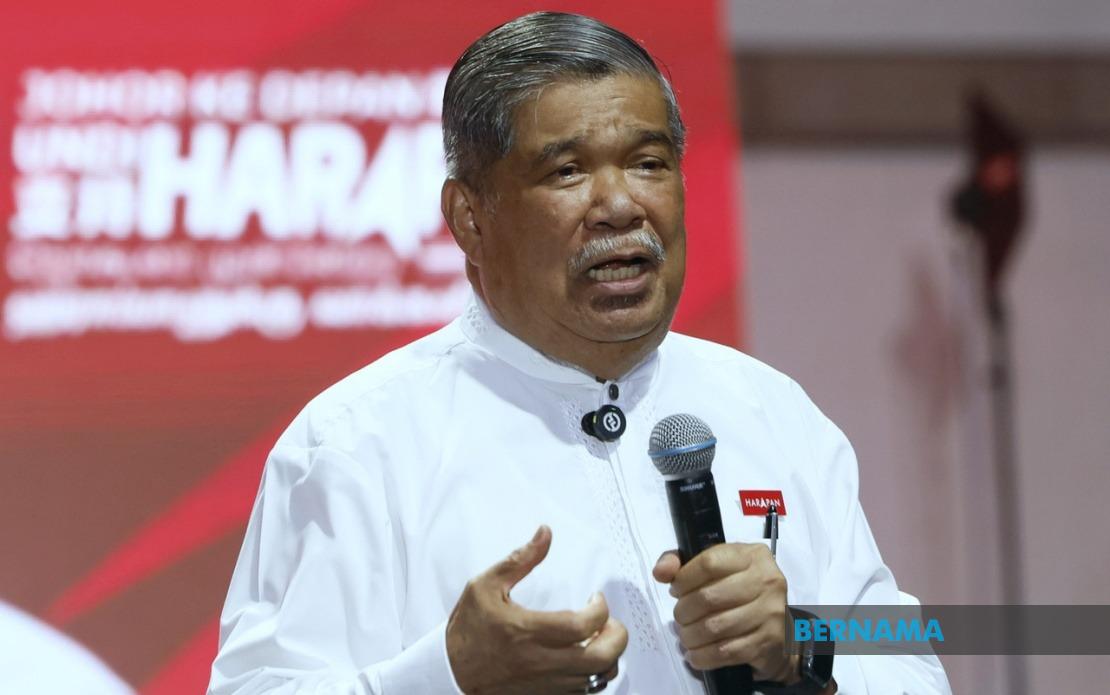
Pakatan Harapan remains unfazed by a political manoeuvre from PAS directing its supporters to back Barisan Nasional candidates in Johor seats the Islamist party is not contesting, coalition leaders said during campaign activities in the state. The directive, intended to consolidate opposition votes behind BN in strategic constituencies, has not rattled the PH machinery, according to Amanah president Datuk Seri Mohamad Sabu, who emphasised that the coalition would proceed with its scheduled campaigning without hesitation or distraction. Speaking after a PH rally in Permas Jaya on July 1, Mohamad insisted that the organisation faced no intimidation from the tactical shift, signalling confidence in the coalition's campaign structure heading into the July 11 polling day.
The Minister of Agriculture and Food Security articulated a broader philosophical argument for why PH believes such tactical manoeuvres will ultimately prove counterproductive. He positioned the coalition's fundamental strength as residing in its deliberately multiracial and multi-religious framework, which he characterised as the bedrock of political stability and the primary engine driving national economic development. This framing transforms the election contest from a purely numerical or strategic calculation into a choice between two competing models of governance: one rooted in inclusive cooperation across demographic lines, and another implicitly reliant on more narrowly targeted appeals. By making this argument explicitly, Mohamad sought to elevate the campaign discourse beyond immediate electoral tactics toward questions of national direction and social cohesion.
Modamad's message to Johor voters contained a specific call to resist what he characterised as divisive influence campaigns. He urged the electorate to base their voting decisions on candidate capability, demonstrated track record of service delivery, and commitment to upholding justice rather than on racial or religious sentiment. This plea functioned on two levels: it rejected the communal fragmentation that could result from PAS's directive, while simultaneously positioning PH as the party trusting voters' sophistication and judgment. The appeal also implicitly criticised competitors for relying on identity-based mobilisation rather than performance-based legitimacy, a distinction that resonates particularly among urban, educated voters who form a crucial demographic in Johor's mixed constituencies.
The coalition's strategic argument for voter support centred on administrative coherence between state and federal governments. Mohamad argued that PH governance at both levels would facilitate implementation of transformative projects specifically benefiting Johor, including overhaul of the public transport infrastructure, modernisation of facilities at international border crossings, and acceleration of foreign investment attraction. These policy promises speak directly to quality-of-life concerns for Johor residents, particularly those in urban centres and those with cross-border connections to Singapore. The emphasis on practical governance outcomes rather than symbolic appeals reflected a calculation that voters in this relatively developed state prioritise tangible improvements over rhetorical positioning.
DAP strategic director Liew Chin Tong, who also serves as Deputy Finance Minister, introduced a demographic variable that PH strategists believe will prove decisive in determining electoral outcomes. He identified younger voter participation as the critical factor, a constituency that PH has worked to mobilise through youth-focused messaging and digital campaign strategies. Liew pointed to the previous Johor state election in 2022 as an instructive case study, noting that suppressed voter turnout—particularly among Johor residents employed in Singapore who faced COVID-19 travel restrictions—had disproportionately benefited BN. This historical observation carried forward into current campaign messaging, with PH organisations now mobilising voters around the importance of participation as itself a political act.
Liew's analysis of the 2022 election dynamics revealed how external circumstances can magnify existing structural advantages in Malaysia's electoral system. The conjunction of pandemic-related barriers to cross-border voting and overall reduced participation had created conditions favouring the incumbent, demonstrating that electoral outcomes sometimes reflect participation patterns as much as ideological or policy preferences. For this election cycle, PH has invested significant resources in encouraging turnout, particularly among younger Johoreans who increasingly have stakes in both the state economy and broader national political outcomes. The strategic importance of mobilising this demographic explains why PH campaign messaging has shifted toward policy areas directly affecting younger voters' aspirations and material conditions.
The second phase of campaigning, according to Liew, should pivot from conventional political rivalry toward substantive policy discussion and comparative governance visions. He articulated a specific set of issues demanding state government priority attention: job creation at sufficient wage levels to retain Johor's young talent within the state rather than driving migration to Singapore; modern public transport systems; flood mitigation and river maintenance infrastructure; demographic planning for an ageing population; and childcare facility expansion. These policy areas reflect genuine governance challenges facing Johor while simultaneously positioning PH as the party focused on bread-and-butter issues rather than political point-scoring. By narrowing the campaign onto these concrete concerns, PH sought to shift electoral discourse away from terrain where tactical manoeuvres like the PAS directive might gain purchase.
Joboan employment migration to Singapore represents a particularly sensitive political issue in this state, where significant numbers of residents work across the Causeway and send remittances home or engage in cross-border consumption patterns. Liew's emphasis on creating high-quality employment opportunities within Johor implicitly challenged the status quo of labour market outcomes and positioned federal-state coordination as the solution. This argument depends partly on the logic that PH's federal government presence enables faster implementation of development projects and investment attraction initiatives that BN, governing only at the state level, cannot achieve unilaterally. The Johor-Singapore Special Economic Zone emerged as a concrete project exemplifying this federal-state partnership model, with accelerated implementation presented as a PH campaign promise.
The Johor-Singapore Special Economic Zone itself features prominently in opposition campaign messaging as a development initiative that requires close federal-state coordination for successful realisation. PH strategists have framed the zone's development as directly dependent on alignment between Kuala Lumpur and Johor Bahru, essentially making state-level administrative coordination a necessary condition for economic benefit delivery. This framing transforms the election choice partly into a question about state government capacity and willingness to work productively with federal institutions, an argument that neutralises some structural advantages BN might otherwise possess through administrative incumbency. By positioning the SEZ as a federal priority requiring state-level cooperation, PH avoided the appearance of making promises entirely dependent on state government resources alone.
The election itself represents the sixteenth state-level contest in Johor's constitutional history, contesting all 56 seats available with both major coalitions fielding complete candidate slates. The condensed campaign timeline—with early voting scheduled for July 7 and general polling on July 11—compressed the period during which competing narratives could develop and persuade. PH's calculated response to the PAS directive functioned partly as a strategy to neutralise a potential complication without allowing it to dominate campaign messaging. By dismissing the move while articulating an alternative vision emphasising multiracial cooperation, policy focus, and federal-state coordination, PH sought to maintain narrative control in a campaign where several key variables—particularly youth turnout and the mobilisation of cross-border workers—remained unpredictable.
The political stakes in Johor extend beyond the state itself, carrying implications for national political mathematics and the viability of different coalition configurations. A strong PH performance would validate the multiracial cooperation model as electorally competitive even in a state where BN holds significant institutional advantages. Conversely, a PAS directive successfully channelling its own supporters toward BN would suggest that despite public statements about multiracial politics, communal identities remain mobilisable and consequential in Malaysian electoral contests. The Johor election thus functioned as a testing ground for competing claims about the trajectory of Malaysian politics and the salience of different voter motivations, making it potentially consequential for national political alignments extending well beyond the immediate state-level outcome.

