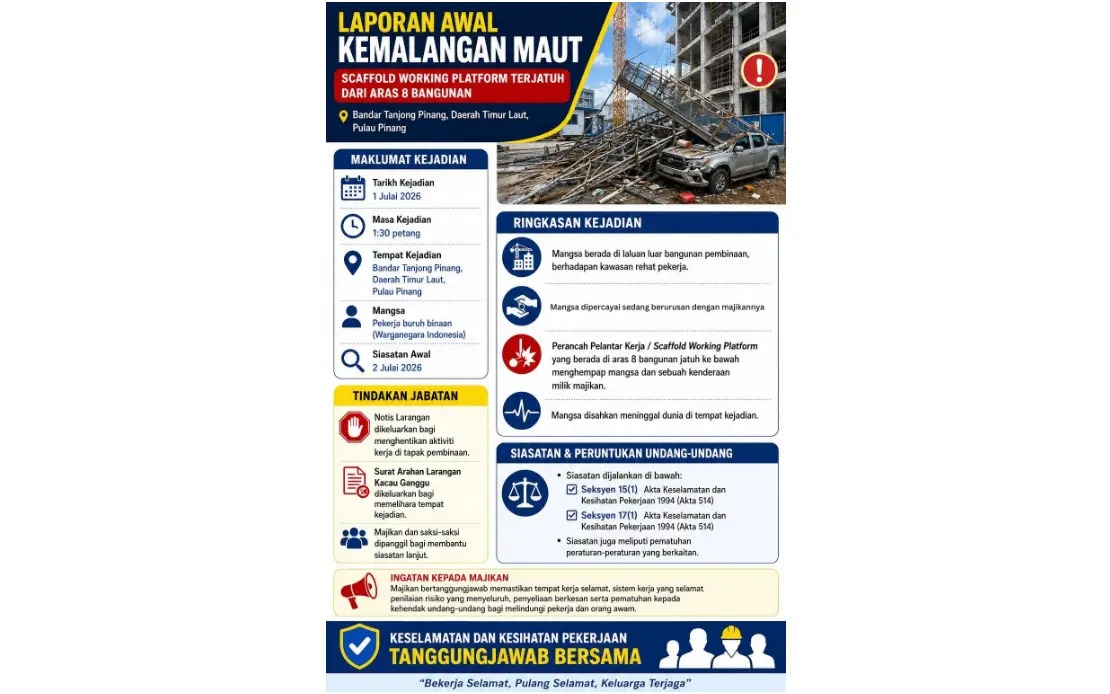
The Department of Occupational Safety and Health (DOSH) in Penang has imposed an immediate work prohibition at a construction project in Bandar Tanjong Pinang, taking decisive action in response to a fatal workplace accident that claimed the life of an Indonesian worker. The fatality occurred on July 1 at approximately 1.30 pm when a scaffolding working platform detached from the eighth floor of the building, plummeting downward and striking the victim on a lower level of the structure.
According to DOSH's account of the incident, the worker was positioned on an external walkway situated in front of a rest area for construction personnel when the equipment failed catastrophically. The falling platform not only struck the victim but also damaged a vehicle belonging to the employer, compounding the severity of the mishap. The rapid issuance of the prohibition notice reflects the regulatory authority's commitment to preventing further incidents at the site and preserving evidence for comprehensive investigation.
Beyond the immediate work stoppage, DOSH Penang has implemented a non-disturbance order that maintains the accident scene in its original condition, a critical procedural measure that enables investigators to reconstruct the sequence of events and identify root causes. This approach is standard practice in serious workplace fatalities, as preserving the physical environment allows safety experts and engineers to examine the structural failure, assess whether maintenance protocols were followed, and determine if design specifications were adhered to.
The ongoing investigation places particular emphasis on whether the employer and main contractor complied with their statutory obligations under the Occupational Safety and Health Act 1994. Investigators are examining compliance with Sections 15(1) and 17(1) of Act 514, provisions that establish employer duties regarding workplace hazard management, risk assessment, and the implementation of control measures. Authorities have begun calling witnesses and relevant personnel to provide statements and clarify the circumstances surrounding the platform's collapse.
For Malaysia's construction industry, this incident underscores persistent safety challenges within a sector where worker fatalities remain a serious concern. The involvement of migrant workers, who comprise a substantial portion of the construction workforce across the country, highlights vulnerable populations who may face language barriers, lack familiarity with local safety standards, or experience employment conditions that compromise occupational health protections. This particular case raises questions about whether adequate safety inductions, proper equipment maintenance schedules, and regular structural inspections were conducted at the site.
DOSH Penang's enforcement apparatus has indicated that legal action will follow if violations of occupational safety regulations are substantiated through the investigation. Such enforcement could encompass substantial fines, criminal charges against responsible parties, or both, depending on the severity of breaches identified. In Malaysia's regulatory framework, companies found to have flagrantly disregarded worker safety face reputational damage that can affect future tender opportunities and business operations.
The regulatory body has issued a broader reminder to developers, main contractors, subcontractors, and employers throughout Penang emphasizing their shared responsibility for systematic safety planning and execution. This messaging reflects an emerging understanding that workplace safety requires integrated commitment across the entire project hierarchy rather than compliance relegated solely to site-level supervisory staff. Proper planning encompasses hazard identification, implementation of engineering controls, provision of appropriate personal protective equipment, and establishment of emergency response protocols.
Scaffolding failures represent a recurring hazard in Malaysia's construction sector, with structural platform collapses accounting for a notable proportion of serious incidents and fatalities. The eighth-floor origin point in this case indicates the platform had considerable height, and the force generated by such a fall creates significant trauma and mortality risk. Industry best practices demand that scaffolding systems undergo regular inspection by qualified personnel, with particular attention to connection points, load-bearing capacity verification, and environmental factors such as wind exposure that affect stability.
For Malaysian employers and project managers, this incident serves as a stark reminder that regulatory compliance transcends mere bureaucratic formality—it represents a foundational commitment to preserving human life. The construction sector's rapid expansion across Southeast Asia has sometimes outpaced the development of robust safety cultures, particularly where cost pressures encourage shortcuts in protective measures. Penang's enforcement action signals that authorities will respond decisively to breaches, establishing deterrence for other operators who might otherwise prioritize schedule or budget considerations above worker wellbeing.
The involvement of DOSH Penang also demonstrates how Malaysia's state-level occupational safety authorities exercise independent jurisdiction within their territorial boundaries, operating alongside national-level frameworks. This decentralized approach allows for localized investigation and enforcement that reflects regional construction practices and economic contexts. The agency's proactive stance in this matter, reflected in the rapid issuance of the prohibition notice, suggests institutional capacity and commitment to preventing cascading incidents at the same location.
As investigations unfold, the construction industry will closely monitor outcomes to understand how regulators assess accountability and what remedial measures may be mandated before the site can resume operations. The incident will likely feature prominently in industry safety discussions and training programs, serving as a case study in how procedural failures at any point in a construction project's hierarchy can result in loss of life. For Malaysian workers, both domestic and migrant, this enforcement action provides assurance that regulatory bodies remain active custodians of occupational safety rights.

