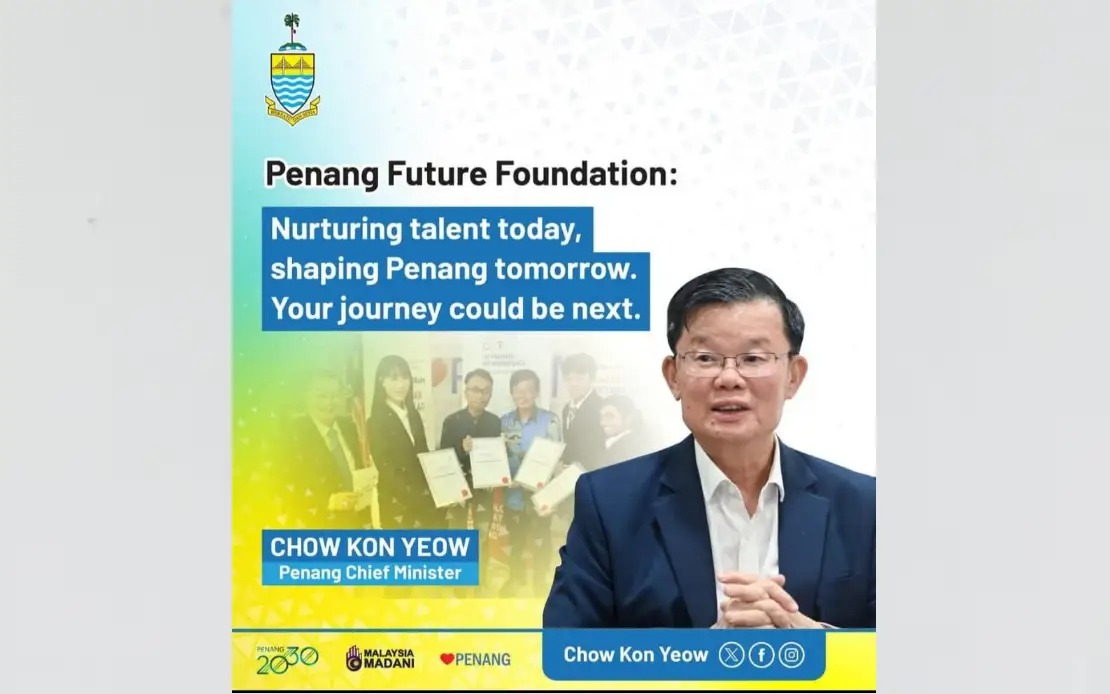
The Penang Future Foundation, a talent development initiative launched by the Penang state government in 2015, has committed roughly RM47.7 million in scholarship funding to 863 deserving Malaysian students, a milestone that underscores the state's strategic commitment to cultivating human capital. Operating now in its 11th year of existence, the foundation represents an integrated approach to nurturing skilled professionals who can drive Penang's competitive advantage in the region and support the state's aspirations for sustained economic expansion across multiple industrial sectors.
Chief Minister Chow Kon Yeow articulated in a recent statement that the foundation remains instrumental to Penang's long-term development strategy, functioning as a deliberate investment in talent retention during a period when regional competition for skilled professionals has intensified significantly. The foundation draws support from a collaborative funding model that combines government backing with corporate sector participation, demonstrating how public-private partnerships can address the persistent challenge of talent scarcity in Malaysia's professional workforce.
During the most recent cycle, the foundation distributed scholarships to 58 students representing varied socioeconomic and educational backgrounds, focusing particularly on fields experiencing acute talent shortages. The chosen disciplines—Science, Technology, Engineering, Mathematics, Accountancy, and Finance—align closely with the priorities outlined in Malaysia's broader economic transformation agenda and Penang's positioning as a hub for technology and professional services investment. This targeted approach reflects recognition that Malaysia's competitiveness depends increasingly on cultivating expertise in knowledge-intensive sectors.
The scholarship framework operates through two distinct pathways designed to accommodate students at different achievement levels. The PFF Penang Scholar track targets high-achieving applicants with cumulative grade point averages of 3.67 and above, while the PFF Mutiara Scholar programme extends opportunity to students maintaining solid academic credentials between 3.00 and 3.66, ensuring broader accessibility without compromising standards. This dual-track model acknowledges that talent manifests across a spectrum and that inclusive selection criteria can uncover promising individuals who might otherwise remain overlooked by more restrictive eligibility requirements.
For Malaysian students throughout the nation contemplating advanced education financing, the foundation presents a meaningful pathway that extends beyond the traditional university offerings within Penang state itself. The initiative actively recruits across Malaysia's geographical expanse, recognising that talent demonstrates no state boundaries and that attracting excellence from across the country strengthens Penang's human resource pool. This national recruitment strategy contradicts any provincial insularity and positions Penang as a destination of choice for ambitious students seeking educational advancement.
Chow emphasised that retaining and attracting talent constitute non-negotiable imperatives for Penang's transformation agenda spanning the next five decades. He framed the challenge not merely in terms of immediate workforce needs but as a fundamental requirement for maintaining investor confidence and supporting the state's evolution toward higher-value economic activity. Industries increasingly demand professionals with advanced capabilities, and the foundation addresses this structural demand by financing education in precisely those competencies that employers actively recruit.
The upcoming scholarship cycle for 2026 opens for applications beginning July 15 and extends until August 5, providing Malaysian students with a defined window to submit their candidacies. Prospective applicants are directed to monitor regular updates via the foundation's official website at www.penangfuturefoundation.my, where detailed application instructions, eligibility criteria, and programme specifics remain accessible. This digital-first approach reflects modern administrative practices while ensuring information reaches geographically dispersed potential candidates efficiently.
From a broader Malaysian perspective, the Penang Future Foundation illustrates how state governments can complement federal education financing mechanisms through targeted scholarship schemes. Rather than duplicating conventional government assistance programmes, the foundation's thematic focus on STEM and professional fields demonstrates strategic differentiation that responds to sectoral labour market gaps. This model potentially merits consideration by other state administrations seeking innovative approaches to talent development within their respective jurisdictions.
The foundation's cumulative disbursement of RM47.7 million across nearly nine hundred recipients represents a substantial fiscal commitment to educational opportunity, though the per-student average of approximately RM55,300 reflects realistic support levels for tertiary and professional qualifications in contemporary Malaysia. Beyond the numerical metrics, the programme embodies a philosophical commitment to meritocracy and to breaking down financial barriers that might otherwise prevent talented students from disadvantaged backgrounds from realising their potential. This equity dimension carries particular significance within Malaysia's diverse social context.
Educational economists recognise that scholarship investment generates returns extending far beyond immediate recipient benefit. Recipients who complete funded programmes typically remain embedded within the funding region's economic ecosystem, eventually contributing through taxation and professional service delivery. Penang's investment in scholarship funding therefore constitutes not merely charitable provision but strategic infrastructure development designed to strengthen the state's long-term competitive positioning and fiscal health through accumulated human capital accumulation.

