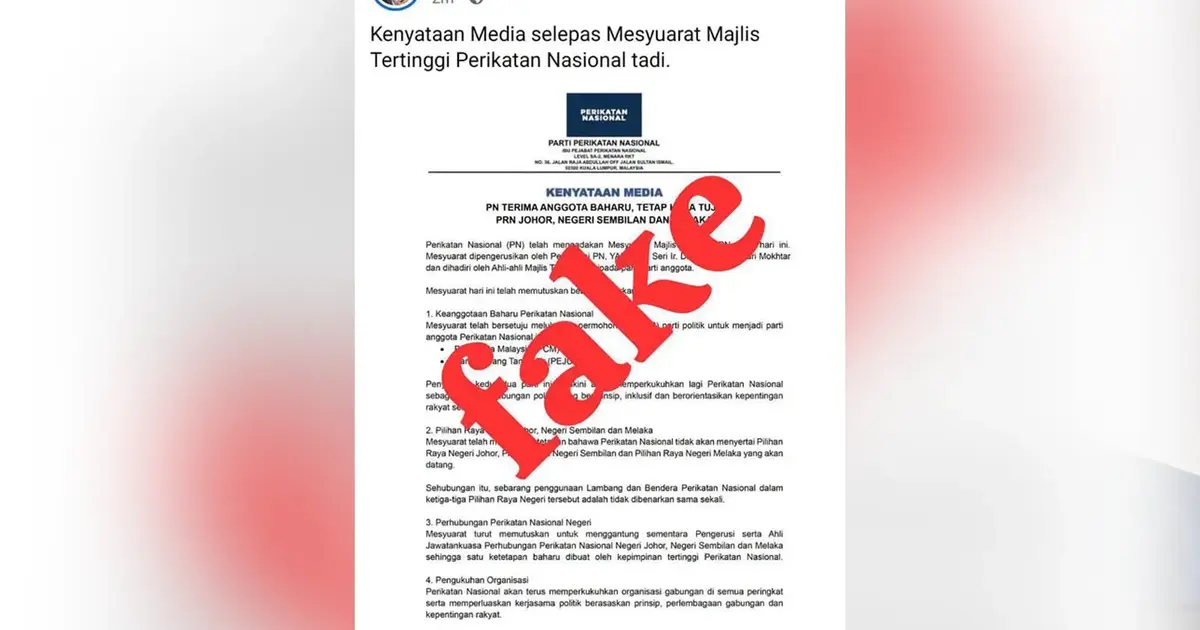
Perikatan Nasional moved swiftly to quash a fraudulent announcement making the rounds on social media and messaging platforms, which falsely attributed to the coalition leadership a decision to abstain from participating in three upcoming state elections. The opposition bloc emphasized that such claims bear no factual basis and represent a deliberate distortion aimed at sowing confusion among supporters and the general public.
The circulation of the spurious statement underscores a persistent challenge facing Malaysia's political landscape, where misinformation and deepfakes targeting major parties have become increasingly sophisticated. Such fabrications can gain traction rapidly through digital channels before fact-checking mechanisms catch up, particularly during periods of heightened political activity or when electoral cycles approach. For PN, which has been positioning itself as a credible alternative to the ruling coalition, the appearance of fake statements creates an additional layer of operational difficulty as the party must constantly manage its public messaging while simultaneously debunking false narratives.
PN's swift denial signals the coalition's commitment to transparency regarding its electoral plans. The organization stressed that any legitimate policy announcements concerning its participation in state elections would come through official channels and be communicated by authorized party spokespersons. This emphasis on official communication reflects growing awareness within Malaysia's political establishment that unverified claims spreading through informal networks can undermine public trust and distort the democratic discourse.
For Malaysian voters attempting to navigate an increasingly complex information environment, this incident serves as a reminder of the importance of verifying political news through established media outlets and official party statements. The prevalence of false attributions targeting political figures and organizations has prompted civil society groups to advocate for greater digital literacy and critical media consumption habits among the electorate.
The coalition's experience with fabricated statements is not isolated. Several Malaysian political parties across the spectrum have recently grappled with similar challenges, ranging from doctored statements to entirely invented policy positions. This pattern suggests a troubling trend where bad actors seek to exploit political divisions by manufacturing contentious or eye-catching claims that might spark controversy or damage a party's credibility. The effectiveness of such tactics depends partly on how quickly and forcefully targeted parties respond.
PN's coalition structure, comprising multiple component parties with sometimes divergent interests, makes it particularly vulnerable to coordinated disinformation campaigns. Opponents seeking to sow discord might deliberately craft false statements that highlight potential tensions between coalition partners or contradict publicly stated positions. By fabricating claims about electoral strategy—a matter of significant concern to party members and supporters—such operators can create unnecessary internal friction.
The timing of false statements can also carry political significance. When elections approach or when specific states move closer to holding polls, the spread of misinformation about participation or boycotts could theoretically influence voter sentiment or party dynamics. Those seeking to hamper PN's electoral prospects might calculate that negative narratives about the coalition sitting out contests would discourage supporters or complicate campaign preparations.
From a broader regional perspective, Malaysia's experience reflects challenges facing democracies across Southeast Asia, where digital political manipulation has emerged as a significant concern. Thailand, Indonesia, and the Philippines have all documented cases of fabricated political statements gaining rapid circulation before authorities or affected parties could respond. The ease with which convincing-looking false messages can be manufactured and distributed through encrypted messaging applications and social media platforms presents an ongoing governance challenge.
PN's response protocol—immediate denial coupled with an assertion that authentic statements would emerge through official channels—represents a relatively straightforward defensive approach. However, some analysts suggest that political parties must do more than simply refute false claims; they should invest in proactive media engagement, digital security measures, and rapid-response fact-checking capacities to combat misinformation more effectively. Building public awareness of how parties communicate officially can help inoculate supporters against believing fabricated statements.
The incident also highlights the responsibility of digital platforms in identifying and flagging potentially misleading political content. While social media companies have implemented various fact-checking partnerships and content moderation policies, critics argue that enforcement remains inconsistent, particularly for content in non-English languages or distributed through private messaging rather than public feeds. For Malaysian parties, this gap in platform accountability means they must maintain heightened vigilance regarding their online reputation and public messaging.
Looking forward, PN and other Malaysian political organizations will likely continue facing sporadic attempts to manipulate perceptions through false statements and coordinated disinformation. Developing institutional capacity to respond credibly and quickly, while building voter sophistication about information verification, emerges as essential for maintaining electoral integrity and public confidence in democratic processes. The stakes become higher as Malaysia moves through various electoral cycles, making the management of political misinformation an increasingly urgent governance issue.

