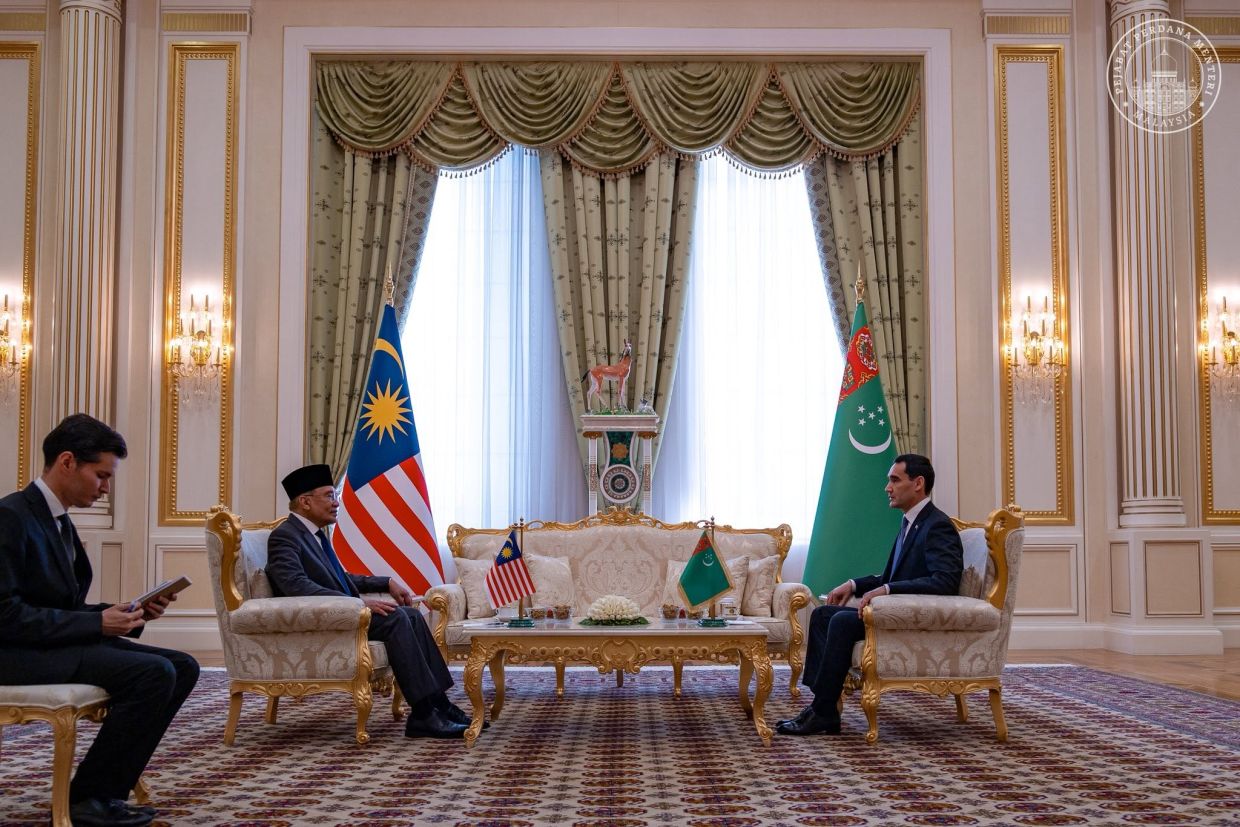
Prime Minister Datuk Seri Anwar Ibrahim and Turkmenistan President Serdar Berdimuhamedov jointly witnessed the formalisation of a strategic partnership between Malaysia's national oil company Petronas and Turkmenistan authorities during a bilateral engagement in Ashgabat today, signalling a significant deepening of energy cooperation between the two countries and underscoring Malaysia's expanding footprint across Central Asia's resource-rich markets.
The accord represents a milestone moment, coinciding with the 30th anniversary of bilateral energy sector engagement that has historically anchored the relationship between Kuala Lumpur and Ashgabat. According to a statement from the Prime Minister's Office, this evolved partnership transcends conventional commercial arrangements, embodying mutual commitment to fostering economic expansion, cultivating skilled workforces, and facilitating the cross-border flow of technological expertise and knowledge systems that benefit both economies.
Central to the partnership's significance is its explicit focus on unlocking the development potential of Turkmenistan's hydrocarbon wealth, particularly its vast natural gas reserves—among the world's most substantial—and exploring pathways for Malaysia's strategic involvement in future resource projects. This dimension carries particular relevance for Malaysia's energy security calculations and industrial competitiveness, as access to diversified gas sources insulates domestic industries against supply volatility and supports the nation's long-term energy transition planning.
The partnership also reflects broader international recognition of Malaysia's technical prowess and institutional capacity within the energy sector. The PMO emphasised that the accord demonstrates how Malaysian expertise, human capital, and technological innovation can compete effectively in global markets and contribute meaningfully to international energy security and economic development objectives. This narrative positioning is strategically important for Malaysia, as it elevates the country's reputation beyond regional boundaries and attracts investment from countries seeking reliable, technically sophisticated energy partners.
Anwar, who commenced his two-day official visit to Turkmenistan the previous day, received a formal welcome from President Berdimuhamedov at the Presidential Palace before engaging in substantive bilateral discussions. The diplomatic protocol extended to the Malaysian delegation underscores the significance both nations place on strengthening institutional relationships and creating pathways for expanded cooperation beyond the energy sector.
Trade figures highlight the commercial momentum underlying the diplomatic engagement. In 2025, Turkmenistan ranked as Malaysia's fourth-largest trading partner among Central Asian nations, with bilateral commerce reaching RM75.80 million. Malaysian exports dominated the trade flow, valued at RM75.50 million, representing a robust 9.0 per cent year-on-year expansion. These growth trajectories suggest deepening commercial integration and expanding business confidence between the two economies, though the relatively modest absolute trade volumes also point to untapped potential that the strategic partnership aims to unleash.
Petrolas's longstanding investment presence in Turkmenistan underscores the company's strategic commitment to the country and region. Since 1996, the national oil company has accumulated cumulative investments totalling RM52.73 billion in Turkmenistan, positioning it as a substantial foreign investor and a key player within the country's energy infrastructure development. This quarter-century-long engagement provides Petronas with deep operational knowledge, established stakeholder relationships, and operational experience that positions it advantageously for expanding its role under the new partnership framework.
The MADANI government's public endorsement of the partnership reflects its strategic vision for Malaysia's international positioning. By welcoming initiatives that strengthen bilateral relations while simultaneously creating broader pathways for economic and investment cooperation, the administration signals its commitment to pragmatic, mutually beneficial engagement across diverse geographical markets and sectoral boundaries. This approach aligns with Malaysia's broader regional diversification strategy and its positioning as a trusted partner capable of managing complex, long-term energy projects across continents.
For Malaysia's broader geopolitical and economic positioning, the Turkmenistan engagement carries implications extending beyond bilateral energy arrangements. Central Asia represents a critical juncture for global energy markets, with vast hydrocarbon reserves, emerging infrastructure development needs, and growing demand from Asian economies. Malaysia's strengthened partnership with Turkmenistan positions the country as a bridge between Southeast Asia and Central Asian energy markets, potentially enabling Malaysian firms to participate in regional supply chains and investment opportunities that serve rapidly expanding Asian demand centres.
The partnership also reflects evolving patterns of South-South cooperation in energy sectors, where developing nations with complementary capabilities collaborate directly without dependence on traditional Western intermediaries. Petronas's capacity to mobilise capital, technology, and project management expertise alongside Turkmenistan's resource endowments represents a partnership model increasingly prevalent across the Global South, where institutional capacity and strategic alignment matter more than historical power dynamics.
Looking forward, the strategic partnership establishes a framework for systematic collaboration across multiple dimensions—from resource exploration and development through to downstream activities, infrastructure investment, and human capital development. The explicit mention of talent development and knowledge transfer suggests both parties recognise that durable competitive advantages in energy sectors derive from sustained institutional learning and capability building rather than transactional resource extraction arrangements.
The partnership also carries symbolic weight within Southeast Asian circles, as it demonstrates Malaysia's ability to expand its economic footprint beyond traditional regions and compete effectively for strategic projects in technologically demanding sectors. This capacity serves Malaysia's broader aspirations within ASEAN and global forums, where countries increasingly compete for legitimacy based on their demonstrated capabilities, institutional credibility, and track record in delivering complex technical projects across diverse geographical and political contexts.

