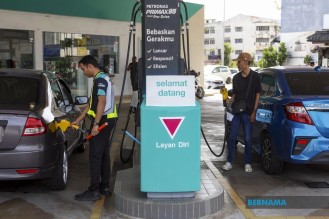
Fuel availability across Petronas petrol stations nationwide will hold steady through August, the government confirmed on June 25, offering reassurance about Malaysia's energy position amid broader global supply uncertainties. Datuk Seri Azalina Othman Said, Minister in the Prime Minister's Department (Law and Institutional Reform), made the announcement following the weekly gathering of the National Economic Action Council (MTEN), citing official information provided directly by Petronas regarding its supply forecasts.
The stability of fuel stocks takes on particular significance given that Petronas Dagangan Bhd, the publicly listed fuel distribution subsidiary of the state-owned Petronas, manages approximately 50 percent of the country's domestic fuel demand. This commanding market share means that supply disruptions at the company would send ripple effects across Malaysia's broader energy ecosystem, affecting transportation networks, industrial operations, and household consumers. The government's explicit confirmation of adequate supplies through the summer months suggests confidence in both domestic refining capacity and existing contractual arrangements for fuel imports.
Concern over energy security has intensified against the backdrop of geopolitical tensions in West Asia, where regional conflicts threaten to disrupt global oil markets and complicate international trade routes. Malaysia, as a net energy exporter but also a significant consumer, faces particular exposure to these international dynamics. The government's decision to establish a dedicated Crisis Management Task Force (PPPK) operating under MTEN reflects the seriousness with which officials are treating these external pressures and demonstrates a coordinated approach to safeguarding the nation's energy independence during an uncertain period.
The newly formed task force operates with a multifaceted mandate extending well beyond simple supply monitoring. Its responsibilities encompass continuous assessment of fuel, petroleum, and energy availability in the months ahead, with explicit focus on maintaining supply security as external conditions remain fluid. Equally important, the task force holds authority over pricing mechanisms, tasked with preventing sharp fluctuations that might destabilise the economy or burden ordinary Malaysians. Additionally, the unit addresses illicit fuel activities including smuggling and other irregular market practices that drain legitimate supplies and create parallel black-market distortions.
Beyond immediate crisis response, the government is pursuing longer-term diversification of crude oil sourcing to reduce dependence on West Asian suppliers, whose production and export capabilities remain vulnerable to regional instability. Malaysian policymakers are actively engaging with petroleum exporters across West Africa and the Americas, exploring potential supply partnerships that could supplement traditional sources. However, such arrangements require careful consideration of crude grades and their compatibility with existing Malaysian refinery infrastructure, alongside commercial terms that make economic sense for a developing nation managing its foreign exchange carefully.
The assurances provided by the government address questions raised by Member of Parliament Khairil Nizam Khirudin representing Jerantut, who had raised concerns over Petronas' earlier statement that fuel guarantees extended only to the end of June 2026. The extension of supply certainty to August suggests either improved market conditions, successful diplomatic negotiations for additional supplies, or refined internal projections that offer greater confidence than the company's initial public messaging. This discrepancy highlights how energy security conversations involve layered communication channels, where different time horizons and confidence levels may initially create public uncertainty before clearer assessments emerge through official government channels.
For Malaysian businesses and consumers, the three-month security window carries practical implications. Manufacturing sectors dependent on stable fuel costs can proceed with greater planning confidence through the third quarter of 2026. Transport operators serving the logistics and delivery sectors face somewhat reduced uncertainty about operating costs, though global crude prices remain volatile regardless of local supply adequacy. The household sector, already managing inflation pressures across numerous categories, gains some breathing room knowing that fuel remains available at pump outlets nationwide without imminent shortage threats.
The institutional response through MTEN and the crisis task force reflects Malaysia's economic governance structures adapting to contemporary global risks. Rather than treating energy security as a purely commercial matter left to Petronas alone, the government has explicitly integrated it into national economic policy coordination. This approach acknowledges that fuel availability intersects with inflation management, foreign exchange preservation, industrial competitiveness, and social stability. The task force's focus on controlling prices while ensuring supply suggests the government recognizes the political and economic costs of fuel shocks, particularly in a nation where transportation and logistics costs ripple through nearly every sector of economic activity.
Looking ahead, Malaysia's energy security picture depends significantly on sustained diplomatic engagement with multiple suppliers, stability within major oil-producing regions, and continued smooth operation of domestic refining infrastructure. The August timeframe represents an interim checkpoint rather than a final resolution, with the government implicitly acknowledging that longer-term energy security requires ongoing management and diversification strategies. For regional observers, Malaysia's proactive response to energy uncertainty offers a case study in how middle-income economies can navigate geopolitical risks through institutional coordination and strategic supply chain management without surrendering market mechanisms or creating excessive price controls.

