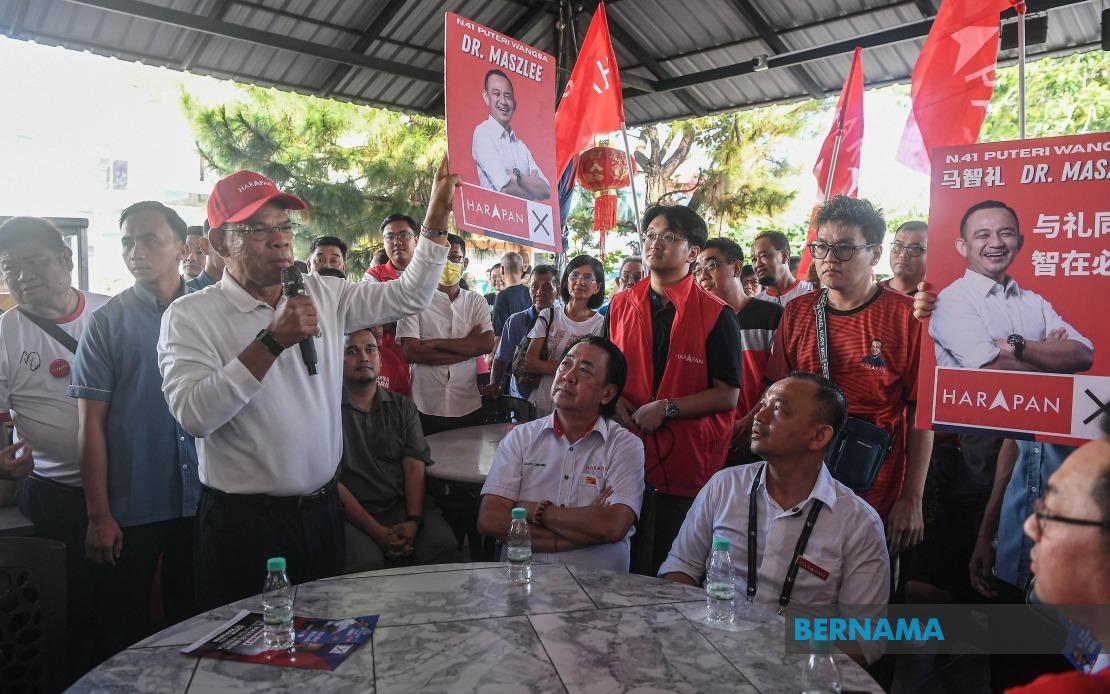
Pakatan Harapan is capitalising on mounting electoral momentum in Johor through a methodical, constituency-specific campaign approach that distinguishes the coalition's messaging and resource allocation based on nuanced local political conditions. PH secretary-general Datuk Seri Saifuddin Nasution Ismail outlined the mechanics of this strategy during an engagement with community leaders in Johor Bahru, revealing how the opposition alliance has systematically prioritised its efforts across the 56 state seats at stake in the 16th Johor state election.
The coalition's framework treats each constituency as a distinct political entity rather than applying a blanket campaign template, recognising that voter concerns, demographic profiles, and competitive dynamics vary significantly across different areas. Saifuddin Nasution illustrated this principle by contrasting constituencies such as Puteri Wangsa, Johor Lama, Larkin, and Endau, each presenting distinct organisational and persuasion challenges that demand customised approaches. By assigning priority grades or ratings to these clusters of seats, PH has designed a resource allocation system that channels campaign energy, candidate deployment, and messaging intensity according to where the coalition calculates it will yield the greatest electoral returns.
This methodical approach reflects lessons learned from previous Malaysian electoral cycles and represents an evolution in opposition campaign sophistication. Rather than assuming all seats warrant equal attention, PH is essentially conducting real-time political triage, directing its strongest performers and most compelling messaging toward constituencies where sentiment polls and grassroots feedback indicate the coalition possesses competitive advantages or untapped persuadable voters. The inverse logic applies to stronghold constituencies where PH support already runs deep, potentially freeing resources for deployment in genuinely contested terrain.
Beyond organisational mechanics, Saifuddin Nasution highlighted how the opposition's own strategic choices have inadvertently benefited PH's positioning. The Islamic Party of Malaysia's decision to contest only 11 of the 56 seats whilst simultaneously directing its supporters to back Barisan Nasional in the remaining constituencies has created perceived confusion about opposition unity and fractionalised the anti-PH vote in ways that advantage the Pakatan coalition. This explicit instruction to PAS voters essentially creates a two-front campaign dynamic where the governing coalition must defend against both PH and PAS pressures simultaneously in different constituencies.
In stark contrast, PH has adopted what Saifuddin Nasution characterised as a transparent approach to seat distribution, clearly announcing candidate allocations among its three component parties—PKR fielding 20 candidates, Amanah 19, and DAP 17 across all 56 constituencies. This comprehensive fielding strategy, combined with what the coalition describes as a practical and implementable policy manifesto, projects an image of organisational coherence and readiness to govern. For voters seeking a clear alternative to the incumbent, the coalition's willingness to contest every seat signals confidence and eliminates the ambiguity that might arise if opposition parties appeared to cede territory to each other.
The electoral mathematics underlying PH's campaign strategy deserve scrutiny in the broader Malaysian context. Johor, historically a Barisan Nasional stronghold with deep institutional roots and considerable federal government influence, has nonetheless emerged as competitive terrain where opposition inroads now appear plausible. A 172-candidate field contesting 56 seats reflects the three-cornered political dynamics now characteristic of Malaysian state elections, where Barisan's incumbency advantage collides with PH's reform narrative and PAS's religious-nationalist appeal. Johor's economic diversity—spanning from agricultural constituencies like Endau to urban centres like Puteri Wangsa—creates precisely the kind of electoral heterogeneity that PH's differentiated strategy is designed to exploit.
Saifuddin Nasution's reference to the presence of former UMNO Supreme Council member Datuk Dr Mohd Puad Zarkashi at campaign events alongside Prime Minister Datuk Seri Anwar Ibrahim carries symbolic weight beyond mere constituency mobilisation. Puad Zarkashi's defection from or public association with PH signals potential fractures within UMNO's traditional base, particularly among intellectuals and former establishment figures who view Anwar's government as offering pathways to political redemption or alignment with modernising agendas. In Johor, where UMNO maintains substantial organisational apparatus and historical legitimacy, securing defections or neutralising prominent figures could prove consequential in competitive constituencies.
The appointment of Dr Maszlee Malik as the Puteri Wangsa candidate exemplifies PH's approach to candidate selection in urban, educated constituencies where policy expertise and professional credentials carry electoral weight. Saifuddin Nasution's emphasis on Maszlee as an asset to PH's potential governance suggests the coalition is not merely seeking electoral victory but consciously constructing a post-election government team that could credibly claim administrative competence. This forward-looking candidate strategy—selecting individuals capable of assuming ministerial or state government responsibilities—represents a departure from purely popularity-driven selections.
The timing of the Johor election, scheduled for July 11 with early voting on July 7, compresses the campaign window and advantages well-organised operations with sophisticated ground machinery. PH's priority-rating system and targeted resource allocation are precisely the tools that mature political organisations deploy when campaign duration becomes limited and voter contact windows narrow. Conversely, less-structured campaigns relying on broad-based enthusiasm without granular constituency intelligence face disadvantages in compressed timelines.
For Malaysia's broader political trajectory, the Johor contest represents a crucial test of whether PH can translate organisational discipline and anti-incumbency sentiment into electoral gains in states where the ruling coalition retains structural advantages. Success in Johor would fundamentally reshape the political map and vindicate the coalition's campaign methodology, whilst failure might expose limitations in the opposition's capacity to dislodge entrenched state governments regardless of campaign sophistication. The Johor election ultimately serves as both a specific contest for state power and a referendum on opposition viability in Malaysia's competitive democratic system.

