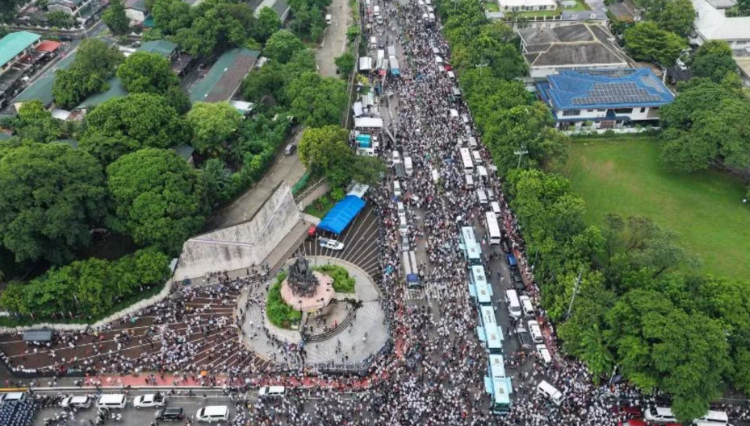
The Iglesia Ni Cristo, one of the Philippines' most influential religious organizations, brought tens of thousands of supporters to Manila's streets on Tuesday to demonstrate against the imminent arrest of Senator Rodante Marcoleta, a prominent church member and ally of embattled Vice President Sara Duterte. The massive gathering transformed EDSA, the capital's main thoroughfare, into a sea of protesters, creating significant traffic disruptions that extended for kilometres during the morning rush hour and forced the closure of most lanes to regular commuters. Police estimated the crowd had swelled to at least 8,000 people by mid-morning, with expectations it would continue expanding throughout the day, underscoring the sect's capacity to mobilize its followers on short notice for political purposes.
The rally's timing proved strategically significant, occurring just one day after the government ombudsman announced that Marcoleta would face graft charges stemming from his failure to declare 75 million pesos—approximately 1.2 million US dollars—in unused election campaign funds. This disclosure triggered an immediate organizational response from the INC, which viewed the legal action against its member as part of a broader pattern of selective prosecution. Speaking through an official video statement posted to social media, INC spokesman Edwil Zabala articulated the sect's position that the legal system was being weaponized against the Duterte faction while ignoring alleged misconduct by administration supporters.
The INC's intervention in this political crisis reflects its enduring status as a substantial voting bloc capable of swaying electoral outcomes and legislative decisions. Marcoleta's significance extends beyond his role as an ordinary senator; observers and analysts widely regard him as virtually certain to vote against convicting Duterte during her forthcoming impeachment trial, which commences the following week with 16 votes required for removal from office. Given the current Senate composition of 24 members, securing Marcoleta's opposition to conviction becomes strategically crucial for Duterte's legal survival, making the INC's show of force less about defending one senator and more about preserving the political viability of the Duterte dynasty at a critical juncture.
The underlying conflict represents the latest manifestation of the spectacular political rupture between former president Rodrigo Duterte and the political establishment now dominated by Ferdinand Marcos, who appears to be systematically targeting Duterte-aligned politicians through legal mechanisms. Earlier instances of this pattern include the filing of charges against another Duterte loyalist, Senator Jose "Jinggoy" Estrada, whose prosecution centres on his alleged participation in a massive corruption scheme involving fraudulent flood control projects that provoked widespread public outrage across the nation. Additionally, Senator Ronald "Bato" Dela Rosa, another Duterte confidant, currently remains in hiding after narrowly evading arrest on an International Criminal Court warrant related to his prominent role in implementing the deadly war on drugs under the former president.
This context demonstrates that Marcoleta's predicament functions as merely one element within a comprehensive campaign to weaken the Duterte political infrastructure. The INC's decision to mobilize substantial crowds represents its implicit acknowledgment that political fortunes for its preferred candidates face genuine jeopardy. The sect has previously demonstrated its mobilization capacity on behalf of Duterte causes, including a demonstration in January 2025 that drew enormous crowds to oppose the initial impeachment proceedings against the vice president. That effort ultimately succeeded when the Supreme Court reversed the impeachment, though her political opponents subsequently pursued fresh charges through the House of Representatives.
The government ombudsman, Jesus Remulla, outlined the specific allegations against Marcoleta with unusual clarity, suggesting the prosecution represents a deliberate, well-documented initiative rather than politically motivated harassment. The failure to declare 75 million pesos in campaign contributions constitutes a violation that extends beyond technical accounting irregularities, implying potential criminal intent in the concealment of substantial financial resources. Campaign finance violations occupy particular sensitivity in Philippine politics, where electoral integrity concerns periodically dominate national discourse and where the management of campaign funds receives heightened public scrutiny.
President Marcos responded to the gathering with visible concern, cancelling a scheduled luncheon with foreign media representatives to personally monitor developments, reflecting recognition that the situation possessed the potential to spiral into broader civil unrest. The INC's demonstrated capacity to disrupt normal urban functioning within hours—transforming a major metropolitan artery into an impassable corridor and affecting tens of thousands of ordinary citizens attempting to reach workplaces and schools—sends an unmistakable message regarding the sect's organizational power and willingness to deploy it for political objectives. This capacity renders the INC impossible for any administration to dismiss casually, regardless of that administration's underlying views regarding the propriety of prosecuting particular individuals.
The sect's framing of the situation as "selective justice" rather than appropriate accountability for genuine misconduct reveals the political lens through which it interprets legal proceedings. INC spokesperson Zabala's declaration that "even if they imprison Senator Marcoleta, we will not stop demanding justice" transforms the arrest from an isolated legal matter into a test of the sect's political influence and determination. This rhetoric, combined with the physical display of mass mobilization, constitutes a form of pressure that operates beyond formal democratic institutions while remaining technically lawful as assembly and petition.
For Malaysian observers and regional analysts, this episode illuminates how religious organizations in Southeast Asia can function as powerful extra-institutional political actors capable of constraining government authority and shaping outcomes in formal electoral and judicial processes. The INC's intervention demonstrates that organizational religion retains substantial political purchase in Philippine society, notwithstanding modernization and democratization trends. The sect's willingness to deploy its membership for explicitly partisan purposes also raises questions about the boundaries between religious mission and political engagement in societies where communal identity frequently transcends formal civic categories.
The intersection of these developments occurs at a moment of genuine constitutional crisis in the Philippines, with the impeachment of a vice president in office representing an extraordinary occurrence that tests constitutional mechanisms and political norms simultaneously. Marcoleta's trial vote, occurring within this context of broader political conflict, transforms what might otherwise constitute a routine ethics investigation into a matter of national consequence. The INC's mobilization therefore constitutes not merely the defence of a single member but an assertion of organizational interests within the larger struggle reshaping Philippine political alignments.

