Philippine Vice President Sara Duterte's defence team launched a robust challenge to the impeachment charges against her on Wednesday, arguing that remarks she made in late 2024 directed at President Marcos, first lady Liza Araneta-Marcos, and former Speaker Martin Romualdez fall short of constituting the "other high crimes" that would justify removal from office under the nation's constitutional framework.
The third day of testimony before the Senate impeachment court centred on a vigorous cross-examination of National Bureau of Investigation senior agent John Mark Calilung, the prosecution's opening witness. Defence counsel systematically questioned the evidentiary foundation underpinning the government's case, emphasizing what they characterised as critical deficiencies in linking the Vice President to an alleged assassination conspiracy. The defence strategy appeared designed to undermine the prosecution's narrative by exposing procedural and investigative gaps rather than directly contesting the statements themselves.
Defence lawyer Mark Vinluan articulated a foundational argument: that House prosecutors had failed to produce tangible evidence demonstrating Duterte had contracted anyone to carry out harm against the three named officials. He presented to the court a contextual reframing of the Vice President's conduct, distinguishing between her official capacity and her personal motivations. Vinluan asserted that when Duterte made the disputed remarks, she was acting as a concerned family member seeking to shield herself and her relatives from genuine security threats, not as an elected official engaged in threats that would meet the constitutional threshold for impeachment.
The defence team introduced allegations of what it described as covert intelligence gathering and surveillance targeting Duterte and her family members by government operatives. According to this version of events, the Vice President's homes in both Davao and Manila had been subjected to detailed profiling exercises documented in classified reports, and her established security detail had been systematically removed. The defence contended these circumstances created intense psychological distress and fear, thereby providing context for understanding her subsequent utterances not as calculated threats but as reactive statements emerging from a position of perceived vulnerability.
Central to the prosecution's case was Article IV of the impeachment complaint, alleging that Duterte issued grave threats during an online press briefing on November 23, 2024. However, the defence seized upon concessions made during earlier questioning by Senator Risa Hontiveros, when prosecution counsel Amando Ligutan acknowledged that the recorded statements did not conclusively establish that Duterte had actually engaged anyone to commit assassination. This admission proved pivotal: the defence used it to demonstrate that statements alone, without corresponding actionable evidence of criminal intent or conspiracy, could not reasonably constitute impeachable offences as contemplated by Article XI, Section 2 of the 1987 Constitution, which enumerated culpable constitutional violation, treason, bribery, graft and corruption, and betrayal of public trust alongside the catch-all category of "other high crimes."
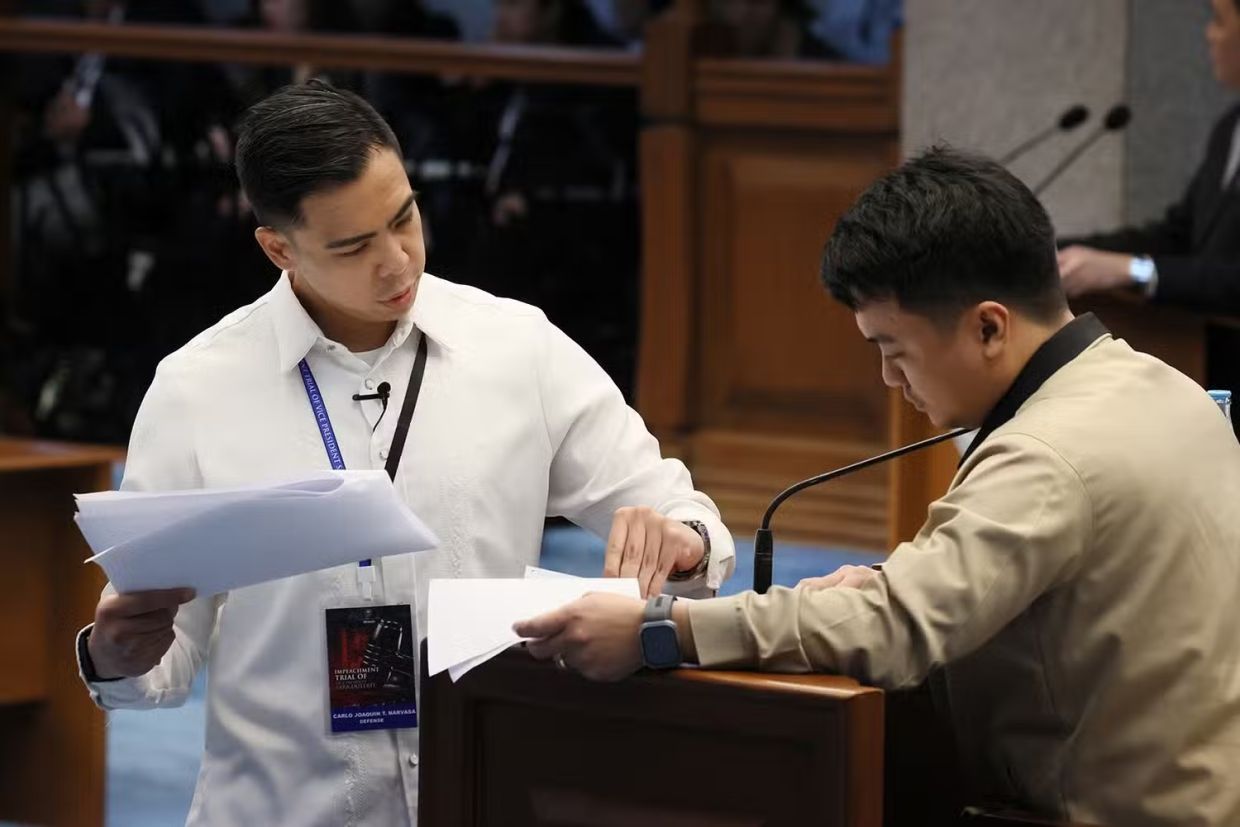
The defence strategy extended to contextualizing Duterte's remarks within the broader political environment surrounding her office. When Duterte's chief of staff Zuleika Lopez appeared in the video footage from the November 23 briefing, visibly distressed over her planned transfer to a correctional facility and the contempt citation she had received from the House committee investigating confidential funds, the defence argued this event triggered the Vice President's statements. Defence lawyer Carlo Narvasa further contended that Duterte and her associates had endured "systematic oppression" orchestrated by the House committee, chaired by Representative Joel Chua, who now appeared among the House prosecutors. This systemic pressure, the defence maintained, provided the genuine causative backdrop for understanding Duterte's controversial utterances.
When Senator Hontiveros pressed Narvasa on whether this reasoning would justify grave threats whenever legitimate grievances existed, the defence counsel declined to accept such a broad proposition, instead maintaining that the constellation of circumstances required holistic evaluation. The defence also challenged the interpretation that Duterte had employed the term "assassin" in her original statements, arguing that external parties had supplied this characterization through selective interpretation extracted from proper contextual framing.
The NBI investigation itself came under intensive scrutiny from defence counsel. Narvasa highlighted a striking procedural absence: none of the three purported targets of Duterte's threats—President Marcos, the first lady, or Speaker Romualdez—had filed formal criminal complaints or personally appeared before the NBI to provide sworn statements. Agent Calilung acknowledged he possessed no personal knowledge of whether these individuals had initiated complaints, confirming instead that the bureau had conducted its investigation motu proprio, meaning without a formal complainant triggering the process. The revised NBI affidavit filed on February 10, 2025, notably lacked sworn statements from either the offended parties or the journalists who attended the November 23 press briefing.
This investigative foundation weakness became particularly significant given the burden of proof required in impeachment proceedings. The absence of victim testimony, formal complaints, or corroborating statements from media personnel present at the alleged threat-making event suggested to the defence that the case rested upon inferential reasoning rather than direct evidence. When Narvasa asked the witness point-blank whether the NBI had genuinely investigated the case—a question that went unanswered after prosecution objection—it highlighted the defence's broader contention that procedural irregularities and evidentiary gaps substantially undermined the prosecution narrative.
The impeachment court's presiding officer, Senator Francis Escudero, intervened to note that the proceedings had coalesced around the central constitutional question: whether Duterte's acts constituted impeachable offences as defined by the Constitution. The defence strategy appeared to hinge on this precise distinction—that even assuming the Vice President had made strong statements, such statements alone could not satisfy the constitutional prerequisite that impeachable conduct constitute "high crimes," a standard traditionally understood to require conduct involving abuse of official position or fundamental breach of constitutional duty.
For Malaysian and broader Southeast Asian observers, the Duterte impeachment trial illuminates the ongoing tensions within Philippine governance between executive authority, legislative oversight, and constitutional limits on removal from office. The case demonstrates how impeachment proceedings, intended as extraordinary constitutional remedies for genuine official malfeasance, can become weaponized in partisan conflicts. The distinction the defence sought to establish—between constitutionally impeachable conduct and statements made by officials in personal capacities—touches fundamental questions about where institutional accountability should yield to individual rights, questions that resonate across democratic systems in the region.
The proceedings also revealed procedural and investigative challenges that could affect the ultimate outcome. The NBI's decision to investigate motu proprio without formal complaints from the alleged victims, combined with the absence of affidavits from these same individuals, created evidentiary vulnerabilities that the defence effectively exploited. Whether the Senate impeachment court would ultimately find these gaps determinative—or instead would accept that circumstantial evidence and inferential reasoning could sustain impeachment charges—remained to be seen as the trial continued.

