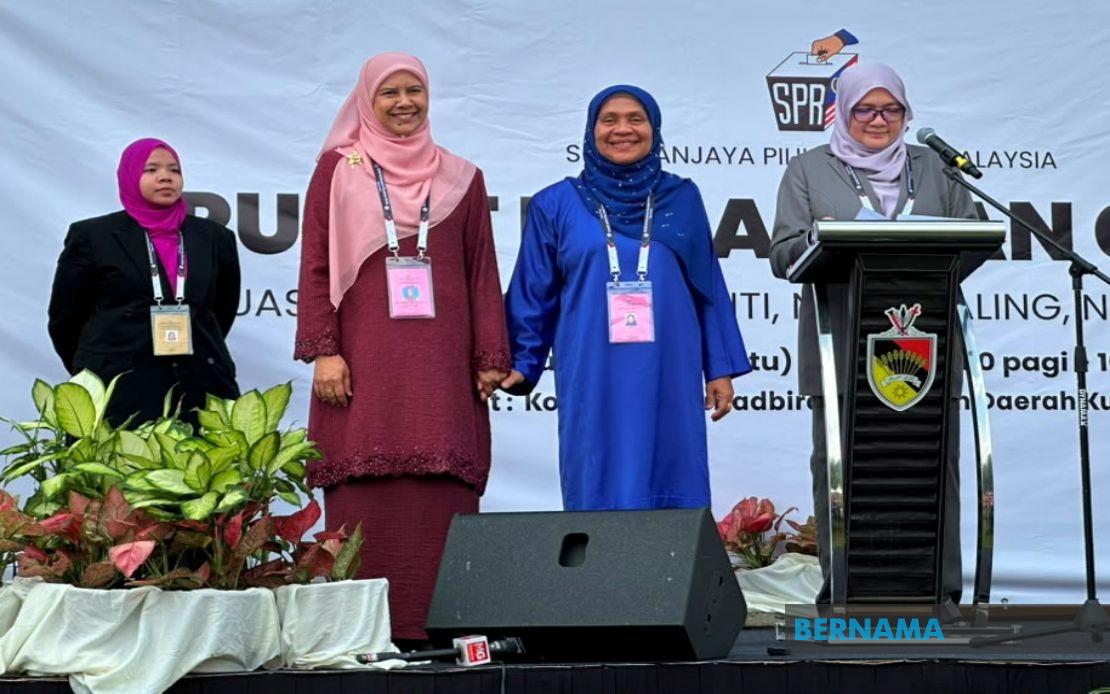
The Pilah state constituency is poised for a notable clash of two women candidates competing for control of the seat in the 16th Negeri Sembilan State Election. Datuk Noorzunita Begum Mohd Ibrahim, who currently holds the position under the Pakatan Harapan banner, will defend her seat against S. Leza Md Yasin, Barisan Nasional's chosen contender. The formal declaration of their candidacies came after the nomination process concluded on July 18, with returning officer Nawal Mohammed Amin confirming the straight fight configuration in this closely watched contest.
The two candidates submitted their nomination papers within minutes of each other at the Kuala Pilah District and Land Office, with Noorzunita Begum filing first at 9.03 am and S. Leza following at 9.09 am. This sequential timing underscored the competitive nature of the race and the determination of both major coalitions to secure this strategically important seat. The presence of senior political figures from both sides during the nomination process reflected the significance attributed to the Pilah contest within the broader state election narrative.
Known for its mixed demographic composition and swing voter tendencies, the Pilah constituency represents a bellwether seat that could provide early indicators of voter sentiment in Negeri Sembilan. The all-female matchup itself carries symbolic weight in Malaysian politics, where women candidates increasingly compete as equals in electoral contests that were historically male-dominated. This development reflects evolving gender dynamics within both PH and BN, as parties recognize the electoral appeal and political competence of female candidates.
Noorzunita Begum's bid for re-election comes at a time when PH seeks to consolidate its position in Negeri Sembilan, a state where coalitional dynamics have shifted in recent years. As the incumbent, she carries the advantage of governmental visibility and the ability to point to constituency-level development projects. However, defending incumbent status in a competitive state election invariably presents challenges, particularly when facing a well-organised opposition machinery.
S. Leza Md Yasin's candidacy represents BN's attempt to recapture ground in a constituency where the coalition once held sway. The choice of a female candidate by BN suggests a deliberate strategy to appeal to women voters and counter the perception of being predominantly male-dominated in candidate selection. This mirrors broader trends across Southeast Asia where opposition coalitions increasingly challenge traditional gender imbalances in political representation.
Beyond the Pilah contest, the broader Negeri Sembilan state election landscape reveals a competitive political environment. The state will witness several three-cornered fights across multiple constituencies, including Juasseh, Seri Menanti and Senaling, where Bersatu has emerged as a significant spoiler force capable of fragmenting votes across the traditional two-coalition divide. The inclusion of Bersatu candidates in three separate races signals the party's determination to establish a foothold in state politics and its willingness to challenge both BN and PH incumbents.
The Juasseh seat will pit PH's Mohd Aidil Abdullah against incumbent Datuk Ismail Lasim of BN and Bersatu's Mohd Zuhami Md Yusof. In Seri Menanti, PH's Mohd Kamarul Arifin Mohd Wafa faces incumbent Muhammad Sufian Maradzi of BN and Bersatu's Datuk Seri Megat D. Shahriman Zaharuddin. The Senaling constituency presents another three-way contest involving PH's Mohd Hanis Mohd Alimin, BN's Mohamad Qayyum Abd Jalil and Bersatu's Mohd Izzafi Khan. Meanwhile, Johol will see a straightforward contest between PH's Mohd Zailan Mohd Munawar and incumbent Datuk Saiful Yazan Sulaiman of BN.
The presence of prominent national figures at the nomination ceremony underscored the stakes involved. PKR Wanita chief Fadhlina Sidek, who holds the portfolio of Education Minister, accompanied PH candidates, while other senior PH figures including Deputy Investment, Trade and Industry Minister Sim Tze Tzin and Youth and Sports Minister Dr Mohammed Taufiq Johari lent their support. BN's contingent proved equally star-studded, with Deputy Home Minister Datuk Seri Dr Shamsul Anuar Nasarah and Perak Menteri Besar Datuk Seri Saarani Mohamad mobilising the coalition's machinery.
From a Malaysian perspective, these state elections hold particular importance as they test the durability of coalition arrangements forged at the federal level. The Negeri Sembilan contest comes at a critical juncture for both PH and BN, with implications extending beyond the state's borders. The performance of PH-aligned candidates will signal whether the coalition can maintain momentum in peripheral states, while BN's results will indicate whether the coalition has successfully arrested its decline in areas where it once dominated unopposed.
The electoral calendar established by the Election Commission provides early voting on July 28 and polling day on August 1, allowing limited time for campaigning but nonetheless sufficient for candidates to mobilise their respective support bases. The compressed campaign period may favour incumbents with established machinery and voter recognition, though it also rewards campaigns that generate distinctive messaging and galvanise grassroots enthusiasm.
For Malaysian political observers and analysts, the Pilah seat's all-female contest represents more than a symbolic milestone. It encapsulates broader transformations within the country's political landscape, where gender diversity in candidate selection has become a legitimacy marker for major parties. The direct confrontation between Noorzunita Begum and S. Leza Md Yasin will provide tangible evidence of how Malaysian voters respond to female candidates competing at equal standing in high-profile electoral contests.
The Negeri Sembilan state election ultimately serves as a barometer for Malaysian electoral sentiment during a period of continued political flux. The various contests, from the high-profile Pilah race to the three-cornered battles across multiple seats, will collectively indicate whether current coalition arrangements enjoy genuine voter endorsement or whether political realignment possibilities remain open. Results from August 1 will therefore warrant careful analysis by political observers across the region seeking to understand Malaysia's electoral trajectory.

