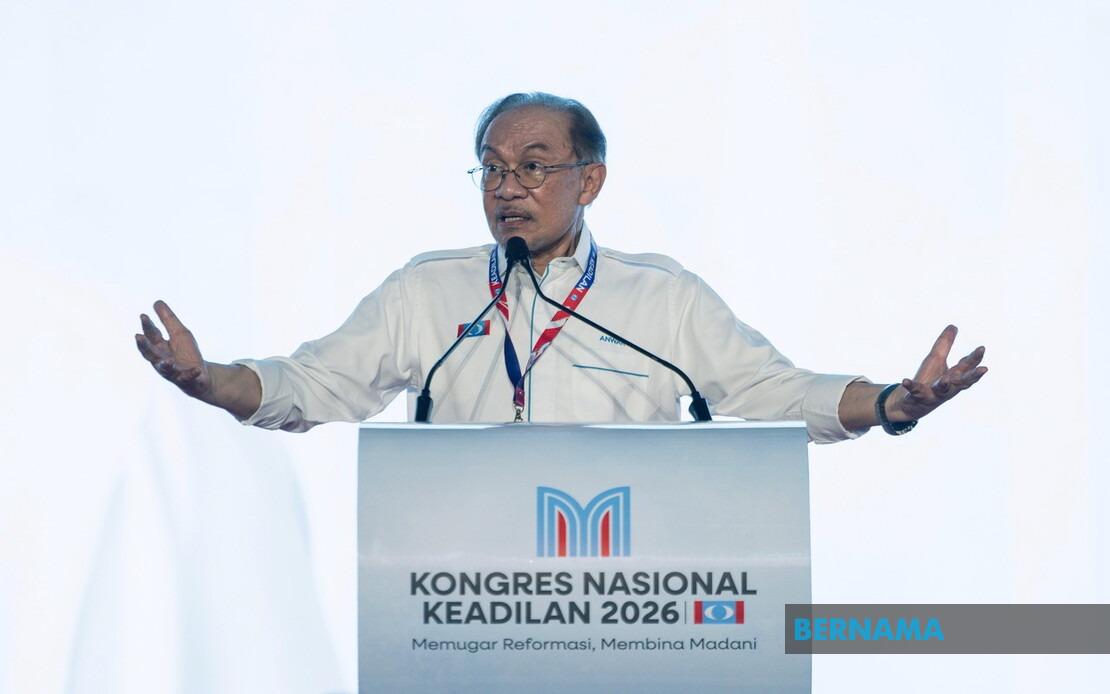
Prime Minister Datuk Seri Anwar Ibrahim has unveiled a fresh RM1 million allocation for every parliamentary constituency across the nation, marking a shift towards decentralised spending that circumvents bureaucratic delays. The announcement, delivered during his closing remarks at the PKR National Congress in Melaka, represents the government's intent to respond more swiftly to community demands without the friction of multiple approval layers. By routing resources directly to constituencies, the administration aims to cut through red tape and place decision-making authority closer to where constituents experience daily hardship.
The initiative sits within a broader fiscal strategy to translate economic gains into visible improvements for ordinary Malaysians. Anwar, who holds the dual portfolio of Prime Minister and Finance Minister, has repeatedly positioned welfare distribution as central to the MADANI Government's brand. The timing of this announcement—at a ruling party congress—underscores its political significance: demonstrating tangible commitment to party grassroots just as Malaysia navigates economic pressures and cost-of-living anxieties that affect household budgets across income brackets.
This fresh allocation complements an existing portfolio of cash assistance schemes that collectively absorb RM16 billion in annual spending. The Sumbangan Tunai Rahmah and Sumbangan Asas Rahmah programmes form the backbone of government welfare, targeting low-income and middle-income households respectively. The new constituency-level funding thus expands the administration's capacity to respond to hyperlocal issues—perhaps urgent repairs to community centres, emergency support for displaced families, or rapid deployment of resources during natural disasters—without waiting for centralised fund requests to wind through ministry channels.
The government has presented poverty reduction as a flagship achievement, with the hardcore poverty rate declining to 0.09 per cent. While critics may question whether such figures adequately capture Malaysia's informal economy and precarious employment situations, the administration's framing reflects confidence in its poverty-alleviation trajectory. The RM1 million per-constituency allocation signals willingness to back those claims with fresh capital, suggesting leadership confidence that the economy can absorb additional spending without triggering fiscal strain.
For parliamentary constituencies in urban centres with large populations, the quantum of RM1 million may address only the most pressing gaps in infrastructure or immediate welfare needs. Rural constituencies with smaller populations, however, might leverage the allocation for more transformative interventions—perhaps constructing a community hall, upgrading water systems, or establishing job-training facilities. This uneven distribution effect reflects a structural tension in Malaysian governance: whether uniform funding per constituency truly serves equity, or whether population-weighted allocation would better align resources with need.
The Prime Minister has tasked party leadership to communicate these initiatives directly to constituents, acknowledging that government programmes often fail not because of inadequate design but because eligible beneficiaries remain unaware. This recognition points to a chronic challenge in Malaysian administration: information asymmetries between government agencies and the populations they serve. By mobilising party machinery to publicise assistance, Anwar implicitly concedes that conventional government communication channels may be insufficient, particularly in underserved communities with limited digital access.
The allocation's impact on different income segments reveals strategic intent. The government explicitly mentioned support for B40 (bottom 40 per cent) and M40 (middle 40 per cent) households through school assistance, subsidised Rahmah sales outlets, and housing financing support. Rather than means-testing that might exclude marginal cases, the administration has opted for broad-based programmes touching multiple income levels. Such an approach simplifies implementation and reduces stigma, though it also risks spreading resources thinly across the population rather than concentrating them on the most vulnerable.
From a regional perspective, Malaysia's approach to decentralised welfare allocation offers lessons for neighbouring Southeast Asian economies grappling with urban-rural inequality and cost-of-living crises. Countries like Thailand, the Philippines, and Indonesia have experimented with direct cash transfers and local-level development funds, yet sustainability often depends on institutional capacity and political will. Malaysia's experience will signal whether such arrangements can survive changes in government or remain hostage to political cycles.
The RM1 million announcement also carries implications for the 2026 general election cycle, which looms within Malaysia's constitutional calendar. Securing visible delivery on constituency-level projects before voters return to the ballot would reinforce the MADANI coalition's claim of competent governance and responsiveness. Opposition parties will likely scrutinise both allocation and execution, questioning whether funds reach intended beneficiaries or whether patronage networks appropriate resources for party-aligned projects. Such contestation is inevitable in Malaysia's polarised political environment.
The government's framing of this allocation as complementary to existing schemes rather than substitutional suggests an intention to expand the welfare envelope rather than redistribute among programmes. If sustained through coming budget cycles, such commitment would represent a gradual shift towards more generous social provisioning—a departure from austerity narratives that dominated Malaysian policy discourse following the 2008 global financial crisis and the post-1MDB fiscal retrenchment. Whether this reflects renewed economic confidence or merely electoral positioning will become clearer as implementation unfolds across constituencies.
Ultimately, the success of this initiative hinges on three factors: timely fund disbursement, effective local coordination among government agencies and elected representatives, and transparent accounting to prevent leakage. Malaysian citizens in constituencies across the peninsula, Sabah, and Sarawak will judge the MADANI Government not by rhetoric alone but by whether this allocation translates into tangible improvements in neighbourhood schools, community healthcare, street lighting, or emergency relief when crises strike. The announcement promises responsiveness; delivery will determine whether that promise holds.

