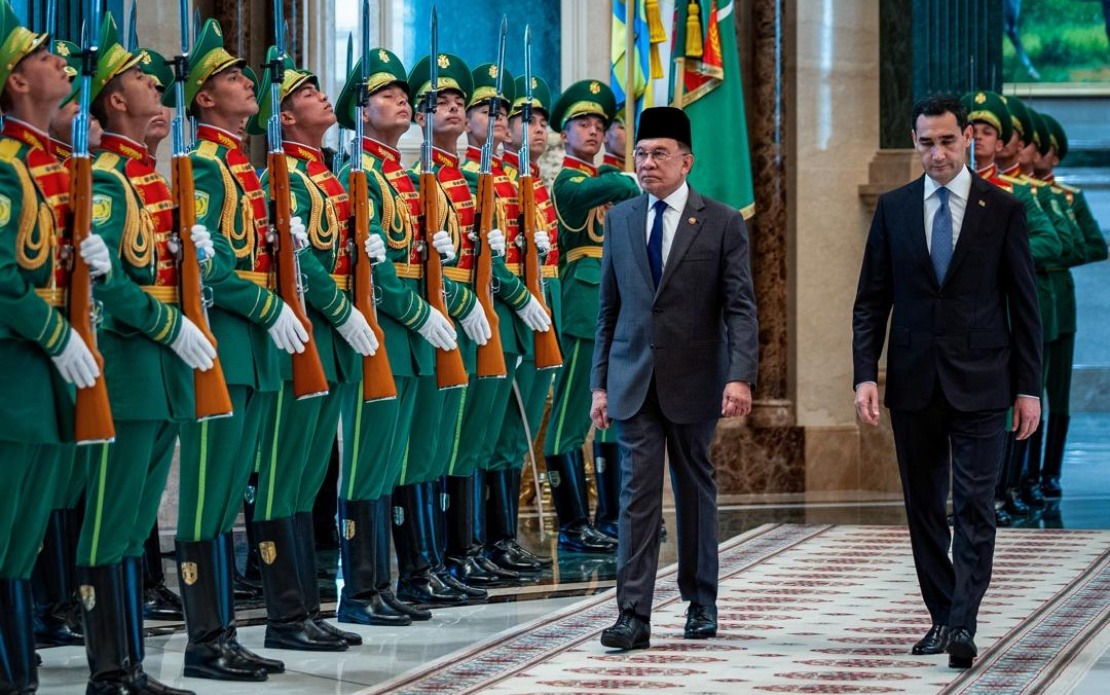
Prime Minister Datuk Seri Anwar Ibrahim was given full ceremonial honours at the Turkmenistan Presidential Palace in Ashgabat on June 19, underscoring the diplomatic significance of his first official visit to the oil-rich Central Asian nation since taking office as Malaysia's 10th Prime Minister eight months earlier. The two-day state visit, which commenced on June 18 at the personal invitation of Turkmenistan President Serdar Berdimuhamedov, represents a strategic engagement in a region increasingly important to Malaysia's diversified foreign policy outlook.
The welcome protocol reflected the formal nature of the occasion, with President Berdimuhamedov personally receiving the Malaysian prime minister upon his arrival. A full guard of honour stood in salute as the national anthems of both countries were performed, a ceremonial gesture that symbolised the mutual respect between Kuala Lumpur and Ashgabat. This level of state reception typically signals the host nation's commitment to strengthening bilateral relations and sets a positive tone for substantive diplomatic engagements.
Following the formal reception, Anwar was introduced to the full Turkmenistan Cabinet and senior government officials, allowing him to establish direct contact with key decision-makers across multiple sectors. This practice, common in high-level state visits, facilitates future diplomatic channels and demonstrates the breadth of the Malaysian delegation's intent to engage across multiple portfolios. The prime minister subsequently introduced his accompanying Malaysian delegation to President Berdimuhamedov, reinforcing Malaysia's interest in building multi-level relationships beyond the executive level.
The bilateral programme proceeded with a restricted four-eyed meeting between Anwar and Berdimuhamedov, followed by expanded discussions involving both delegations. Such structured engagement formats allow leaders to address sensitive or strategic matters candidly before broadening discussions to include specialist advisers and ministers. The agenda would typically encompass trade relationships, energy cooperation, investment opportunities, and regional security considerations—areas of particular relevance given Turkmenistan's vast natural gas reserves and strategic location along the historic Silk Road corridors.
Turkmenistan holds significant strategic and economic interest for Malaysia and the broader Southeast Asian region. The country possesses the world's fourth-largest proven natural gas reserves and has increasingly sought to diversify its international partnerships beyond traditional Russian and Chinese relationships. For Malaysia, engagement with Central Asian energy producers aligns with long-term energy security strategies and reduces dependency on any single supplier or geographic region. The timing of Anwar's visit reflects Malaysia's proactive approach to securing stable energy supplies amid global market volatility.
Anwar's journey to Ashgabat also represents Malaysia's broader pivot toward expanding economic ties beyond traditional partners. Central Asia, long considered a secondary priority in Malaysian foreign policy, has assumed greater importance as the government pursues a more geographically balanced and pragmatic approach to international relations. The visit signals to Malaysian businesses that the government actively supports commercial engagement in the region, potentially opening doors for Malaysian companies in energy, construction, telecommunications, and service sectors.
The diplomatic overture carries particular significance given Malaysia's positioning within the broader Muslim-majority nations network. Turkmenistan, while predominantly Muslim, maintains a secular governance structure and has pursued careful diplomatic balancing between major regional powers. Malaysia's engagement demonstrates its capacity to work with diverse Muslim-majority nations across different political and economic systems, avoiding a monolithic approach to regional diplomacy.
Bilateral cooperation frameworks discussed during such visits typically extend beyond energy and trade into areas including educational exchanges, tourism promotion, cultural programmes, and technical collaborations. These people-to-people connections, though less headline-grabbing than energy deals, often form the foundation for sustained long-term relationships. Malaysian universities could potentially attract Turkmen students, while Malaysian companies might establish regional headquarters or service centres in Ashgabat to access broader Central Asian markets.
The visit also reflects Malaysia's commitment to the Belt and Road Initiative framework and broader connectivity initiatives linking Asia. Turkmenistan's geographic position as a bridge between South Asia, East Asia, and Europe makes it a crucial node in contemporary trade and logistics networks. Malaysian policymakers recognise that strengthening ties with such transit nations enhances Malaysia's own positioning within continental economic systems and creates opportunities for Malaysian logistics and financial services companies.
From a regional perspective, Malaysia's engagement with Turkmenistan contributes to a multipolar diplomatic architecture in Central Asia. As larger powers like Russia and China compete for influence, medium-sized Asian nations like Malaysia can offer alternative partnerships based on mutual economic benefit rather than geopolitical competition. This approach resonates with Turkmenistan's stated preference for balanced international relationships and non-alignment policies.
The successful completion of this inaugural state visit may establish templates for deeper engagement. Follow-up working groups, business missions, and ministerial exchanges typically emerge from such visits, translating diplomatic courtesies into concrete institutional cooperation. Malaysian investors and companies should monitor development announcements and joint cooperation frameworks that may materialise in the weeks following the visit, as these often signal genuine government commitment to sector-specific partnerships.

