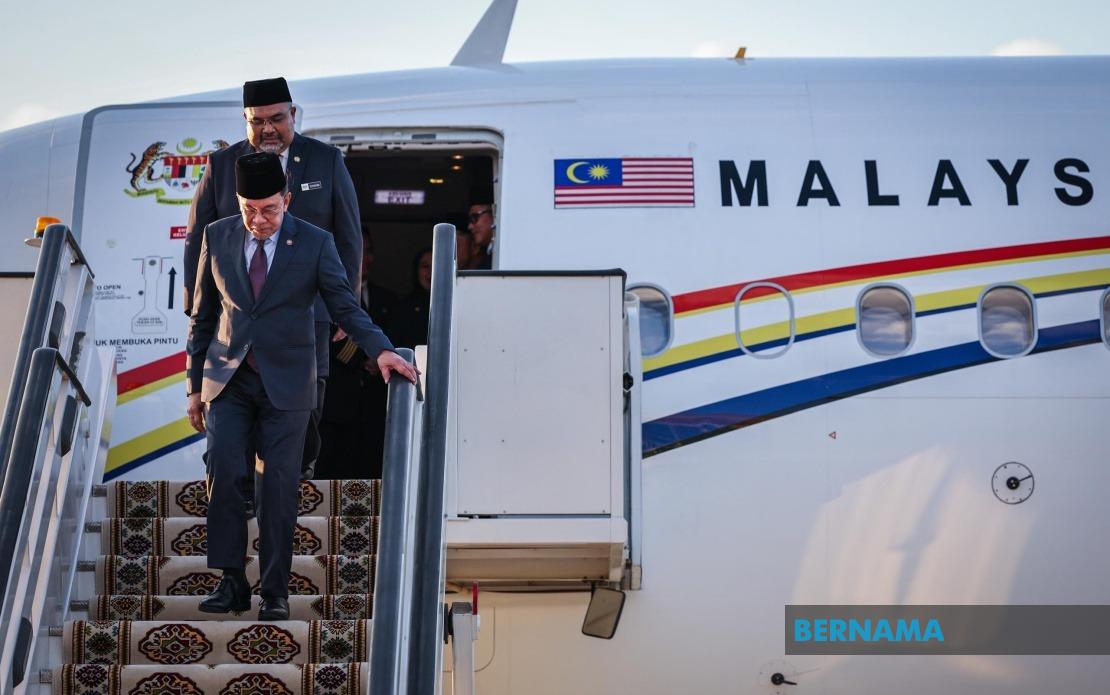
Prime Minister Datuk Seri Anwar Ibrahim landed in Ashgabat on June 18 for a two-day official visit to Turkmenistan, marking a significant milestone in Malaysia's diplomatic relations with the Central Asian nation. The arrival at Ashgabat International Airport at 8 pm local time capped Anwar's earlier working visit to Kazan in Russia's Republic of Tatarstan, underscoring Malaysia's renewed commitment to strengthening ties across the Eurasian region. This represents Anwar's first presidential-level visit to the country and the fifth by any Malaysian prime minister, signalling the growing importance of Central Asia within Malaysia's foreign policy framework.
The prime minister travelled with a substantial delegation reflecting the importance Malaysia places on the engagement. Minister of Investment, Trade and Industry Datuk Seri Johari Abdul Ghani and Minister of Economy Akmal Nasrullah Mohd Nasir accompanied Anwar, alongside key officials from the Prime Minister's Office and the Foreign Ministry. This composition suggests the visit encompasses not merely ceremonial exchanges but substantive discussions on trade, investment, and bilateral cooperation. Upon arrival, Malaysia's Ambassador to Turkmenistan Mohd Suhaimi Ahmad Tajuddin received the delegation, while Turkmenistan's Deputy Chairman of the Cabinet of Ministers for Oil and Gas Guvanch Agajanov led the welcoming contingent from the host nation.
The bilateral visit represents a reciprocal gesture following Turkmenistan President Serdar Berdimuhamedov's official visit to Malaysia in December 2024, demonstrating the momentum in diplomatic exchanges between the two nations. Such mutual visits at the highest level typically pave the way for deeper institutional cooperation and expanded economic partnerships. Anwar's itinerary reflects the multifaceted nature of contemporary diplomatic engagement, beginning with a diaspora dinner upon arrival, acknowledging the Malaysian community within Turkmenistan and broader regional networks.
June 19 promises a full schedule of formal activities designed to solidify bilateral relations. The day will commence with an elaborate welcoming ceremony at the Presidential Palace hosted by President Berdimuhamedov, followed by bilateral discussions and the signing of a joint statement. The planned exchange of agreements and memoranda of understanding suggests that Malaysian and Turkmenistan officials have already advanced negotiations on specific cooperation frameworks. The inclusion of an official luncheon and Anwar's participation in Friday prayers at the Turkmenbashi Ruhy Mosque demonstrates the cultural and religious dimensions of the diplomatic engagement, reflecting respect for Turkmenistan's Islamic heritage.
The jointly officiated Malaysia-Turkmenistan Forum at the Chamber of Commerce and Industry of Turkmenistan represents a crucial platform for private sector engagement and business networking. Such forums facilitate connections between Malaysian and Central Asian enterprises, fostering commercial relationships that transcend governmental channels. The subsequent press conference signals transparency and the importance placed on media engagement, allowing Malaysian journalists to directly report on outcomes and ensure domestic awareness of the diplomatic mission.
From an economic perspective, Turkmenistan occupies a strategically important position within Malaysia's Central Asian engagement. In 2025, the nation ranked as Malaysia's fourth-largest trading partner among Central Asian countries, with bilateral trade reaching RM75.80 million. Malaysian exports to Turkmenistan totalled RM75.50 million, representing a 9 per cent year-on-year increase that underscores growing commercial dynamism between the nations. However, the trade relationship remains heavily imbalanced, with Malaysia functioning primarily as an exporter to the Central Asian market rather than a balanced trading partnership.
Petroliam Nasional Bhd (Petronas), Malaysia's national oil company, represents the most significant Malaysian economic presence in Turkmenistan. The company's cumulative investments since 1996 have reached RM52.73 billion, establishing it as a major player within Turkmenistan's energy sector. This substantial commitment reflects the strategic importance of Turkmenistan's hydrocarbon resources and Petronas's regional strategy for securing energy supplies and developing technical expertise in challenging operational environments. The presence of such a major Malaysian entity provides a solid foundation for broader economic cooperation and demonstrates the depth of existing bilateral engagement beneath governmental-level relations.
Turkmenistan's significance extends beyond its immediate economic metrics. The nation commands considerable natural gas and oil reserves, making it strategically valuable within global energy markets and particularly relevant for Asia-Pacific energy security considerations. Central Asia as a whole increasingly attracts attention from Southeast Asian nations seeking to diversify economic partnerships and reduce dependence on traditional trading relationships. Malaysia's diplomatic focus on the region reflects broader Asian positioning strategies aimed at building bridges between East and West Asia.
The timing of Anwar's visit carries regional implications. Malaysia's active engagement in Central Asia complements ASEAN's dialogue partnerships and broader Indo-Pacific strategic considerations. As geopolitical competition intensifies globally, Southeast Asian nations increasingly recognize the value of cultivating relationships across diverse regions, reducing vulnerability to great power rivalries while creating alternative pathways for economic and political advancement. Turkmenistan's neutral foreign policy stance and significant natural resource wealth make it an attractive partnership candidate for Malaysia.
The visit also signals Malaysia's commitment to economic diversification and exploring untapped markets. While Southeast Asia remains central to Malaysian commerce, expanding footprints in Central Asia, the Middle East, and other regions reduces economic concentration risk and creates multiple growth vectors. Anwar's delegation composition—emphasizing trade and investment ministers—reflects this strategic orientation toward commercial expansion beyond traditional markets.
Bilateral cooperation frameworks may address infrastructure development, technological transfer, and capacity building in areas where Malaysian expertise can contribute to Turkmenistan's development objectives. Energy cooperation through Petronas will likely feature prominently, but the visit's breadth suggests discussions spanning multiple sectors including manufacturing, technology, and services. The planned agreements and memoranda of understanding will provide concrete mechanisms for advancing identified cooperation areas.
For Malaysian stakeholders, the visit offers opportunities to strengthen existing relationships and establish new ones within Turkmenistan's business and governmental spheres. Malaysian companies seeking regional expansion pathways may leverage diplomatic momentum to advance market entry strategies and partnership development. The diaspora dinner particularly highlights Malaysia's efforts to maintain connections with citizens and long-term residents abroad, fostering networks that support broader national objectives.
As Anwar concludes his Central Asian tour, the Turkmenistan visit demonstrates Malaysia's sophisticated diplomacy balancing traditional relationships with emerging opportunities. Central Asia represents a frontier of Malaysian engagement, combining historical commercial ties through Petronas with newer governmental-level cooperation initiatives. The visit's success will be measured not merely in immediate agreements but in catalyzing sustained momentum toward deeper Malaysia-Turkmenistan partnership across governmental, commercial, and people-to-people dimensions.

