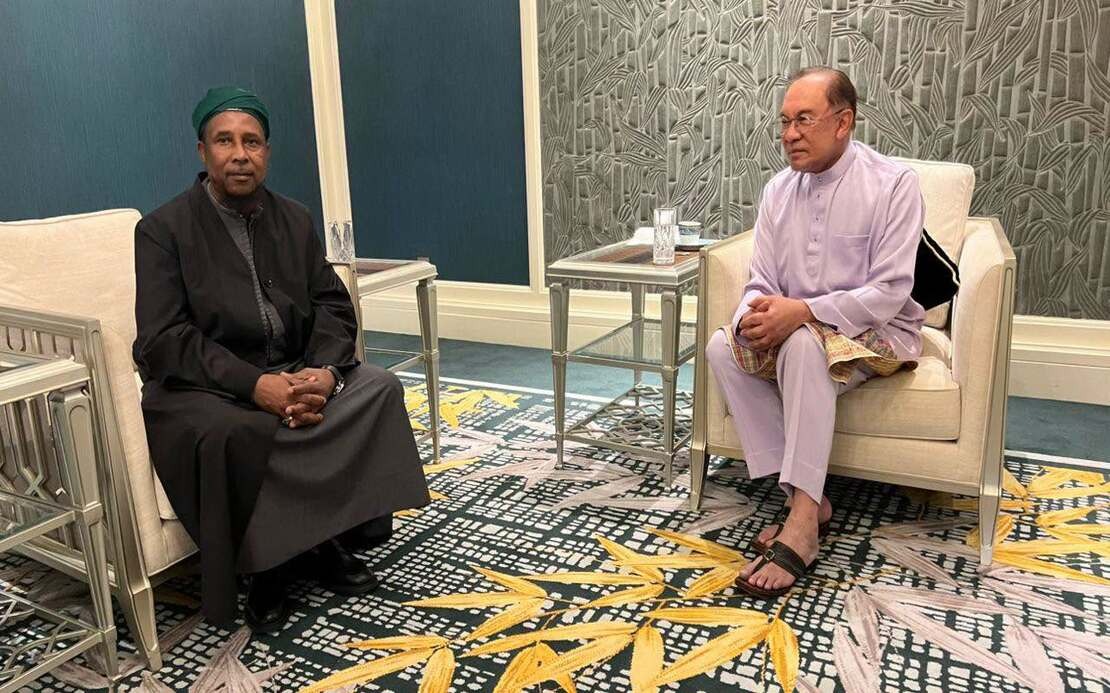
Prime Minister Datuk Seri Anwar Ibrahim extended a formal farewell reception to Gambian Islamic scholar Sheikh Muhammad Haydara Al-Jilani on June 26, marking the conclusion of an extended visit to Malaysia that spanned approximately four weeks. The meeting, documented through Anwar's official Facebook post, coincided with observances of the Day of Ashura on a Friday, an occasion the Prime Minister identified as particularly significant for seeking spiritual intercession for the nation's welfare.
During his extended stay in Malaysia, Sheikh Muhammad Haydara Al-Jilani undertook an ambitious itinerary of religious and educational engagements, conducting dhikr gatherings and knowledge-sharing sessions at multiple venues across the country. These programmes represented part of a broader dakwah initiative designed to deepen Islamic scholarly discourse and spiritual understanding among Malaysian communities. The scholar's presence attracted interest from various segments of Malaysia's Muslim population seeking engagement with international Islamic thought and practice.
The timing of the farewell reception held particular resonance for Anwar, who utilised the occasion to request the scholar's prayers for Malaysia's continued prosperity, internal peace, and national stability. In his social media statement, Anwar emphasised the importance of seeking divine blessing and protection for the Malaysian people, framing the interaction as an opportunity to invoke spiritual support during an auspicious Islamic calendar moment. This approach reflects the Prime Minister's integration of religious observance with official state functions, a characteristic feature of his leadership approach.
Ashura, commemorated during the Islamic month of Muharram, holds profound spiritual significance across Muslim communities globally, though particular prominence in Shia Islamic tradition. By anchoring the farewell meeting to this observance, Anwar signalled Malaysia's inclusive approach to diverse Islamic theological traditions and practices. Such symbolic gestures contribute to Malaysia's positioning as a nation respectful of various interpretations and schools within the Islamic faith, an important consideration in a multi-ethnic, multi-religious society.
Sheikh Muhammad Haydara's visit represents a pattern of Malaysia hosting international Islamic scholars and spiritual leaders, reflecting the country's role as a hub for Islamic intellectual exchange in Southeast Asia. These exchanges facilitate cross-pollination of Islamic thought and practice between Malaysia and the broader Muslim world, particularly West African Islamic scholarship traditions. For Malaysian Muslim communities, exposure to visiting scholars broadens theological perspectives and enriches devotional practices beyond purely local frameworks.
The dakwah programmes conducted throughout the scholar's stay targeted diverse audiences at selected nationwide locations, suggesting a coordinated effort to distribute Islamic knowledge and spiritual guidance across urban and potentially regional areas. Such initiatives contribute to Malaysia's ongoing efforts to strengthen religious understanding and social cohesion through faith-based programming, particularly relevant in contemporary Malaysia where discussions of Islamic interpretation and practice carry significant social and political dimensions.
The farewell protocol extended by the Prime Minister underscores official government recognition and support for such international scholarly exchanges. By personally receiving the visiting scholar, Anwar communicated the Malaysian government's investment in facilitating Islamic knowledge dissemination and spiritual enrichment activities. This level of engagement signals that such visits carry diplomatic and cultural significance beyond purely religious dimensions.
For Malaysia's relationship with The Gambia and West African nations more broadly, scholar exchanges contribute to people-to-people connections and institutional networking across Islamic centres of learning. The Gambia, as a West African Muslim-majority nation, represents an important partner in Malaysia's wider engagement with the Islamic world. Such academic and spiritual exchanges strengthen bilateral relationships and position both nations within broader Islamic civilizational frameworks.
Sheikh Muhammad Haydara's extended presence throughout Malaysia likely generated substantial interest among Malaysian Islamic institutions, educational organisations, and faith-based communities seeking access to visiting international scholarship. The concentration of multiple programmes across different locations suggests systematic planning to maximise the scholar's accessibility and impact during the limited visit window. This approach optimises the investment in hosting and facilitating international scholarly visits within practical and logistical constraints.
Moving forward, the impact of such visits extends beyond the immediate programme period, as Malaysian attendees integrate learned materials and spiritual experiences into their ongoing religious practice and community engagement. Visiting scholars often leave behind networks of correspondence and continued intellectual exchange with local counterparts, creating sustained connections that transcend the physical visit. For international Islamic scholarship circulation throughout Southeast Asia, Malaysia's role as a receptive host for diverse scholarly voices reinforces the country's positioning as an intellectual and spiritual centre within regional Islam.

