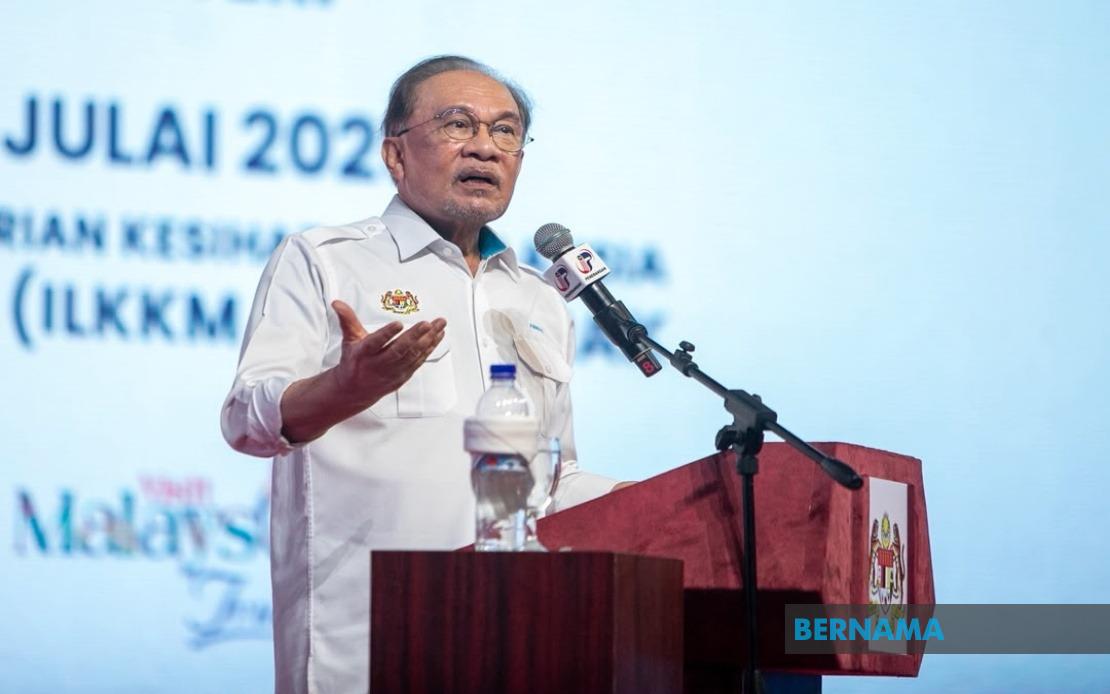
Prime Minister Datuk Seri Anwar Ibrahim has made an impassioned plea to Malaysia's younger generation to recognise and value the historical foundations upon which the nation's independence rests, emphasising that such understanding should extend far beyond superficial patriotic gestures. Speaking at the official launch of the 2026 National Month and Fly the Jalur Gemilang Campaign (MPBKKJG 2026) in Ipoh on July 19, Anwar framed national observance not merely as ceremonial tradition but as a deliberate educational exercise designed to cultivate deeper historical consciousness among Malaysians.
The Prime Minister's remarks underscore a growing concern among senior government figures that contemporary citizens, particularly those born well after independence, risk losing connection with the foundational narratives that shaped the nation-state. Anwar's intervention suggests recognition that patriotism divorced from historical understanding can become hollow and ineffective in fostering genuine national cohesion. By explicitly linking flag-flying and National Month celebrations to historical education, he repositioned these customs as vehicles for transmitting collective memory rather than mere ceremonial exercises divorced from substantive meaning.
Anwar characterised the independence struggle in visceral terms—blood, sweat, and tears—deliberately invoking the human cost of Malaysia's transition to statehood. This rhetorical choice carries particular weight for a generation increasingly engaged with sanitised, abstract versions of national history. By emphasising the bodily suffering and emotional exhaustion endured by independence fighters, Anwar sought to bridge the temporal distance separating contemporary youth from those transformative decades, making historical sacrifice palpable and immediate rather than antiquated and irrelevant.
The three-pronged approach outlined by Anwar—revisiting historical pages, performing patriotic symbolism through flag-flying, and mobilising collective action toward future prosperity—establishes a coherent narrative arc connecting past, present, and future. This framework acknowledges that commemorative activities cannot function solely as backward-looking exercises; they must instead serve as platforms for renewing national purpose and galvanising action toward contemporary objectives. The emphasis on building a "brighter and more glorious future" reframes National Month not as nostalgic reflection but as catalytic moment for recommitment to shared national ambitions.
The gathering in Ipoh brought together senior government figures whose portfolios span communications, national unity, and state-level administration. Communications Minister Datuk Seri Fahmi Fadzil's presence reflects the campaign's emphasis on messaging and public engagement, while National Unity Minister Datuk Aaron Ago Dagang's attendance underscores the administration's view of historical education as essential infrastructure for social cohesion. Perak Menteri Besar Datuk Seri Saarani Mohamad's participation signals efforts to embed the campaign within state-level administration and community structures across the federation.
For Malaysian readers, Anwar's intervention carries implications extending beyond symbolic politics. The Prime Minister's explicit targeting of younger citizens suggests government awareness that social polarisation and reduced civic engagement represent genuine challenges requiring sustained educational intervention. National Month campaigns, traditionally focused on flag sales and ceremonial displays, are being reframed as instruments for addressing more fundamental questions about national identity, social cohesion, and collective historical consciousness. This represents a subtle but significant shift in how the government conceptualises patriotic observance.
The timing of this campaign launch—with the 2026 National Month observance still months away—suggests administrative commitment to extended public engagement rather than last-minute ceremonial preparation. By initiating the campaign in July, authorities signal intent to allow extended periods for educational activities, community engagement, and grassroots mobilisation well before formal celebratory periods. This extended timeline potentially allows for more substantive integration of historical education into school curricula, community programmes, and public discourse than traditional compressed campaigns permit.
Anwar's explicit address to "children" carries particular significance given Malaysian demographics skew young. Approximately two-thirds of the nation's population was born after 1980, meaning most citizens have no direct experience of the struggles characterising earlier national periods. For this demographic cohort, independence represents historical abstraction rather than living memory. The Prime Minister's rhetorical choice to directly address younger citizens acknowledges this generational gulf and attempts to bridge it through emotional and moral appeals rather than expecting automatic intergenerational transmission of historical consciousness.
The emphasis on appreciation—a sentiment requiring active emotional and intellectual engagement—distinguishes Anwar's appeal from more didactic approaches to patriotic education. Appreciation implies acknowledgment of value, recognition of sacrifice, and gratitude for beneficiaries' current circumstances. By framing the challenge as one of cultivating appreciation rather than simply disseminating information, Anwar positioned historical education as fundamentally affective enterprise, requiring emotional resonance and personal investment rather than mere factual accumulation.
Within the Southeast Asian context, Malaysia's emphasis on managing historical memory and national identity through coordinated campaigns reflects broader regional patterns. Thailand, Vietnam, and Indonesia similarly employ state-orchestrated patriotic campaigns to sustain national cohesion amid rapid social change and generational transition. Anwar's approach suggests Malaysian government shares these regional concerns about historical disconnection while attempting to address them through education-focused messaging rather than more coercive mechanisms employed elsewhere in the region.
The 2026 National Month campaign thus represents more than ceremonial positioning. It reflects deliberate government strategy to integrate historical consciousness into national observance, positioning patriotic ritual as vehicle for educational transmission rather than end in itself. By explicitly articulating these objectives, Anwar signals that contemporary Malaysian governance views historical education and civic engagement as continuous projects requiring sustained leadership attention rather than sporadic seasonal priorities.

