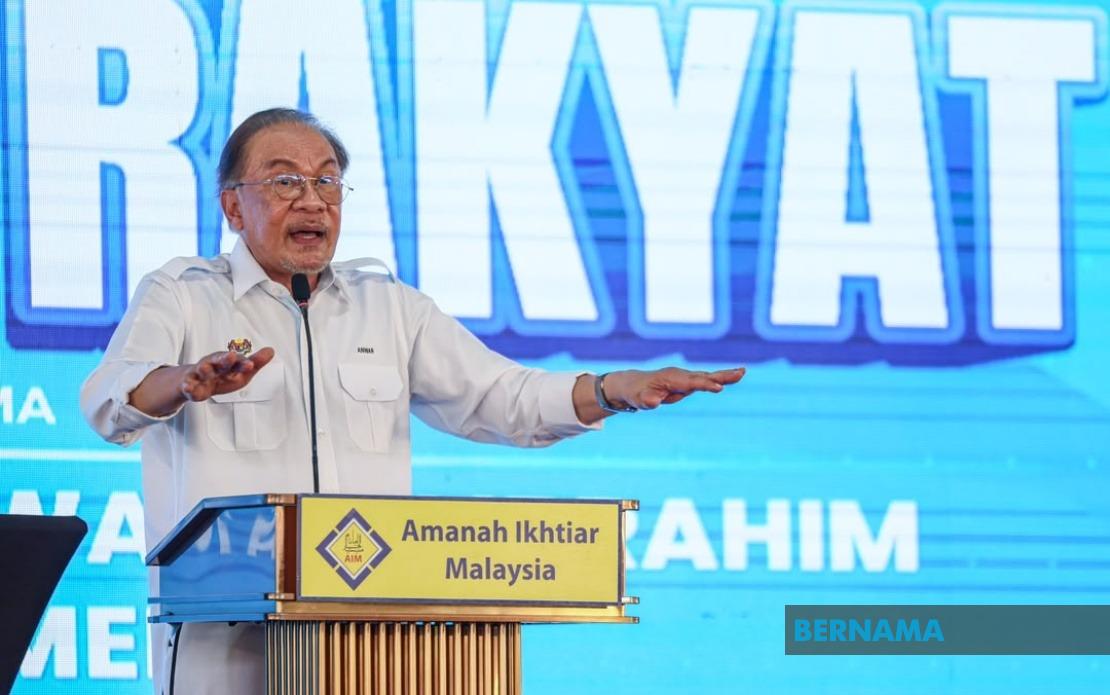
Prime Minister Datuk Seri Anwar Ibrahim has asserted that opposition political parties are joining forces to challenge his leadership precisely because his MADANI Government maintains an unwavering stance against corruption and the misuse of public office. Speaking at a campaign event in Batu Pahat during the Johor state election campaign, Anwar positioned his administration's zero-tolerance approach to graft and power abuse as a core reason for heightened political antagonism, suggesting that those threatened by stricter governance standards are mobilising against his government.
Anwar, who also serves as chairman of Pakatan Harapan, described the political pressure he faces as a natural consequence of enforcing rigorous oversight over public resources and leadership conduct. He characterised his administration's guiding principle as fundamentally straightforward: preventing leaders from leveraging their positions to acquire land, secure lucrative contracts, obtain equity stakes, or accumulate personal wealth through state machinery. This framing positions integrity as a dividing line between his government and the political alternatives available to voters.
The Prime Minister emphasised his personal commitment to this principle by referencing his repeated visits to Johor as the nation's leader. He stated explicitly that despite numerous trips to the state, he has neither acquired land, obtained projects, nor invested in shares there. This personal testimony serves as a counterpoint to allegations that might be levelled against other political figures and underscores Anwar's argument that leadership should be exemplary in adhering to anti-corruption standards. The implicit message is that these are not mere rhetorical positions but lived practices within his administration.
Anwar's remarks carry particular significance in the context of Malaysian politics, where corruption allegations have historically been weaponised across partisan divides and where public trust in institutions remains a persistent challenge. His emphasis on principle-driven governance reflects an ongoing debate within Malaysian society about whether political leadership genuinely prioritises public interest over factional gain. For Southeast Asian observers, Anwar's positioning of anti-corruption as both a governance priority and a political differentiator illustrates how accountability mechanisms can become central campaign issues in competitive democracies.
The Prime Minister used the platform to appeal to Johor voters to grant Pakatan Harapan the opportunity to govern the state, arguing that alignment between state and federal administrations would facilitate more effective delivery of development initiatives and welfare programmes. He highlighted that despite Johor receiving billions of ringgit in development projects, fundamental issues persist affecting ordinary residents, including housing affordability, infrastructure maintenance, religious facility construction, and targeted assistance for vulnerable populations. This framing suggests that governance quality and resource distribution matter as much as absolute investment levels.
Anwar specifically addressed housing affordability as an emblematic issue, noting that continued economic development has not translated into accessible housing for ordinary Johoreans. He characterised this gap as a failure of state-level governance and called for more inclusive prosperity rather than wealth concentration among a narrow elite. This argument resonates with broader Southeast Asian economic concerns about inequality and the distribution of developmental gains, positioning anti-corruption not merely as an ethical issue but as foundational to equitable development outcomes.
The Prime Minister also used his campaign address to defend Pakatan Harapan's coalition arrangement with DAP, responding to implied criticism about the partnership. Anwar noted that throughout his three-and-a-half years leading the government, DAP Cabinet ministers have consistently supported programmes benefiting Malays and Islam, challenging narratives that position the coalition as inherently misaligned on communal interests. This defensive positioning suggests that coalition-building and interfaith political cooperation remain sensitive topics in Malaysian electoral contests, even as demographic and political realities necessitate such arrangements.
Anwar's emphasis on DAP's parliamentary support for Bumiputera and Islamic initiatives serves to counter-narrative suggestions that his government sacrifices communal interests for coalition stability. The public record of Cabinet votes, in his view, demonstrates that political diversity within government need not translate to abandonment of core constituencies' interests. This argument has implications for Malaysia's broader political evolution, suggesting pathways toward more inclusive coalitions without perceived loss of community representation.
The Prime Minister remarked upon the strong turnout of supporters at the Senggarang campaign event, describing the enthusiasm as exceptional despite the intense heat. He contrasted this energy with his previous ceramah experiences, suggesting that grassroots support for his political vision remains robust at the state level. This observation, whether reflective of genuine momentum or campaign rhetoric, indicates Anwar's confidence heading into the Johor contest and his assessment that anti-corruption messaging resonates with voters beyond elite political circles.
The context of Anwar's remarks is the Johor state election, featuring 172 candidates contesting 56 state assembly seats. The election is scheduled for July 11, with early voting commencing on July 7. Johor's electoral outcome carries significance beyond the state itself, as Malaysia's most developed southern state represents a barometer for voter sentiment regarding federal governance and coalition performance. A strong Pakatan Harapan result would validate Anwar's anti-corruption messaging at the grassroots level, while setbacks might suggest that other governance issues or partisan calculus outweigh anti-graft concerns in voter decision-making.
For Malaysia and Southeast Asia more broadly, Anwar's framing of anti-corruption as both a governance imperative and a political differentiator reflects evolving expectations regarding institutional accountability. His assertion that rival parties fear strict governance standards implicitly acknowledges that corruption has been normalised within previous administrations and that enforcement represents genuine change rather than rhetorical positioning. Whether this messaging translates into sustained electoral advantage or institutional reform beyond the current electoral cycle will determine whether anti-corruption becomes institutionalised within Malaysian governance or remains a cyclical campaign theme.
The broader implications for Southeast Asia include the recognition that anti-corruption platforms can mobilise voters and shape political competition, even in contexts where graft has been historically entrenched. Anwar's willingness to position his administration's record on this issue as a central differentiator suggests that governance quality and institutional integrity may increasingly influence electoral outcomes, particularly among voters concerned about equitable development and resource distribution. The Johor election results will provide concrete evidence of whether anti-corruption messaging converts into electoral performance at the state level.

