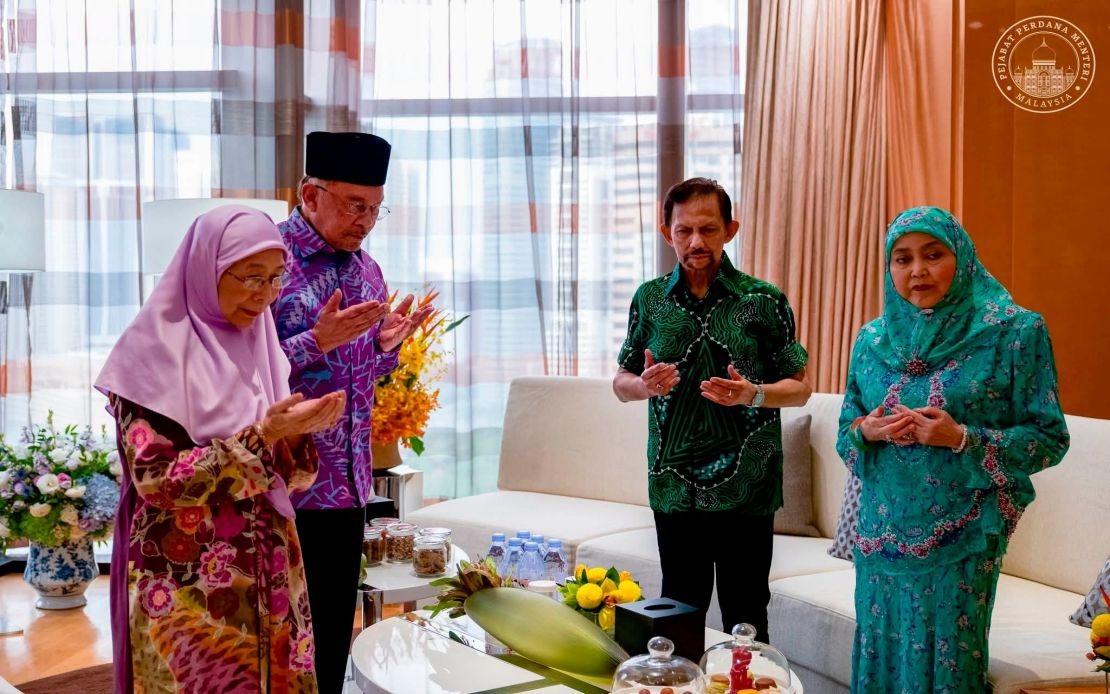
Prime Minister Datuk Seri Anwar Ibrahim extended Malaysia's official congratulations to the Sultan of Brunei, Sultan Hassanal Bolkiah, marking his 80th birthday on July 15. The gesture, conveyed through a public Facebook post, underscores the importance Kuala Lumpur places on its diplomatic relations with the sultanate, one of Southeast Asia's closest neighbours and fellow members of the Association of Southeast Asian Nations.
Anwar's message carried significance beyond mere ceremonial protocol, representing both the Malaysian government and the Malaysian people. In his statement, the Prime Minister invoked Islamic sentiment by praying that His Majesty would continue guiding Brunei Darussalam with the wisdom and prudence expected of a venerable monarch. This tone reflects the deep cultural and religious affinities shared between Malaysia and Brunei, both Islamic monarchies with similar constitutional frameworks and shared Malay heritage.
The substantive component of Anwar's congratulations focused on bilateral cooperation. He expressed hope that the existing ties between Malaysia and Brunei would grow stronger in coming years, explicitly framing this strengthening as beneficial to both nations and their respective populations. This emphasis on mutual advantage demonstrates how Malaysia views its relationship with Brunei—not as a relationship between unequal partners, but as a collaborative partnership where both countries stand to gain from enhanced coordination and deeper engagement across economic, cultural, and political spheres.
Sultan Hassanal Bolkiah's historical significance cannot be overstated. Born on July 15, 1946, in Bandar Brunei, which has since been renamed Bandar Seri Begawan, he ascended to the throne as the 29th Sultan of Brunei in 1967. This lineage places him within one of Asia's longest-established and most stable monarchical dynasties, and his personal reign has now spanned more than five decades of continuous rule.
The Sultan's international standing underwent a notable shift in September 2022 following the death of Queen Elizabeth II. With her passing, Sultan Hassanal Bolkiah automatically assumed the position of the world's longest-reigning monarch still actively ruling a nation. This distinction carries considerable symbolic weight in international affairs and diplomatic circles, elevating his stature in global forums and multilateral institutions where longevity of leadership is often regarded as a marker of stability and institutional continuity.
For Malaysia, maintaining cordial relations with Brunei holds strategic importance. The two countries share maritime boundaries, interconnected supply chains, and numerous cultural ties that bind their societies together. Beyond ceremonial exchanges, bilateral cooperation encompasses trade, defence collaboration, and joint efforts on regional security matters. Brunei's strategic location along key shipping lanes connecting the Pacific and Indian Oceans makes it a significant player in regional security architecture.
The birthday message also reflects Anwar's personal approach to diplomacy, which emphasises relationship-building and public affirmation of regional partnerships. Since assuming office, the Prime Minister has demonstrated a preference for maintaining and expanding Malaysia's network of regional allies, particularly among ASEAN members. His willingness to offer public congratulations on significant occasions serves as a soft-power tool, reinforcing narratives of friendship and shared destiny among neighbouring states.
For Brunei, marking its monarch's milestone birthday with acknowledgment from neighbouring capitals carries domestic significance as well. The international recognition of Sultan Hassanal Bolkiah's longevity and continuing stewardship reinforces narratives of stability and wise governance within Brunei itself. In a region where institutional continuity and dynastic legitimacy remain important elements of political culture, such external affirmations validate the internal narratives of monarchical governance.
Looking forward, the warmth expressed in Anwar's message suggests Malaysia intends to deepen its engagement with Brunei across multiple domains. This could encompass expanded trade arrangements, joint infrastructure projects, enhanced people-to-people exchanges, and more robust defence cooperation. Both nations face similar challenges in navigating geopolitical tensions in Southeast Asia and protecting their economic interests in an increasingly multipolar world order where regional solidarity becomes ever more valuable.
The gesture also demonstrates how diplomatic niceties, while seemingly procedural, serve important functions in maintaining the social capital necessary for effective bilateral relations. By publicly celebrating Sultan Hassanal Bolkiah's birthday and explicitly wishing for continued cooperation, Anwar signals Malaysia's commitment to sustaining its relationship with Brunei as a foundational element of its regional foreign policy. In the context of evolving great-power competition in Southeast Asia, such affirmations of intra-ASEAN solidarity become increasingly consequential.

