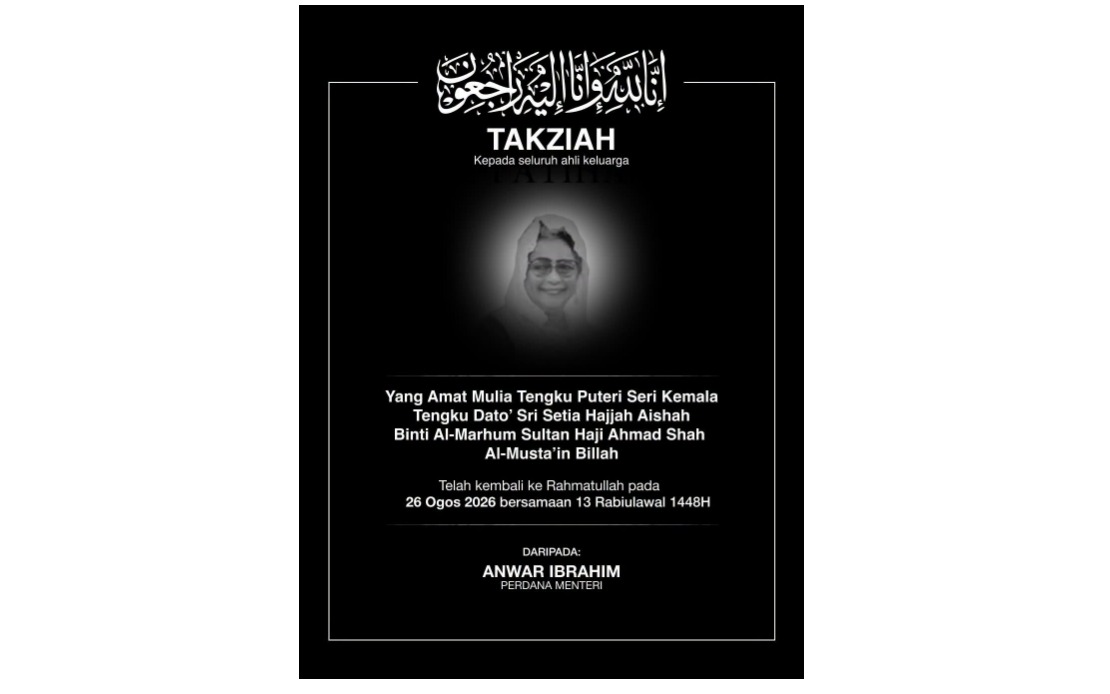
Prime Minister Datuk Seri Anwar Ibrahim has conveyed his sympathies to Sultan Al-Sultan Abdullah Ri'ayatuddin Al-Mustafa Billah Shah and the entire Pahang Royal Family following the death of the Sultan's elder sister, Tengku Puteri Seri Kemala Tengku Datuk Seri Aishah Almarhum Sultan Ahmad Shah. The senior member of the royal household passed away on August 26, marking a significant loss to one of Malaysia's major sultanates and drawing expressions of respect from the nation's highest political office.
Through a statement posted on his official social media account, the Prime Minister invoked religious sentiments appropriate to the occasion, beseeching divine mercy and forgiveness for the departed. His message reflected the deep respect traditionally accorded to members of the royal households across Malaysia's constitutional monarchy system. Such expressions of condolence from the Prime Minister represent an important ceremonial function in Malaysian governance, reinforcing the bonds between the executive branch and the institution of the monarchy that forms the constitutional foundation of the federation.
The passing of Tengku Datuk Seri Aishah represents the conclusion of a chapter in Pahang's modern royal history. As the elder sister of the reigning Sultan, she occupied a position of considerable standing within the state's royal household. Members of the extended royal family, particularly those in senior positions, often play significant roles in state functions and ceremonial occasions. Her presence across decades of Pahang's development would have witnessed substantial transformations in the state's economic and social landscape.
Beyond the immediate expression of condolence, the Prime Minister's words extended to Sultan Abdullah's consort, Tengku Ampuan of Pahang Tunku Azizah Aminah Maimunah Iskandariah, and sought strength for the entire royal family during this period of mourning. Such inclusive messaging acknowledges the collective nature of grief within institutional families and recognises the broader support network required during times of loss. The formal acknowledgement of family members at various levels of the royal hierarchy underscores the structured nature of Malaysian royal protocols and the importance of maintaining harmonious relationships between government and monarchy.
The funeral arrangements proceeded according to Pahang's royal traditions, with the deceased's remains being committed to the Pahang Royal Mausoleum in Pekan, the state capital. This location, which serves as the final resting place for members of the Pahang royal house, carries historical and cultural significance within the state. Pekan itself holds importance as the traditional seat of Pahang's sultanate, and the mausoleum represents a spiritual and symbolic centre for the state's royal lineage. The choice of venue reflects continuity with established customs and the enduring connection between the ruling family and their historical homeland.
Tengku Datuk Seri Aishah's final hours were spent at a private hospital facility in Kuala Lumpur, where she passed away at 9:15 PM on August 26. The use of premier medical facilities in the capital reflects the healthcare standards typically available to senior members of Malaysia's royal families. Her death at this hour meant that funeral preparations had to proceed swiftly, as Islamic burial practices traditionally require interment within a short timeframe following death, generally within 24 hours.
For Malaysian readers and observers of the constitutional monarchy, the passing of senior royal family members serves as a reminder of the institutional continuity that underpins the federation's political system. The Sultan of Pahang holds particular significance not only as the ruler of the east coast state but also as a member of the Council of Rulers, the body responsible for electing the Yang di-Pertuan Agong from among the nine hereditary rulers. Any major transitions within a sultanate's household can reverberate through these institutional structures, though the succession of executive authority remains unaffected by such transitions.
The Prime Minister's involvement in publicly acknowledging the death demonstrates the careful attention Malaysian political leadership maintains toward the royal institutions. This relationship, formalized through constitutional arrangements, requires both deference and respectful protocol from the executive branch. Prime ministerial condolences, while perhaps routine in a procedural sense, carry weight within Malaysia's political culture and serve to reinforce the stability of the constitutional arrangement that has governed the nation since independence.
For Pahang specifically, the loss represents the passing of another generation that witnessed the state's transformation from a primarily resource-dependent economy to one increasingly diversified with manufacturing and services sectors. The state has undergone significant development in recent decades, and senior members of the royal family often champion various social and economic initiatives. The absence of such figures inevitably shifts the dynamics within state governance and ceremonial life.
The news also reflects broader considerations about succession and continuity within Malaysia's hereditary institutions. While the death of a Sultan's sibling does not directly impact the line of succession to the throne, it nonetheless represents the natural passage of time within royal households. These transitions are managed within the framework of established protocols and traditions, allowing Malaysian institutions to absorb such changes while maintaining their fundamental character and constitutional role in the federation's system of governance.

