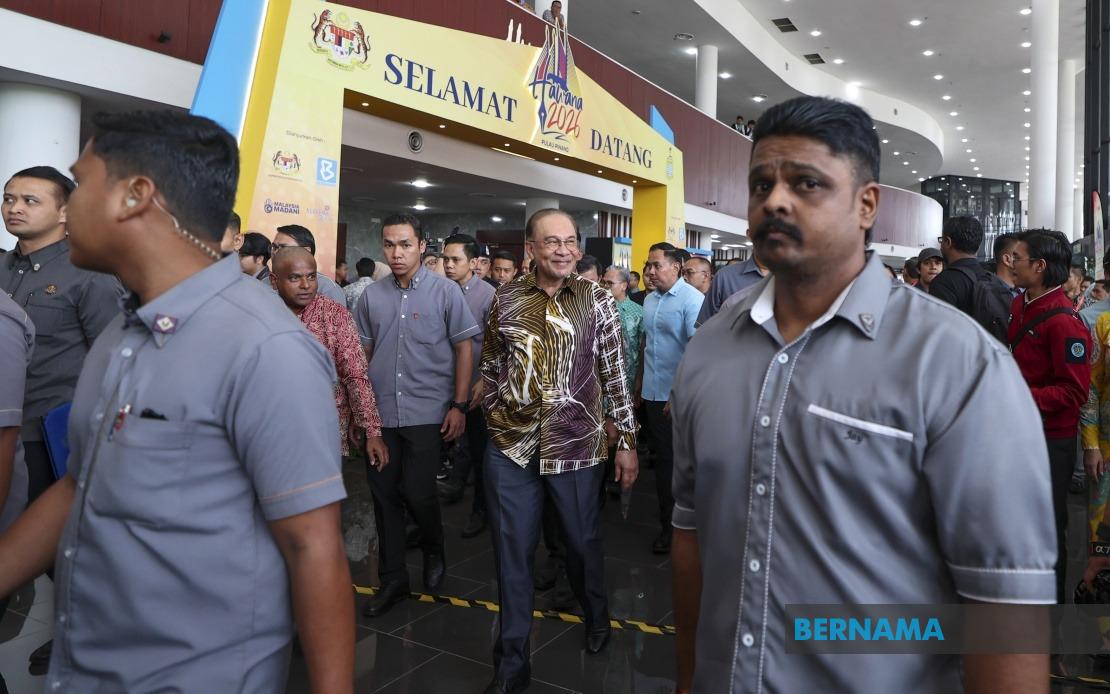
Prime Minister Datuk Seri Anwar Ibrahim attended the PICCA Convention Centre @ Butterworth Arena on June 20 to formally open the National Journalists' Day 2026 celebration, marking a significant occasion for Malaysia's media community. Arriving at 2.40 pm, he was greeted by Penang Chief Minister Chow Kon Yeow, Communications Minister Datuk Fahmi Fadzil, and Communications Ministry secretary-general Datuk Abdul Halim Hamzah, underscoring the event's importance at both state and federal levels.
The Prime Minister took time to walk through exhibition booths and view the HAWANA 2026 Photo Gallery housed in the convention centre's foyer, engaging directly with displays showcasing the breadth of contemporary Malaysian journalism. This informal engagement reflected his interest in the diverse media landscape and the stories being told by practitioners across the country.
The gathering represented a notable demonstration of institutional coordination within Malaysia's media and communications sphere. Bernama chairman Datuk Seri Wong Chun Wai, chief executive officer Datin Paduka Nur-ul Afida Kamaludin, and editor-in-chief Arul Rajoo Durar Raj were among the senior figures present, alongside project director Mohd Shukri Ishak. Their presence highlighted the central role of Malaysia's national news agency in organising what has become a flagship annual event for the journalism community.
What distinguished this year's ceremony was its distinctly regional dimension. The event drew significant participation from ASEAN neighbours, including Timor-Leste's Secretary of State for Social Communication Expedito Loro Dias Ximenes and Cambodia's Undersecretary of State at the Ministry of Information Prak Thaveak Amida. The presence of Laos' Permanent Secretary of the Cabinet Office of the Ministry of Technology and Communications Phuangpasert Keosouvanh reflected deeper cooperation within the Southeast Asian media space. Additionally, representatives from Timor-Leste's national news agency, Agencia Noticiosa de Timor-Leste, attended alongside their Indonesian and Vietnamese counterparts, signalling a maturing dialogue on journalistic standards and practices across the region.
International media organisations extended their reach to the ceremony as well. Delegations from Indonesia's Antara News Agency, Vietnam News Agency, and Xinhua News Agency participated, alongside professional bodies including the Indonesian Journalists Association and the Malaysia-Indonesia Journalists Fellowship. This international presence demonstrated how HAWANA has evolved beyond a domestic celebration into a platform for cross-border media dialogue and professional exchange.
The ceremonial centrepiece involved the Prime Minister presenting the HAWANA Award and Special HAWANA Award to individuals recognised for exceptional contributions to journalism and the advancement of informed public discourse. These accolades serve to reinforce professional standards within the industry and acknowledge those who have shaped Malaysia's media environment. Alongside these recognitions, Anwar distributed contributions from the Kasih@HAWANA Fund to media veterans facing hardship, demonstrating a commitment to supporting those whose careers have been dedicated to the profession.
This year's theme, 'Media Integrity Strengthens Credibility,' carries particular resonance in the contemporary media ecosystem where misinformation and credibility crises plague multiple democracies globally. By anchoring the celebration around integrity, the organising ministry and Bernama signalled their commitment to upholding journalistic standards that ensure public trust in information sources. The theme suggests an understanding that as media landscapes fragment and digital platforms proliferate, the foundation of journalism must remain rooted in verifiable facts and ethical practice.
The event attracted approximately one thousand media practitioners from within Malaysia and abroad, creating a substantial gathering for professional networking and ideological alignment within the industry. Such a congregation provided opportunities for journalists, editors, and media managers to discuss emerging challenges, share best practices, and collectively consider the future trajectory of their profession in an increasingly digitalised world. For Malaysian practitioners in particular, the assembly offered a chance to position their work within broader ASEAN and global contexts.
Organised jointly by the Communications Ministry and Bernama as the implementing agency, HAWANA has established itself as an institutional mechanism for recognising journalistic professionalism and emphasising the media's fundamental role in democracy. The celebration underscores how journalism, when practiced with rigour and integrity, serves as a public good by delivering accurate, authentic, and credible information that underpins informed citizenship. In an era when media outlets face mounting pressures from commercial imperatives and political interference, such formal recognition of journalistic values carries deeper significance than ceremonial convention might suggest.
The Prime Minister's presence and active participation signalled the federal government's investment in media relations and its acknowledgement of journalism's democratic function. By attending personally and presenting awards, Anwar reinforced messaging around the government's stance on press freedom and professional standards. For Malaysia's media community, this engagement from the highest political office provided validation of their work and a platform to articulate their concerns and aspirations for the industry's future development in an increasingly complex information environment.

